3.4 - Electronegativity and Bond Polarity
- 1
What electronegativity is
- 2
Polar covalent bonds
- 3
Electron density maps for simple molecules
- 4
How electronegativity differences predict bond type
Electronegativity is the ability of atoms to attract bonding electrons
Electronegativity is a measure of an atom's ability to attract the shared electron pair in a covalent bond towards itself.
- Fluorine is the most electronegative element, followed by oxygen, nitrogen and chlorine.
- Electronegativity is measured on the Pauling scale. A higher value on this scale means an atom is more electronegative.
| Element | H | C | N | O | F | Cl |
|---|---|---|---|---|---|---|
| Electronegativity (Pauling scale) | 2.1 | 2.5 | 3.0 | 3.5 | 4.0 | 3.0 |
Polar bonds arise from electronegativity differences
Differences in electronegativity between bonded atoms can cause polar bonds:
- In a covalent bond between atoms with different electronegativities, the bonding electrons are more strongly attracted to the more electronegative atom. This unequal sharing of electrons makes the bond polar.
- Polar bonds have a permanent electric dipole. A dipole is a separation of positive and negative charges within a polar covalent bond or polar molecule, resulting from an uneven distribution of electrons.
- In a polar bond, the more electronegative atom acquires a slight negative charge (δ-) and the less electronegative atom acquires a slight positive charge (δ+). The bigger the difference in electronegativity, the more polar the bond.
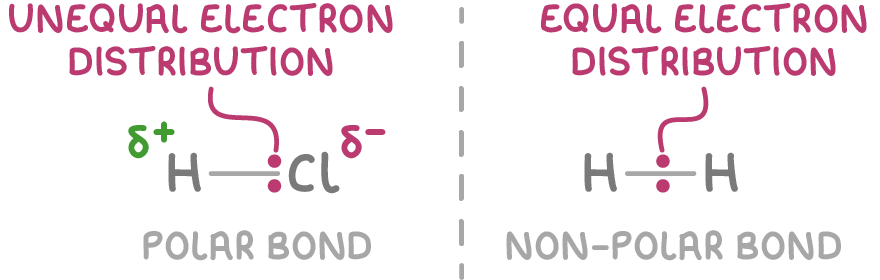
Bonds between atoms of the same element, like H2 and Cl2, are non-polar because the electrons are shared equally.
Bonds between atoms with similar electronegativity, such as carbon and hydrogen, are essentially non-polar due to an even electron distribution.
Visualising electron density distribution
Electron density maps provide a powerful tool for visualising the distribution of electrons in covalent bonds, helping us understand the relationship between electronegativity and bond polarity.
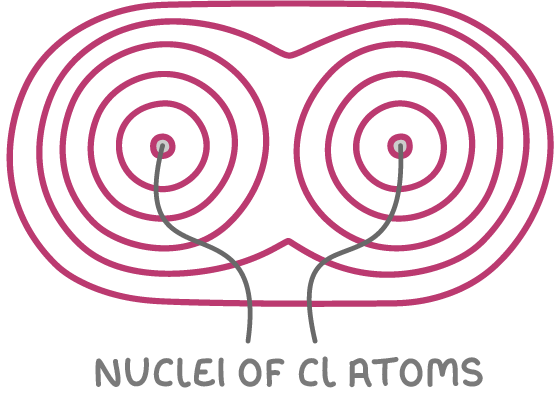
- Non-polar bonds In molecules where two identical atoms are bonded together, the electron density is symmetrically distributed between the two nuclei. This symmetry occurs because both atoms have an equal ability to attract the bonding electrons. As a result, the electron density map for such molecules shows contour lines that are evenly spaced around both nuclei.
For example, the electron density map for Cl2 is:
- Polar bonds
When atoms with different electronegativities form a covalent bond, the electron density distribution becomes asymmetrical, resulting in a polar covalent bond.
For example, the electron density map of HCl is:
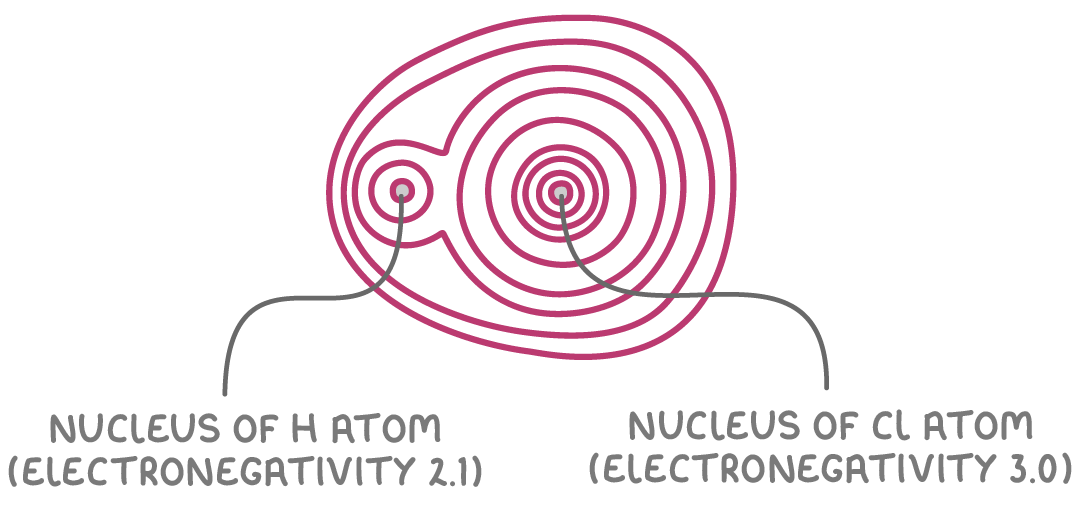
- Chlorine attracts electrons more strongly than hydrogen.
- The electron density map shows contour lines more closely spaced near the chlorine atom.
- This uneven distribution leads to a partial negative charge (δ-) on the chlorine end and a partial positive charge (δ+) on the hydrogen end.
Electronegativity differences predict bond type
The type of bond formed between two atoms can be predicted by the difference in their electronegativities:
- When the electronegativity difference is zero, as in diatomic molecules like H_2_ and O_2_ where the atoms are identical, the bonding electrons are shared equally, resulting in a pure (non-polar) covalent bond.
- As the electronegativity difference increases, the bond becomes more polar covalent. For example, in HCl, the chlorine atom attracts the bonding electrons more strongly than the hydrogen atom, leading to a polar covalent bond.
- When the electronegativity difference is very large, the bond is considered ionic. In this case, the more electronegative atom effectively takes the bonding electrons from the less electronegative atom. An example is NaCl, where the chlorine atom takes an electron from the sodium atom, forming Na+ and Cl- ions.
Most compounds fall somewhere between these extremes, exhibiting a mix of ionic and covalent character depending on the electronegativity difference between the bonded atoms.
| Difference in electronegativity | Bond type | Example |
|---|---|---|
| Less than 1.0 | Non-polar covalent | H_2_ |
| 1.0 to 2.0 | Polar covalent | HCl |
| Greater than 2.0 | Ionic | NaCl |