15.9 - Principles of NMR Spectroscopy
- 1
What NMR spectroscopy is
- 2
Chemical environments and chemical shifts
- 3
The use of tetramethylsilane (TMS) as a reference standard
NMR determines molecular structure
Nuclear magnetic resonance (NMR) spectroscopy is a powerful analytical technique that is used to understand the structure of molecules.
There are two main types:
- 13C NMR - This form provides information about the positions of carbon atoms within a molecule.
- 1H NMR - This form provides information about the positions of hydrogen atoms within a molecule.
The basis of NMR involves analysing the changes in magnetic properties of atomic nuclei brought about by their surrounding molecular environments.
Chemical environments influence magnetic properties
In NMR spectroscopy, when a molecule is placed in an external magnetic field, the nuclei within the molecule experience varying degrees of shielding from the external magnetic field. This shielding is due to their local "chemical environment" which encompasses all atoms, functional groups, and bonds directly connected to the nucleus.

The electron density surrounding each nucleus acts as a magnetic shield, protecting it from the full strength of the external magnetic field. The degree of shielding varies depending on the specific chemical environment, with nuclei in different environments experiencing slightly different resonance frequencies when absorbing radio waves.
The more shielded a nucleus is, the lower its resonance frequency will be, as it requires less energy to flip its spin state in the presence of an external magnetic field.
By analysing these variations in resonance frequencies various nuclear environments, NMR spectroscopy provides valuable information about molecular structure.
Chemical shift
In NMR spectroscopy, chemical shift (δ) is a measure of the difference in resonant frequency between a given nucleus and a reference standard. It is expressed in parts per million (ppm) and it increases from right to left on the x-axis of an NMR spectrum.
Tetramethylsilane (Si(CH3)4), or TMS, is used as the standard in NMR spectroscopy because:
- TMS produces a single absorption peak due to all its carbon and hydrogen atoms being in identical chemical environments.
- The TMS peak appears at a lower frequency, located to the right of most analytes on the NMR spectrum, making it an ideal reference point.
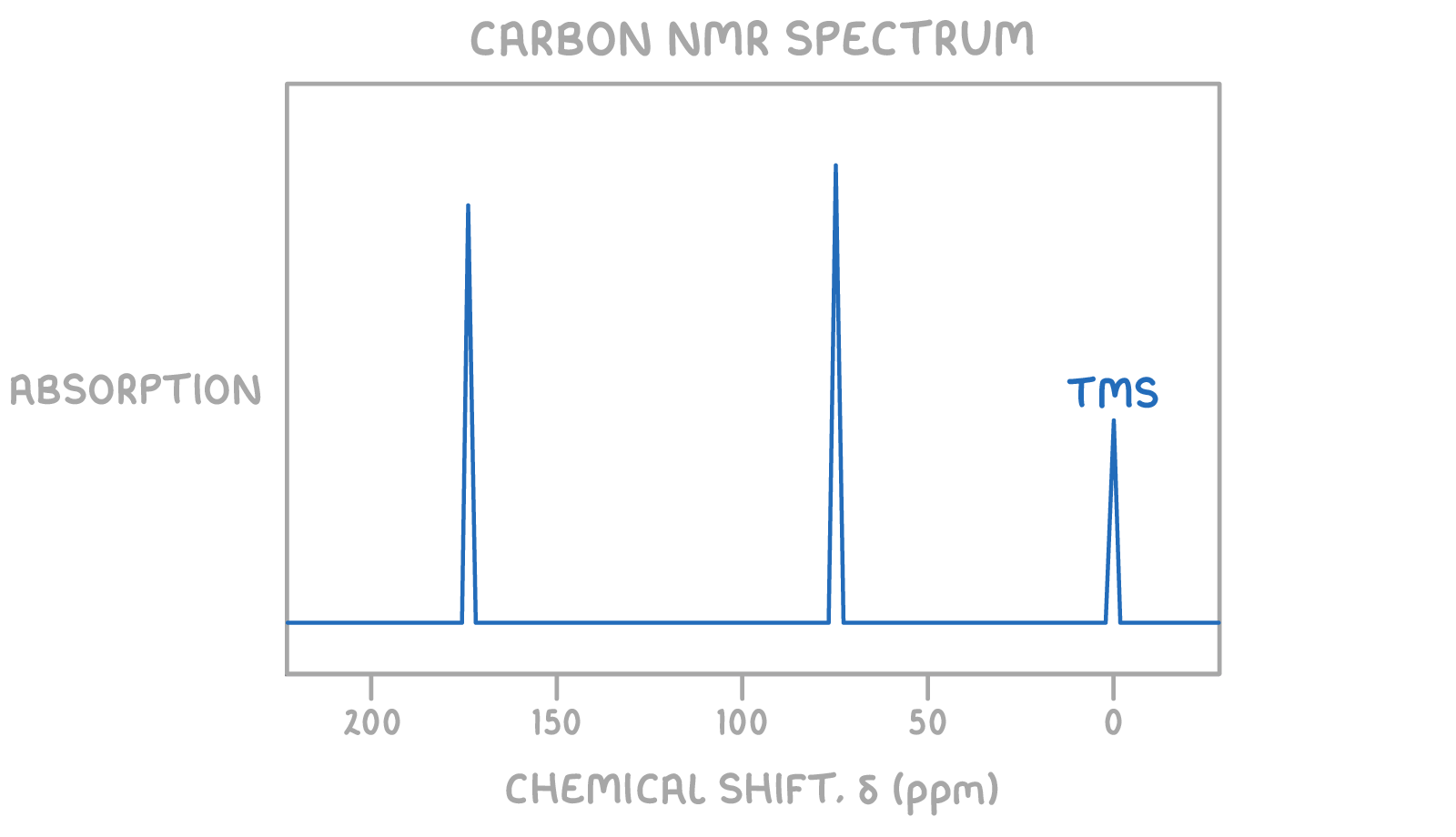
The TMS peak is assigned a chemical shift value of 0 ppm, serving as the reference point for measuring chemical shifts of other peaks in the spectrum.
Peaks from the sample that absorb at frequencies higher than that of TMS appear at higher chemical shift values measured relative to the TMS peak at 0 ppm. These peaks are located to the left of the TMS peak, indicating that the corresponding nuclei are less shielded than TMS. Consequently, these nuclei experience a stronger effective magnetic field.