13.4 - Relating Entropy to Equilibrium Constants
- 1
How temperature affects the total entropy change (ΔStotal)
- 2
The relationship between ΔStotal and the equilibrium constant (K)
- 3
Using ΔStotal to calculate K
Temperature and total entropy change
The total entropy change (ΔS_total) of a system is given by:
ΔStotal = ΔSsystem + ΔSsurroundings
Where:
- ΔSsystem = entropy change of the system
- ΔSsurroundings = entropy change of the surroundings
ΔStotal is positive for all spontaneous changes. While ΔSsystem doesn't vary much with temperature (unless there's a phase change), ΔSsurroundings is significantly affected.
The entropy change of the surroundings is calculated using:
ΔSsurroundings =
Where:
- ΔH = enthalpy change of the reaction (J mol-1)
- T = absolute temperature (K)
This equation shows that as temperature increases, the magnitude of ΔSsurroundings decreases. We can use this to determine if a reaction is spontaneous at a given temperature.
Worked example 1 - Determing reaction spontaneity at different temperatures
Consider the decomposition of magnesium carbonate:
MgCO3(s) ➔ MgO(s) + CO2(g) ΔH = +118.5 kJ mol-1, ΔS_system_ = +175.6 J K-1 mol-1
Determine the spontaneity of the reaction at 20°C and at 600°C.
Step 1: Conversion of °C into K
To convert from °C into K, add 273
20°C = 293 K
600°C = 773 K
Step 2: Calculate ΔStotal at 20°C
ΔSsurroundings = 404.4 K-1 mol-1
ΔStotal = +175.6 404.4 = 228.8 J K-1 mol-1
Step 3: Determine spontaneity at 20°C
ΔStotal < 0, so reaction is not spontaneous
Step 4: Calculate ΔStotal at 600°C
ΔSsurroundings = 153.3 J K-1 mol-1
ΔStotal = +175.6 153.3 = +22.3 J K-1 mol-1
Step 5: Determine spontaneity at 600°C
ΔStotal > 0, so reaction is spontaneous
This example demonstrates that the spontaneity of a reaction can change with temperature due to the impact on ΔSsurroundings.
The relationship between ΔStotal and the equilibrium constant (K)
For a reversible reaction at equilibrium, both the forward and reverse reactions occur spontaneously at equilibrium. This means ΔStotal must be positive in both directions.
Consider the equilibrium:
N2O4(g) ⇌ 2NO2(g)
The graph below shows how it is possible for the reaction to be spontaneous in each direction.
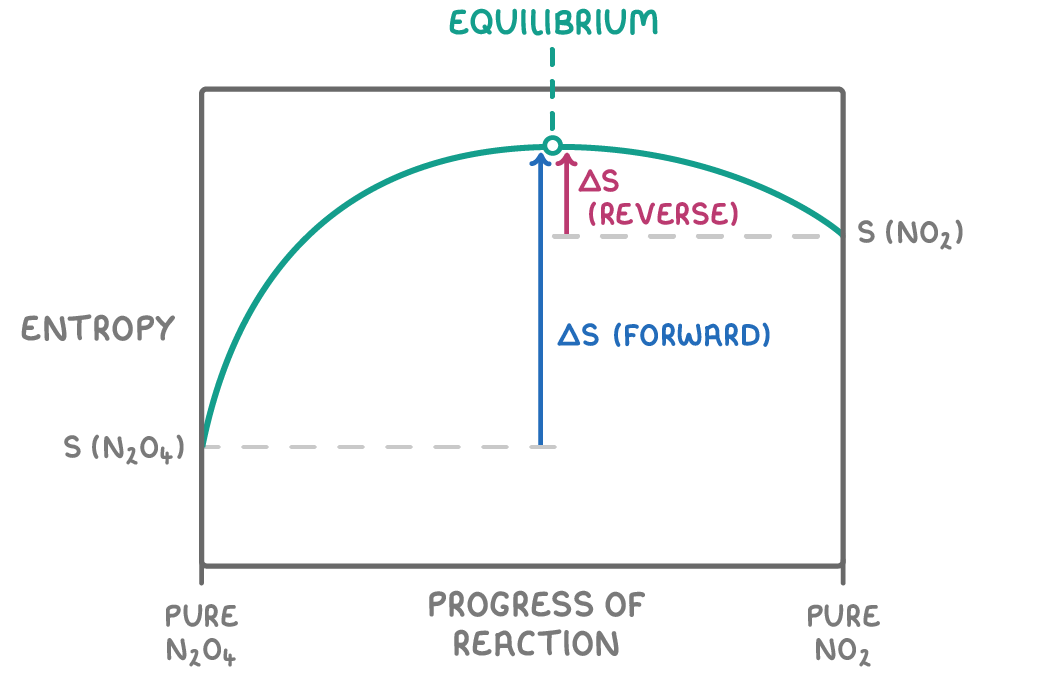
This graph demonstrates that:
- At equilibrium, entropy is at a maximum. Moving away from equilibrium, whether toward pure reactants or products, decreases entropy.
- The change in entropy as you move from pure reactants or products to the equilibrium mixture is always positive. This makes both the forward and reverse reactions spontaneous.
- Moving from the equilibrium mixture toward pure reactants or products results in a negative entropy change, preventing the reaction from proceeding to completion in either direction.
- At equilibrium, ΔStotal(forward) = ΔStotal(reverse).
The relationship between ΔStotal and K is given by:
Where:
- R = gas constant (8.31 J K-1 mol-1)
- K = equilibrium constant (Kc or Kp)
A large positive ΔStotal corresponds to a high K value.
Worked example 2 - Calculating K from ΔStotal
For the reaction: SO2(g) + ½O2(g) ⇌ SO3(g), ΔS⦵total = 238.3 J K-1 mol-1
Calculate the value of the equilibrum constant (K). Give your answer to 3 significant figures.
Step 1: Equation
Step 2: Rearrange equation
Step 3: Substitution and correct evaluation
This large K value suggests the equilibrium lies far to the right (products side).