15.3 - Redox Reactions of Carbonyl Compounds
- 1
Oxidation of aldehydes to carboxylic acids
- 2
Reduction of aldehydes and ketones to alcohols
- 3
How to distinguish aldehydes from ketones
- 4
Using alkaline iodine to identify methyl ketones
Aldehydes are easily oxidised to carboxylic acids
Aldehydes can be oxidised by oxidising agents such as acidified potassium dichromate(VI) to form carboxylic acids. The colour change observed during this oxidation is from orange to green, as the Cr(VI) in the dichromate ion is reduced to Cr(III). However, ketones do not undergo oxidation under the same conditions, so no colour change is seen.
For example, methanal is oxidised to methanoic acid:
HCHO + [O] ➔ HCOOH
By contrast, propanone does not react with oxidising agents:
CH3COCH3 + [O] ➔ no reaction
This difference in reactivity occurs because the hydrogen atom attached to the carbonyl carbon in an aldehyde is weakly acidic, so it is easily displaced. By contrast, ketones lack that weakly acidic hydrogen, so oxidation does not occur.
Reduction of aldehydes and ketones to alcohols
Aldehydes and ketones can be reduced to primary and secondary alcohols respectively using reducing agents like lithium aluminium hydride (LiAlH4) dissolved in dry ether.
Carbonyl compounds undergo nucleophilic addition reactions because the carbonyl carbon is electrophilic due to the polarisation of the C=O double bond, which makes it susceptible to attack by nucleophiles.
The reduction reactions are:
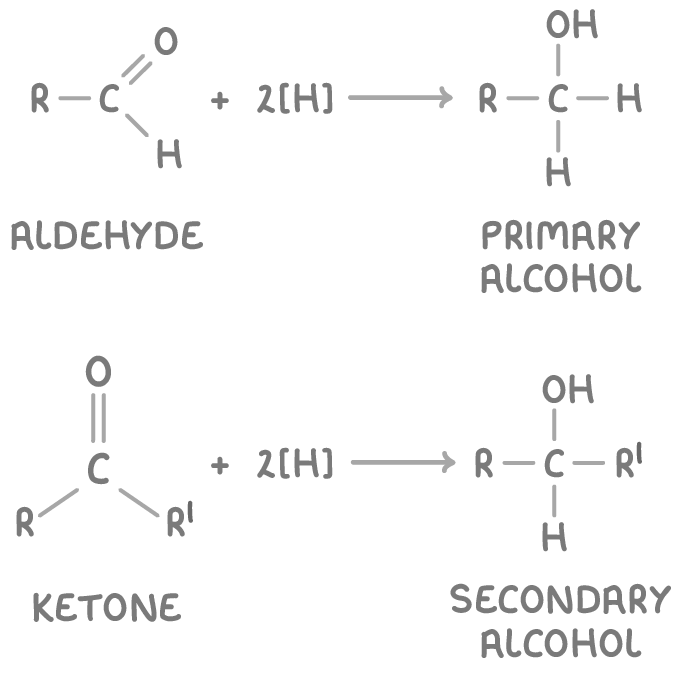
Where:
- [H] represents the reducing agent.
- R and R’ represent alkyl groups.
Distinguishing aldehydes from ketones
Aldehydes can be distinguished from ketones because aldehydes can be easily oxidised into carboxylic acids, while ketones cannot.
Reagents are used that change colour when reduced as the aldehyde gets oxidised.
Three commonly used reagents are:
- Tollens’ reagent
- Fehling’s or Benedict's solution
- Acidified potassium dichromate
Using Tollens' reagent
Tollens' reagent is a colourless solution containing complexed silver ions, [Ag(NH3)2]+, formed by the addition of aqueous ammonia to silver nitrate.
When warmed with an aldehyde, the Ag+ ions in Tollens' reagent undergo reduction to Ag, depositing silver metal as a silver mirror. No reaction occurs with ketones.
Full equation:
2[Ag(NH3)2]+ + RCHO + 3OH- ➔ 2Ag + RCOO-+ 4NH3 + 2H2O
Using Fehling's or Benedict's solution
Fehling's and Benedict's solutions contain blue copper(II) complex ions dissolved in sodium hydroxide or sodium carbonate respectively.
When warmed with an aldehyde, the copper(II) ions are reduced to a red precipitate of copper(I) oxide, Cu2O. No reaction occurs with ketones.
Full equation:
RCHO + 2Cu2+ + 5OH- ➔ RCOO- + Cu2O + 3H2O
Using acidified potassium dichromate(VI)
Heating an aldehyde with acidified potassium dichromate(VI) causes oxidation to a carboxylic acid.
The orange dichromate(VI) ions (Cr2O72-) act as the oxidising agent, being reduced to green Cr3+ ions. Ketones do not react.
Full equation:
3RCHO + Cr2O72- + 8H+ ➔ 3RCOOH + 2Cr3+ + 4H2O
Summary of observations
The table below summarises the observations for each reagent when used with aldehydes and ketones:
| Reagent | With an aldehyde | With a ketone |
|---|---|---|
| Tollens’ reagent | Silver mirror forms on test tube walls | Solution remains colourless |
| Fehling’s or Benedict's solution | Brick-red precipitate forms | Solution remains blue |
| Acidified potassium dichromate | Colour change from orange to green | Solution remains orange |
Alkaline iodine solution identifies methyl ketones
A solution of iodine in sodium hydroxide can detect the presence of methyl ketones (RCOCH3).
On warming with a methyl ketone, a yellow precipitate of triiodomethane (CHI3) forms.
This yellow precipitate can be identified as triiodomethane by collecting the crystals and determining their melting point, which is 119°C.
The reaction involves two main steps:
- Step 1 - Halogenation, where the hydrogen atoms on the methyl group are replaced by iodine atoms.
- Step 2 - Hydrolysis, leading to the formation of the yellow precipitate of triiodomethane (CHI3).
Full equation:
RCOCH3 + 3I2 + 4OH- ➔ RCOO- + CHI3 + 3I- + 3H2O