4.6 - Hazards, Risks and Control Measures
- 1
The difference between hazard and risk
- 2
Hazard warning symbols and their meanings
- 3
Risk assessments and control measures
- 4
Strategies for reducing risks and ensuring safe reactions
Distinguishing hazard and risk
The terms 'hazard' and 'risk' are often used interchangeably, but they have distinct meanings in the context of lab safety.
- Hazard - The inherent property of a substance or situation that can potentially cause harm.
- Risk - The likelihood of that harm occurring in a specific context or use.
To illustrate this difference, let's consider two examples:
- Concentrated hydrochloric acid is inherently hazardous due to its corrosive nature. However, the risk depends on how it is used, its concentration, and whether control measures are followed.
- Water is generally considered safe, but boiling water or steam presents a risk of burns. The hazard (heat) remains the same, but the risk changes depending on how it's handled.
Hazard warning symbols
Hazard warning symbols, or pictograms, provide visual warnings about the specific hazards associated with chemical substances. These symbols are part of the globally harmonised system (GHS), developed by the United Nations, and they are easy to recognise by their red diamond shape.
Below are some common GHS hazard pictograms and their meanings:
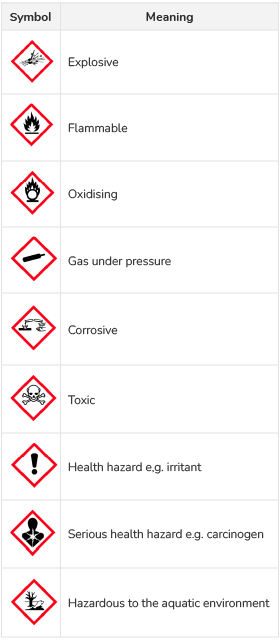
Substances may have multiple hazard symbols, especially for aqueous solutions at different concentrations. For instance, hydrochloric acid at 0.1 mol dm-3, and 10 mol dm-3 have very different hazards.
Risk assessments in laboratory safety
Risk assessments are essential for ensuring that laboratory work is carried out safely and that risks to health are minimised. The process involves:
- Identify hazards - Examine all substances and procedures involved.
- Evaluate risks - Consider how substances will be used and potential for harm.
- Implement control measures - Put in place measures to reduce the associated risks.
Key factors considered in risk assessments include:
- The amount of a substance used.
- The experience and age of the user.
- The need for ventilation or fume hoods.
- Personal protective equipment (PPE), like goggles and gloves.
- Safe handling procedures.
- Spill management and first aid procedures.
Control measures for reducing risks
Control measures are specific actions taken to reduce the risks associated with chemical experiments. They should be clearly outlined in risk assessments and strictly followed.
For example, the following control measures are implemented when using concentrated hydrochloric acid:
- Wear goggles and gloves for protection.
- Ensure good ventilation or use a fume cupboard.
- Keep the container sealed when not in use.
- Have a neutralising agent ready for spills.
- Know the location of safety showers and eyewash stations.
Strategies for reducing risks
There are several strategies to reduce risks when conducting organic chemistry experiments:
-
Working on a smaller scale - Using smaller amounts of chemicals reduces both the likelihood and severity of accidents.
-
Taking precautions specific to the hazard - Tailor safety measures to the specific risks of the chemicals being use, such as:
- Use a fume hood when working with volatile or toxic substances.
- Wear appropriate PPE such as gloves, lab coats, and safety glasses.
- Ensure proper ventilation and keep flammable substances away from any sources of ignition.
- Using alternative methods that involve less hazardous substances - Where possible, replace hazardous chemicals with safer alternatives. For instance, using ethyl acetate instead of diethyl ether as a solvent can reduce the risk of fire or explosion.