8.8 - Redox Reactions in Group 7
- 1
Reactions of halogens with group 1 and 2 metals
- 2
Displacement reactions between halogens and halide ions
- 3
Identification of halogens based on colour changes in displacement reactions
- 4
What disproportionation reactions are
- 5
How chlorine is used to disinfect drinking water
- 6
Producing bleach through the disproportionation of chlorine
Oxidising power of halogens decreases down group 7
The oxidising power of halogens refers to their ability to take electrons from other substances to form halide ions. Oxidising power is directly related to reactivity.
The oxidising power of halogens decreases down group 7, as does reactivity. This is because the increasing size and shielding makes it harder for larger halogens to remove electrons from (i.e. oxidise) other substances.
Therefore, fluorine is the strongest oxidising agent and iodine is the weakest.
Halogens displace less reactive halide ions
The relative reactivity and oxidising ability of the halogens can be seen in displacement reactions.
If an aqueous halogen solution is added to a solution containing halide ions, a more reactive halogen will displace a less reactive halide from the solution.
- The displacing halogen is reduced as it gains an electron to form the halide ion.
- The displaced halide is oxidised as it loses an electron to form the halogen molecule. The rule is: a halogen will displace any halide ion below it in group 7.
Here is a summary table including the ionic equations for the displacement reactions:
| Halogen | Displaces | Ionic equation(s) |
|---|---|---|
| Chlorine (Cl) | Bromide (Br) and Iodide (I) | Cl + 2Br ➔ 2Cl + Br / Cl + 2I ➔ 2Cl + I |
| Bromine (Br) | Iodide (I) | Br + 2I ➔ 2Br + I |
| Iodine (I) | None | No reaction |
This table shows that oxidising ability decreases down group 7 because:
- Chlorine can oxidise both bromide and iodide, showing it is the strongest oxidising agent.
- Bromine can oxidise iodide but not the more reactive chloride, so bromine has intermediate oxidising strength.
- Iodine cannot oxidise either chloride or bromide, so it has the weakest oxidising power.
Reactions of halogens with group 1 and 2 metals
The halogens also react with group 1 and group 2 metals, forming the corresponding halide salts. The reactivity of the halogens in these reactions decreases as you move down group 7, following the same trend seen previously.
Reactions with group 1 metals:
Group 1 metals react with halogens in a 2:1 ratio. For example:
2Na(s) + F2(g) ➔ 2NaF(s)
In this reaction:
- Sodium is oxidised: Na ➔ Na+ + e- (oxidation state changes from 0 to +1).
- Fluorine is reduced: F2 + 2e- ➔ 2F- (oxidation state changes from 0 to -1).
Reactions with group 2 metals:
Group 2 metals react with halogens in a 1:1 ratio. For example:
Mg(s) + Cl2(g) ➔ MgCl2(s)
In this reaction:
- Magnesium is oxidised: Mg ➔ Mg2+ + 2e- (oxidation state changes from 0 to +2).
- Chlorine is reduced: Cl2 + 2e- ➔ 2Cl- (oxidation state changes from 0 to -1).
Colour changes in halogen displacement reactions
When a more reactive halogen displaces a less reactive halide ion in solution, visible colour changes occur that allow the halogen product to be identified.
Colour changes in aqueous solution
When halogens displace less reactive halide ions in aqueous solution, visible colour changes occur if a reaction takes place:
- If bromide (Br-) is displaced, forming bromine (Br2), the aqueous solution turns yellow.
- If iodide (I-) is displaced, forming iodine (I2), the aqueous solution turns orange/brown.
- If no reaction occurs, the aqueous solution remains colourless. These colour changes allow the halogen present to be identified.
| Potassium chloride (KCl) | Potassium bromide (KBr) | Potassium iodide (KI) | |
|---|---|---|---|
| Chlorine (Cl) | Yellow (Br) | Orange/brown (I) | |
| Bromine (Br) | No colour change (no reaction) | Orange/brown (I) | |
| Iodine (I) | No colour change (no reaction) | No colour change (no reaction) |
Colour changes in organic solution
The halogen products can be more clearly visualized by using an organic solvent like cyclohexane. After the reaction, shaking the aqueous layer with hexane will result in the halogen dissolving in the organic layer. This separates out on top of the aqueous solution:
- If bromide (Br-) is displaced, forming bromine (Br2), the organic layer turns orange.
- If iodide (I-) is displaced, forming iodine (I2), the organic layer turns purple.
- If no reaction occurs, the organic solution remains colourless.
| Potassium chloride (KCl) | Potassium bromide (KBr) | Potassium iodide (KI) | |
|---|---|---|---|
| Chlorine (Cl) | Orange (Br) | Purple (I) | |
| Bromine (Br) | No colour change (no reaction) | Purple (I) | |
| Iodine (I) | No colour change (no reaction) | No colour change (no reaction) |
So the halogen products can be clearly identified based on the colour changes in both aqueous and organic layers after the displacement reactions.
Disproportionation reactions
Disproportionation reactions occur when a substance is simultaneously oxidised and reduced in the same chemical reaction.
Disproportionation occurs if the oxidation number of the same element both increases (oxidation) and decreases (reduction) within the same reaction.
For example, when chlorine gas reacts with water, it undergoes the following disproportionation reaction:
Cl2(g) + H2O(l) ➔ HCl(aq) + HClO(aq)
Here, the oxidation number of chlorine increases from 0 to +1 in HClO and decreases to -1 in HCl, showing it has undergone disproportionation.
Using chlorine to disinfect drinking water
When chlorine gas is bubbled through water, disproportionation occurs:
Cl2(g) + H2O(l) ➔ HCl(aq) + HClO
The hypochlorous acid (HClO) then dissociates:
HClO ➔ H+(aq) + ClO-
These hypochlorite ions (ClO-) act as a disinfectant, killing microorganisms in the water to make it safe to drink.
In sunlight, chlorine gas react with water to form hydrochloric acid and oxygen gas:
Cl2(g) + 2H2O(l) ➔ 2HCl(aq) + 1⁄2O2(g)
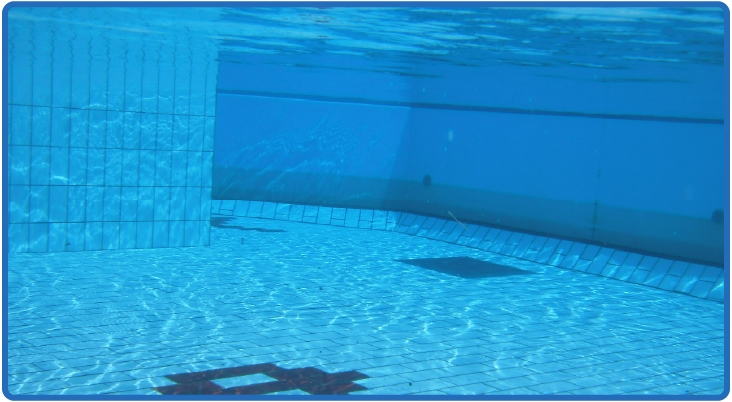
This reaction depletes the hypochlorite ion disinfectant, meaning swimming pools require regular additions of chlorine to maintain effective disinfection.
Making bleach through disproportionation
Mixing chlorine gas with cold dilute sodium hydroxide solution produces sodium chlorate(I) solution (NaClO), which is the key component of bleach:
- Cl2(g) + 2NaOH(aq) ➔ NaClO(aq) + NaCl(aq) + H2O(l) The oxidation number of chlorine increases from 0 to +1 in NaClO and decreases to -1 in NaCl, showing it has undergone disproportionation.
This bleach solution contains chlorate(I) ions (ClO-) that act as oxidising agents to kill bacteria, making the bleach widely useful for disinfecting and cleaning purposes.
If chlorine is reacted with hot concentrated sodium hydroxide solution, sodium chlorate(V) solution (NaClO3) is produced instead:
- 3Cl2(g) + 6NaOH(aq) ➔ NaClO3(aq) + 5NaCl(aq) + 3H2O(l) The oxidation number of chlorine increases from 0 to +5 in NaClO3 and decreases to -1 in NaCl, showing it has undergone disproportionation.
The sodium chlorate(V) solution produced contains chlorate(V) ions (ClO3-) that are powerful oxidising agents used for bleaching paper and textiles.