19.1 - Amines and their Preparations
- 1
The structure and classification of amines
- 2
How the structure of amines affects their basicity
- 3
The solubility of amines in water
- 4
How aliphatic and aromatic amines are produced
Amines are derivatives of ammonia
Amines are organic compounds that come from ammonia (NH3). This transformation happens when one or more hydrogen atoms in the ammonia molecule are replaced with alkyl or aryl groups.
Amines can be classified into two main categories: aliphatic and aromatic. Aliphatic amines have alkyl groups attached to the nitrogen atom, while aromatic amines contain a nitrogen atom directly bonded to a benzene ring.
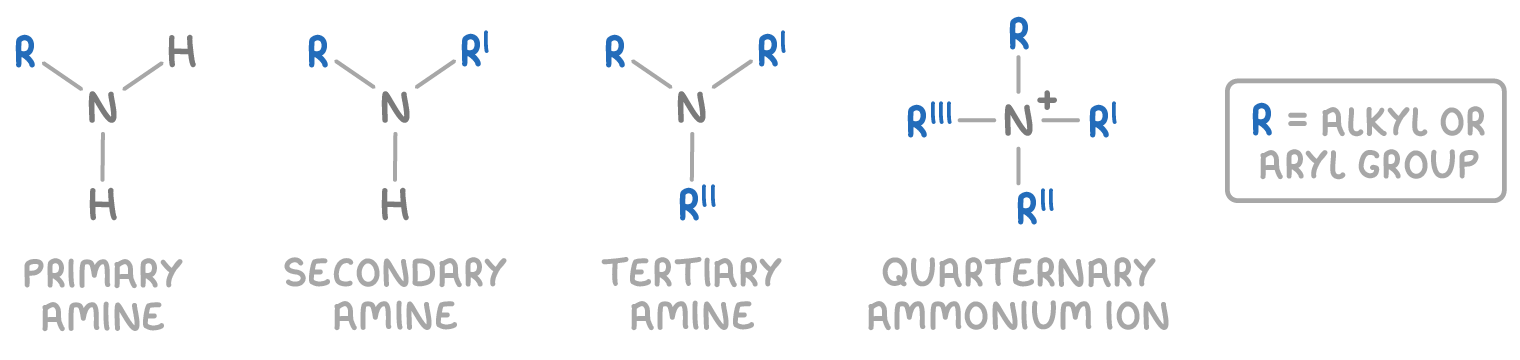
Amines are further categorised based on the number of hydrogen atoms that have been replaced:
- Primary amines - One hydrogen is replaced. The general formula is RNH2.
- Secondary amines - Two hydrogens are replaced. The general formula is R2NH.
- Tertiary amines - Three hydrogens are replaced. The general formula is R3N.
- Quaternary ammonium ions - Four organic groups are attached to positively charged nitrogen, general formula R4N+.
Amines contain a lone pair of electrons
Amines contain a nitrogen atom with a lone pair of electrons, enabling them to act as weak Brønsted-Lowry bases. They accept protons (H+ ions) from acids, forming substituted ammonium salts through the transfer of a proton from the acid to the amine.
This neutralisation reaction occurs due to the lone pair's ability to accept protons.
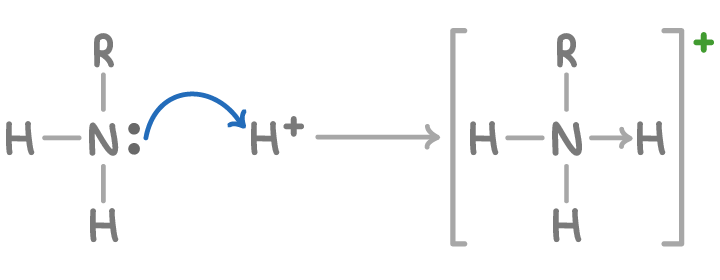
For example, butylamine neutralises hydrochloric acid to form butylammonium chloride:
CH3(CH2)3NH2 + HCl ➔ CH3(CH2)3NH3+ Cl-
Phenylamine neutralises nitric acid to form phenylammonium nitrate:
C6H5NH2 + HNO3 ➔ C6H5NH3+ Cl-
Aliphatic amines are stronger bases than aromatic amines
The strength of an amine as a base is influenced by how available nitrogen's lone pair of electrons is:
- Aromatic amines have the electron density of the nitrogen reduced by the partial delocalisation of the lone pair into the π-system, which decreases its availability for bonding.
- Aliphatic amines, however, have electron-donating alkyl groups that increase the electron density on the nitrogen, making the lone pair more readily available for bonding.
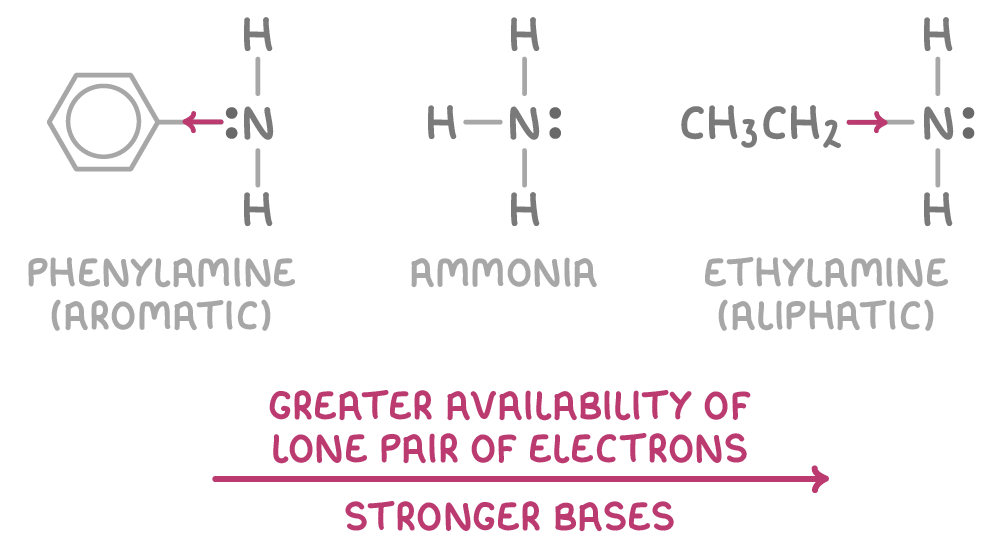
The more available the lone pair of electrons, the stronger the base. So the order of increasing basicity is:
primary aromatic amines < ammonia < primary aliphatic amines
Solubility of amines in water
Amines are miscible with water due to hydrogen bonding between the nitrogen atom's lone pair of electrons and water molecules.
The solubility of amines depends on their size:
Small amines such as butylamine are highly soluble in water due to strong hydrogen bonding between the amine group and water molecules.
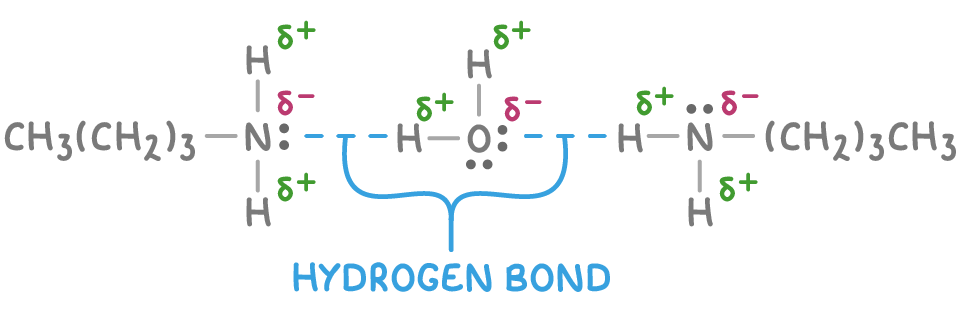
Larger amines are less soluble because:
- Increased London forces between amine molecules require more energy to overcome.
- Large carbon chains disrupt the hydrogen bonding network of water.
When amines dissolve in water, they create alkaline solutions. This happens because some amine molecules accept a proton from water, forming alkyl ammonium ions and hydroxide ions.
For example, butylamine dissolves in water as follows:
CH3(CH2)3NH2 + H2O ⇌ CH3(CH2)3NH3+ + OH-
Phenylamine undergoes a similar dissolution process in water:
C6H5NH2 + H2O ⇌ C6H5NH3+ + OH-
Aliphatic amines form from halogenoalkanes or nitriles
There are two main ways to produce aliphatic amines:
- Nucleophilic substitution of halogenoalkanes.
- Reduction of nitriles.
Nucleophilic substitution of halogenoalkanes
Primary aliphatic amines can be produced by heating a halogenoalkane with excess ethanolic ammonia in a nucleophilic substitution reaction.
For example, bromoethane reacts with ammonia to give ethylamine:
CH3CH2Br + 2NH3 ➔ CH3CH2NH2 + NH4Br
The mechanism for this reaction is:

Reducing nitriles to amines
Primary aliphatic amines can be prepared by reducing nitriles through catalytic hydrogenation. This process involves reacting the nitrile with hydrogen gas (H2) in the presence of a metal catalyst, such as nickel or platinum.
The general reaction for this reduction is:
R-C≡N + 4[H] ➔ R-CH2-NH2
For example, the reduction of ethanenitrile to ethylamine can be represented as follows:
CH3CN + 4[H] ➔ CH3CH2NH2
An advantage of catalytic hydrogenation is that it produces a purer product compared to other methods, such as the reaction of halogenoalkanes with ammonia. In catalytic hydrogenation, the primary amine formed does not undergo further substitution reactions, preventing the formation of secondary, tertiary, and quaternary ammonium compounds as byproducts.
Aromatic amines from nitro compounds
Aromatic amines are produced by reducing nitro compounds in a two-step process:
- The nitro compound is heated under reflux with tin and concentrated HCl to form an ammonium salt.
- The ammonium salt is then treated with aqueous NaOH to give the free amine.
For example, nitrobenzene is reduced to phenylamine via phenylammonium chloride:

Aromatic amines like this are useful in organic synthesis for making pharmaceuticals, dyes, and other compounds.