3.2 - Ionic Radii and Polarisation of Ions
- 1
Factors affecting the strength of ionic bonds
- 2
Trends in ionic radius
- 3
Polarisation of ions
Factors affecting ionic bond strength
The strength of an ionic bond depends on two key factors.
1. Ionic charge
- Higher ionic charges result in stronger ionic bonds.
- This is due to increased electrostatic attractions between oppositely charged ions.
- For example, MgCl2 has stronger ionic bonds than NaCl because the Mg2+ ion has a higher charge than Na+, leading to stronger electrostatic attractions.
2. Ionic radius
- Smaller ions form stronger ionic bonds.
- This is because smaller ions have higher charge density and can pack more closely together.
- The closer packing increases the strength of electrostatic attractions between ions.
- For example, LiCl has stronger ionic bonds than NaCl because the Li+ ion is smaller than Na+ ion, allowing for closer packing and stronger electrostatic attractions.
Trends in ionic radius
Ionic radius increases down a group
Similar to atomic radius, ionic radius increases down a group for both cations and anions. This is due to the increasing number of electron shells and greater shielding of the nucleus by inner electrons as you move down the group.
Trend in ionic radius across a period
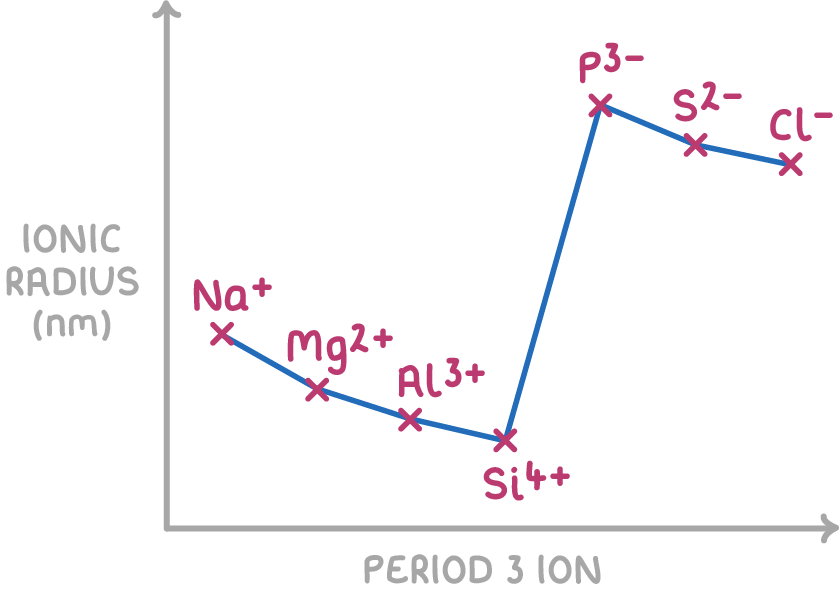
Ionic radius decreases for cations but increases for anions across a period, as shown by the period 3 ions in the graph above:
- For cations, the ionic radius decreases across a period as nuclear charge increases. With more protons, the electrostatic attraction between the nucleus and remaining electrons increases, drawing the electrons closer.
- For anions, the ionic radius increases across a period as the addition of electrons results in more shielding. This weaker attraction allows the valence electrons to locate further from the nucleus.
- Anions have larger ionic radii than cations from the same period because they have an extra electron shell. The increase in shielding outweighs the increase in nuclear charge.
Ion polarisation in ionic compounds
- Ionic bonds are not always purely ionic; they can exhibit some degree of covalent character due to a phenomenon called ion polarisation.
- Ion polarisation occurs when the positive charge on a cation attracts the electrons in a nearby anion, distorting the anion's electron cloud. This distortion causes the anion to lose its spherical shape.
- The ability of a cation to polarise nearby anions is called its polarising power. The greater the ion polarisation, the more covalent character the ionic bond exhibits.
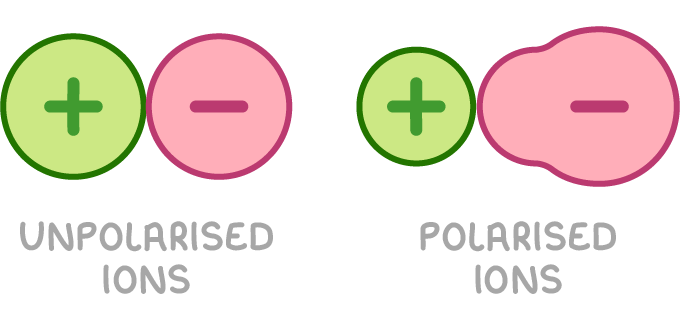
Factors affecting ion polarisation
- Small, highly charged cations have greater polarising power - Their positive charge is more concentrated, increasing their attraction to the anion's electrons.
- Large anions with high charge are more easily polarised - Their electrons are further from the nucleus and experience greater repulsion, making them more susceptible to attraction by cations.
3.3 - Covalent Bonding in Simple MoleculesNext up
How were these notes?