6.2 - Standard Enthalpy Change of Combustion
- 1
Standard enthalpy change of combustion
- 2
How calorimetry allows us to measure enthalpy changes
- 3
Combustion calorimetry
- 4
Calculating standard enthalpy change of combustion
Standard enthalpy change of combustion
The standard enthalpy change of combustion (ΔH⦵c) is the enthalpy change when one mole of a substance combusts fully in oxygen under standard conditions. Combustion is exothermic so ΔH⦵c values are always negative.
For example, the equation representing the standard enthalpy change of combustion of methane (CH4) is:
CH4(g) + 2O2(g) ➔ CO2(g) + 2H2O(l) ΔH⦵c = 890 kJ mol-1.
Measuring enthalpy changes with calorimetry
We can measure the energy transferred in a reaction as heat using an apparatus called a calorimeter. This allows us to determine enthalpy changes for reactions.
There are two main types of calorimetry experiments:
- Combustion calorimetry - used to find the enthalpy change when a fuel is burned i.e. the enthalpy change of combustion.
- Solution calorimetry - used to find enthalpy changes for reactions occurring in aqueous solutions such as the enthalpy change of neutralisation.
Combustion calorimetry
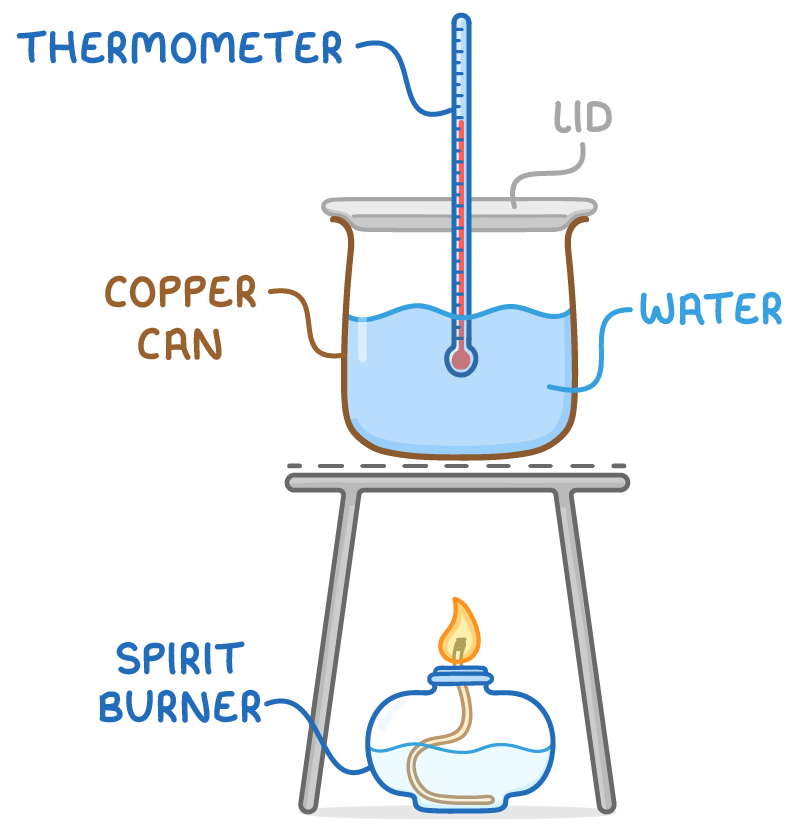
To find the enthalpy change using combustion calorimetry:
- A weighed fuel sample is burnt underneath a metal canister (calorimeter) containing a known mass of water.
- As the fuel combusts, heat is transferred to the water. A thermometer measures the temperature change.
- The temperature change along with the mass and heat capacity of water are used to calculate the heat energy.
Understanding inaccuracies in enthalpy change
Inaccuracies in calorimetry can lead to deviations in the measured enthalpy change, generally resulting in an underestimation of the true enthalpy change.
Common sources of error
- Heat loss - Heat escaping to the surroundings means less is absorbed by the water, leading to a lower measured enthalpy change.
- Incomplete combustion - When fuel doesn't burn completely, less heat is produced, resulting in a lower calculated enthalpy change.
- Fuel evaporation - If some fuel evaporates before burning, it reduces the amount of heat generated, thereby decreasing the measured enthalpy change.
Calculating enthalpy change of combustion
To measure the enthalpy change of combustion, you need to use two key equations sequentially: first to calculate the heat energy change, and then to use that value to calculate the enthalpy change per mole.
First, the heat energy change can be calculated using the equation:
q = mcΔT
Where:
- q = heat energy (J)
- m = mass of water (g)
- c = specific heat capacity of water, 4.18 J g^-1^ K^-1^
- ΔT = temperature change (K) The official unit for ΔT is Kelvin (K). However, the Celsius scale gives the same numerical temperature change, so °C can also be used.
Next, use the value of q obtained from the first equation to find the enthalpy change with the equation:
Where:
- ΔHc = enthalpy change of combustion (kJ mol-1)
- q = heat energy (kJ)
- n = number of moles of the fuel (mol) Enthalpy changes are typically expressed in kJ mol-1 so you need to convert q from J to kJ by dividing by 1,000 before using it in the second equation.
Worked example 1 - Calculating standard enthalpy of combustion
In a laboratory experiment, 1.45 g of an organic liquid fuel (Mr = 58.0) were completely burned in oxygen. The heat formed during this combustion raised the temperature of 100 g of water from 293 K to 372 K.
Calculate the standard enthalpy of combustion (ΔH⦵c) of the fuel.
The specific heat capacity of water, c = 4.18 J g-1 K-1.
Step 1: Calculate heat energy transferred
q = mcΔT = 100 x 4.18 x (372 - 293) = 33,022 J
Step 2: Conversion of J into kJ
To convert from J into kJ, divide by 1,000
33,022 J = 33.022 kJ
Step 3: Calculate number of moles of fuel burnt
Step 4: Calculate heat released per mole of fuel
The minus sign indicates this is an exothermic reaction, releasing heat.