19.4 - Amino Acids
- 1
The structure of amino acids
- 2
The chirality of most amino acids
- 3
Zwitterions
Amino acids contain amine and acid groups
Amino acids consist of both amine and acid functional groups:
- An amino group (-NH2).
- A carboxyl group (-COOH). In nature, amino acids are found as 2-amino acids, where the amino group is attached to the second carbon atom (the α-carbon), and the carboxyl group is always attached to the first carbon atom.
The general structure of a 2-amino acid is illustrated below:
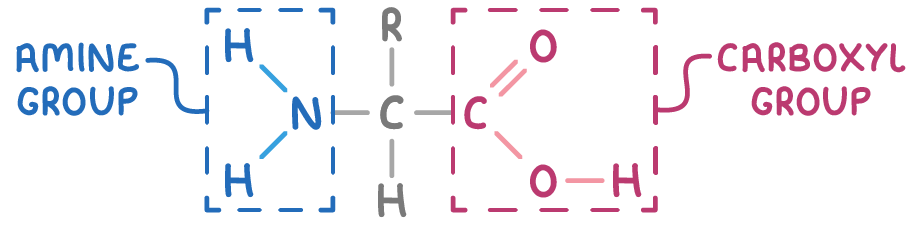
Here, R denotes a variable organic substituent i.e. an alkyl or aryl group, which is known as the side chain.
Most 2-amino acids are chiral molecules
Most 2-amino acids are chiral molecules because their α-carbon is attached to four different groups: the carboxyl group, amino group, hydrogen atom, and R group (side chain). This configuration leads to the existence of two optical isomers (enantiomers).
For example, the two enatiomers of the amino acid alanine are shown below:
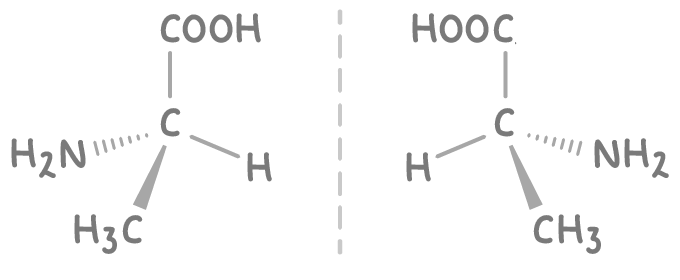
When plane-polarised monochromatic light passes through an aqueous solution containing a single enantiomer of a 2-amino acid, the plane of the light is rotated due to the presence of the chiral carbon.
An exception to this rule is glycine, where the R group is a hydrogen atom. With two hydrogen atoms attached to the α-carbon, glycine is achiral and does not rotate the plane of polarised light.
Amino acids as zwitterions
Amino acids can form zwitterions around their isoelectric point - the pH at which they carry no net charge.
A zwitterion contains both positive and negative charges within the same molecule. This happens to amino acids when the pH is close to their isoelectric point.
Specifically, a zwitterion forms through:
- Amine group protonation - The NH2 group gains a proton to become positively charged NH3+.
- Carboxyl group deprotonation - The COOH group loses a proton to become negatively charged COO-.
These opposite charges balance out, giving an overall neutral charge. This process involves an internal transfer of a proton (H+) from the carboxyl group to the amine group.
Whether the zwitterion forms depends on the pH:
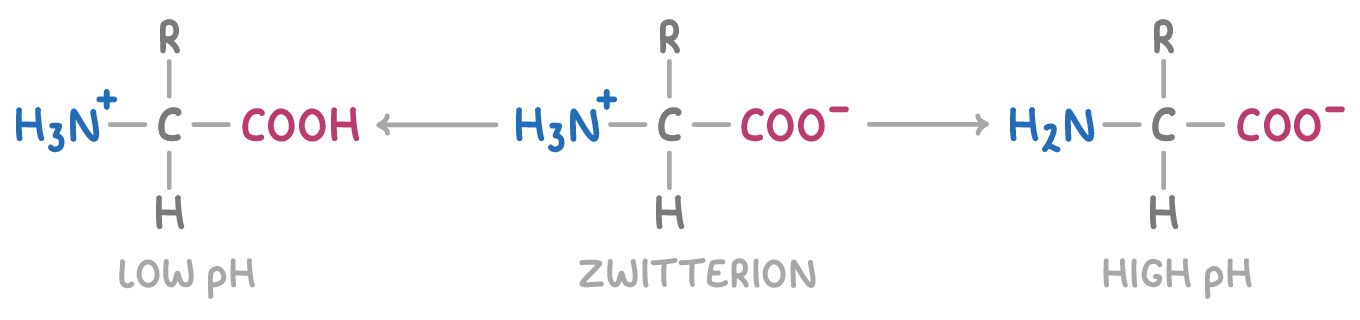
- Lower pH (more acidic than isoelectric point) - The COOH group gets deprotonated.
- Isoelectric point - The zwitterion itself forms as both the carboxyl and amino groups ionise.
- Higher pH (more alkaline than isoelectric point) - The NH3+ group loses its proton.
The existence of these pH-dependent zwitterions demonstrates that amino acids are amphoteric. They can act as both acids (via the carboxyl group) and bases (via the amine group).
The exact isoelectric point where the zwitterion forms depends on the amino acid's R-group. Different R-groups alter the relative acidity and basicity of the functional groups.