9.3 - Effect of Catalysts on Rate of Reaction
- 1
What catalysts are and how they function
- 2
How reaction profiles and Maxwell-Boltzmann distributions illustrate the role of catalysts
- 3
Benefits of catalysts
Catalysts speed up reactions
A catalyst is a substance that accelerates the rate of a chemical reaction without being permanently altered by the reaction itself. Catalysts achieve this by providing an alternative reaction pathway that has a lower activation energy. This allows a greater proportion of particle collisions to result in successful reactions.
Key features of catalysts:
- They are highly efficient - A small quantity of catalyst can facilitate the reaction of a large amount of reactants.
- They are usually very specific - Most catalysts only work for particular reactions.
- They participate in the reaction but are regenerated at the end.
How catalysts work
Catalysts function by altering the reaction pathway, thereby lowering the activation energy required for the reaction to proceed. This can be visualised using reaction profile diagrams.
A simplified comparison of reaction profiles for uncatalysed and catalysed reactions shows the difference in activation energy:
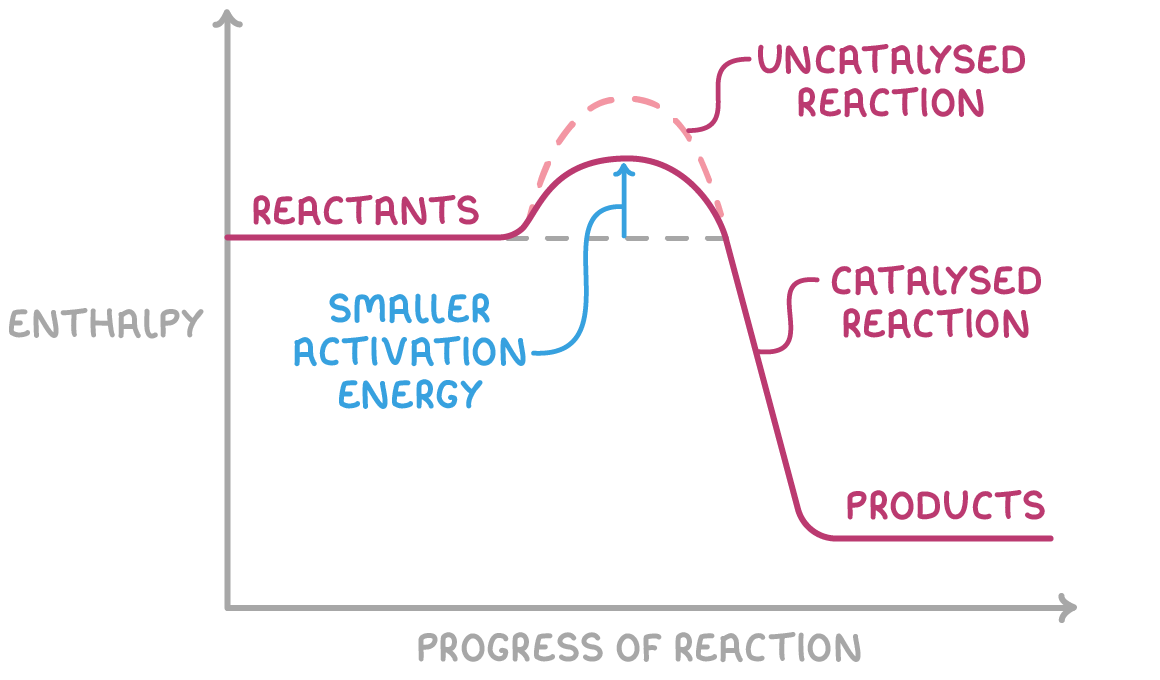
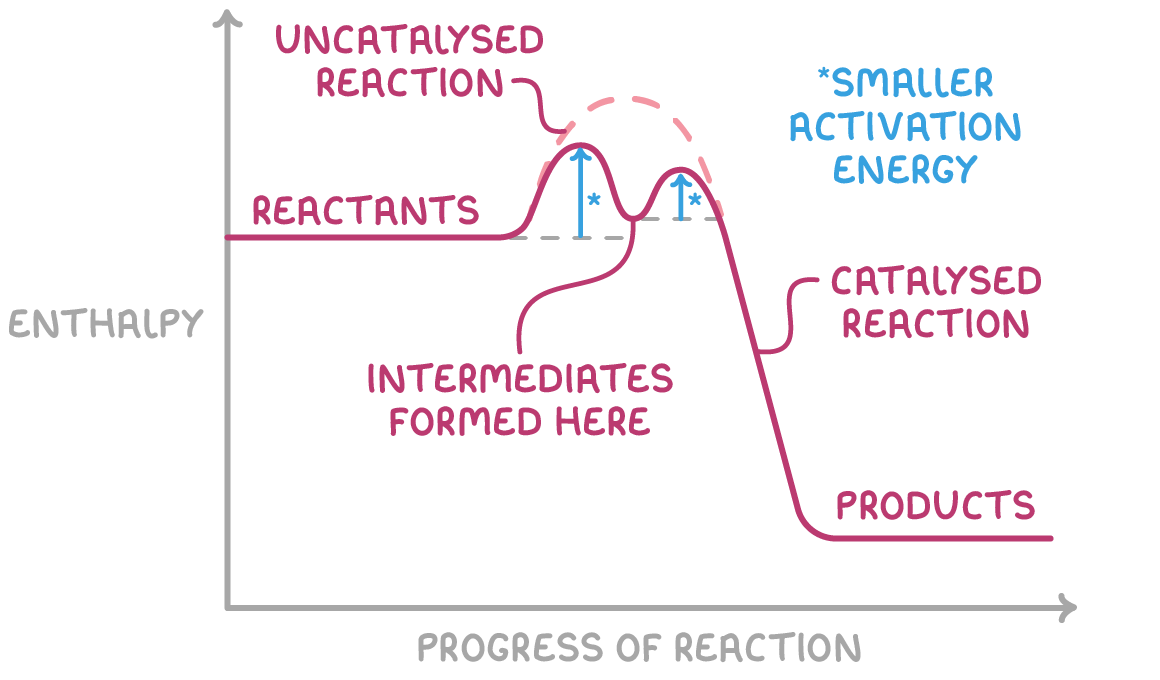
In many cases, reactants combine with the catalyst to form an intermediate species. This intermediate then reacts to form the products and regenerate the catalyst.
A more detailed reaction profile illustrating this process demonstrates the multiple steps involved in catalysis:
Catalysts and the Maxwell-Boltzmann distribution
The effect of catalysts can also be understood using Maxwell-Boltzmann distribution curves, which illustrate the distribution of molecular energies in a system.
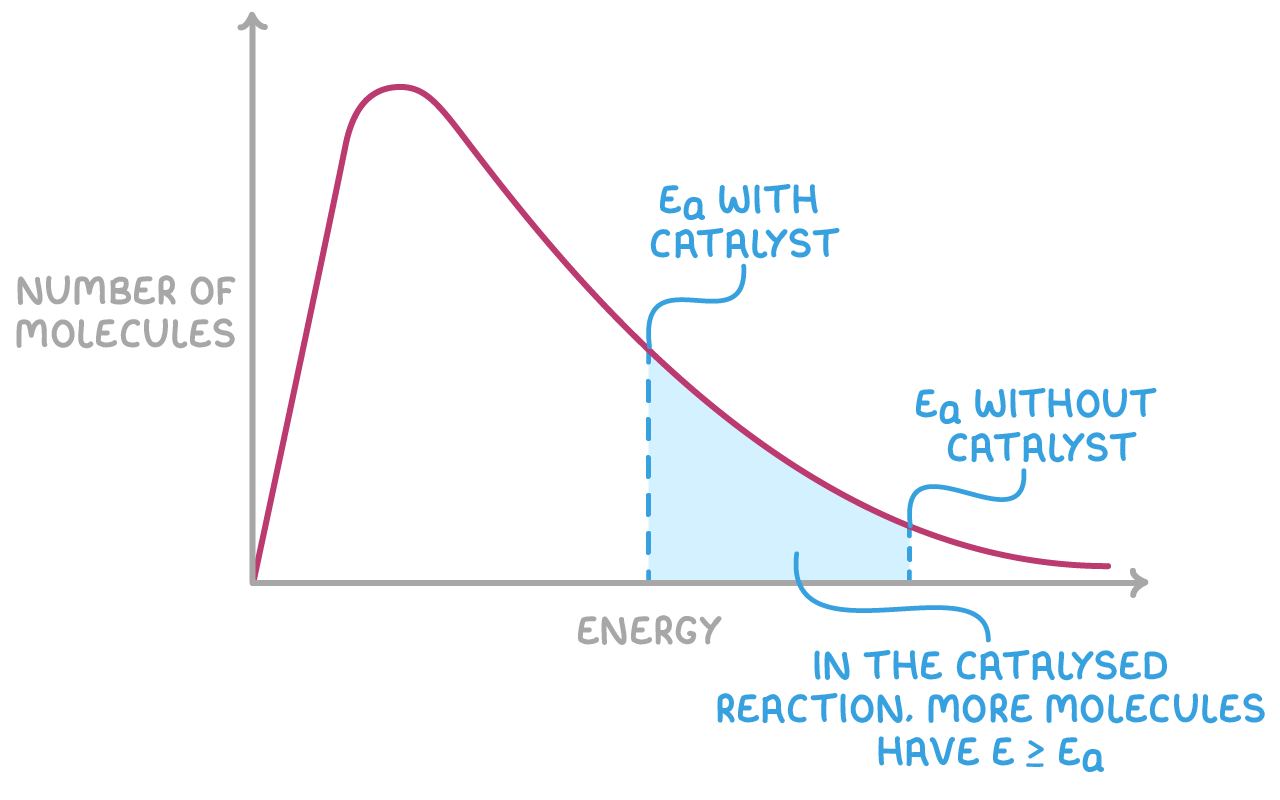
By lowering the activation energy, catalysts increase the proportion of molecules with sufficient energy to react upon collision. This leads to an increased reaction rate.
Benefits of catalysts
Economic benefits
Catalysts bring about significant economic advantages:
- They speed up production, allowing more products to be manufactured and sold.
- They enable reactions to occur at lower temperatures and pressures, reducing energy consumption.
- They improve atom economy, which minimises material wastage. An example is the use of zeolite catalysts in developing lower-temperature processes for cracking hydrocarbons, producing more gasoline fuel from each barrel of oil.
Sustainability benefits
Catalysts contribute to more sustainable chemical processes:
- Reactions requiring lower temperatures result in reduced emissions of greenhouse gases, such as CO2.
- They allow for reactions with better atom economy, cutting down on the waste produced.
- Catalysts can accelerate the breakdown of pollutants from industrial processes. A notable application is the use of platinum catalysts in vehicle catalytic converters, which accelerate the breakdown of harmful emissions like carbon monoxide and nitrogen oxides into less harmful substances, significantly reducing air pollution from vehicles.