20.1 - Organic Analysis
- 1
Using combustion analysis to calculate empirical and molecular formulas
- 2
The sequence of spectroscopic techniques used to determine organic structures
- 3
Examples showing the step-by-step analysis of unknown compounds
Combustion analysis
Combustion analysis is a reliable method for determining the empirical and molecular formulas of organic compounds that contain carbon, hydrogen, and oxygen. When these compounds undergo complete combustion in an excess of oxygen, they produce carbon dioxide (CO2) and water (H2O).
The amounts of CO2 and H2O produced allow calculation of the moles of carbon and hydrogen in the original compound, leading to determination of its empirical formula.
Worked example 1 - Calculating empirical formulas from combustion masses
When 9.00 g of an unknown carbonyl compound X is burnt in excess oxygen, it produces 22.0 g of carbon dioxide and 9.00 g of water.
Calculate the empirical formula for this compound.
Step 1: Calculate moles of CO2
Moles of CO2 = mol
1 mole of CO2 contains 1 mole of C, so there are 0.500 moles of C in compound X.
Step 2: Calculate moles of H2O
Moles of H2O = = 0.500 mol
1 mole of H2O contains 2 moles of H, so there are 0.500 x 2 = 1.00 moles of H in compound X.
Step 3: Calculate mass of C and H in compound X
Mass of C = n x Ar = 0.500 x 12.0 = 6.00 g
Mass of H = n x Ar = 1.00 x 1.0 = 1.00 g
Step 4: Calculate mass and moles of O in compound X
Mass of O = total mass (mass of C + mass of H) = 9.00 (6.00 + 1.00) = 2.00 g
Moles of O = mol
Step 5: Calculate empirical formula
C : H : O mole ratio =
Therefore, the empirical formula of X is C4H8O.
Calculating molecular formulas from combustion reaction volumes
In gaseous reactions, the volumes of the reactants and products can be directly used to determine the molecular formula. This is because all gases at the same temperature and pressure have the same molar volume, allowing us to use the ratio of reacting gas volumes to calculate molar ratios.
Worked example 2 - Calculating molecular formula from combustion volumes
50 cm3 of hydrocarbon Y undergoes complete combustion with 250 cm3 of oxygen, producing 150 cm3 of carbon dioxide.
Determine the molecular formula of Y.
Step 1: Write a balanced equation using the given volumes
50Y + 250O2 ➔ 150CO2 + nH2O
Step 2: Simplify the equation by dividing all coefficients by the coefficient of Y
Y + 5O2 ➔ 3CO2 + nH2O
Step 3: Determine the coefficient for H2O (n)
5 moles of O2 react to form 3 moles of CO2 and n moles of H2O. Any oxygen atoms not in CO2 must be in H2O.
n = (5 × 2) (3 × 2) = 4
The balanced equation is:
Y + 5O2 ➔ 3CO2 + 4H2O
Step 4: Deduce the molecular formula of Y
All C atoms from Y end up in CO2, so there are 3 C atoms in Y.
All H atoms from Y end up in H2O, so there are 8 H atoms in Y.
Therefore, the molecular formula of Y is C3H8.
Sequence of techniques for structure determination
After determining the empirical and molecular formulas, chemists employ a series of spectroscopic techniques to progressively reveal the complete structure of an unknown organic compound:
- Mass spectrometry - Provides the molecular mass and offers clues about structural fragments.
- Infrared (IR) spectroscopy - Identifies functional groups through their characteristic bond vibrations.
- Nuclear magnetic resonance (NMR) spectroscopy - Shows the chemical environment and connectivity of hydrogen and carbon atoms.
By integrating the information from these techniques, chemists can deduce the full structure of the compound.
The following examples show how to apply this sequence of techniques to determine the structures of unknown organic compounds.
Worked example 3 - Determining the structure of an organic molecule
Using the following information provided, determine the structure of the unknown organic compound.
- Elemental analysis: C: 60.00%, H: 13.33%, O: 26.67%
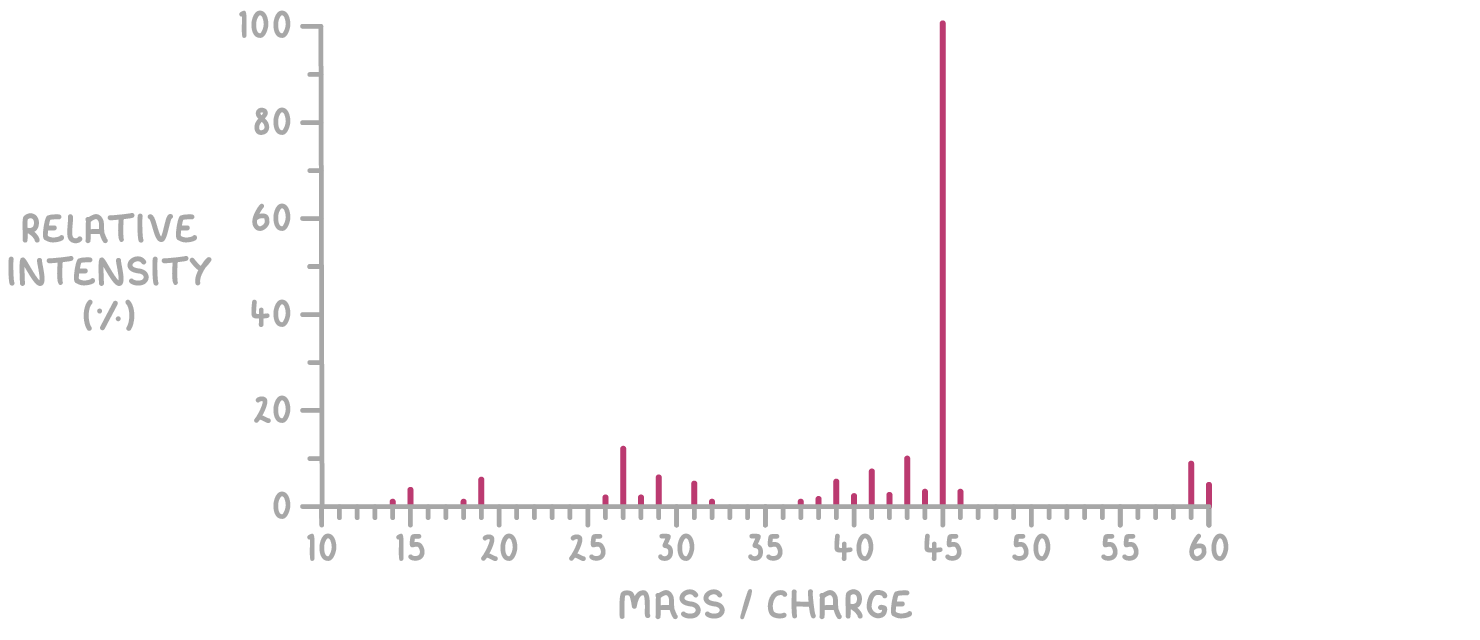
- Mass spectrum:
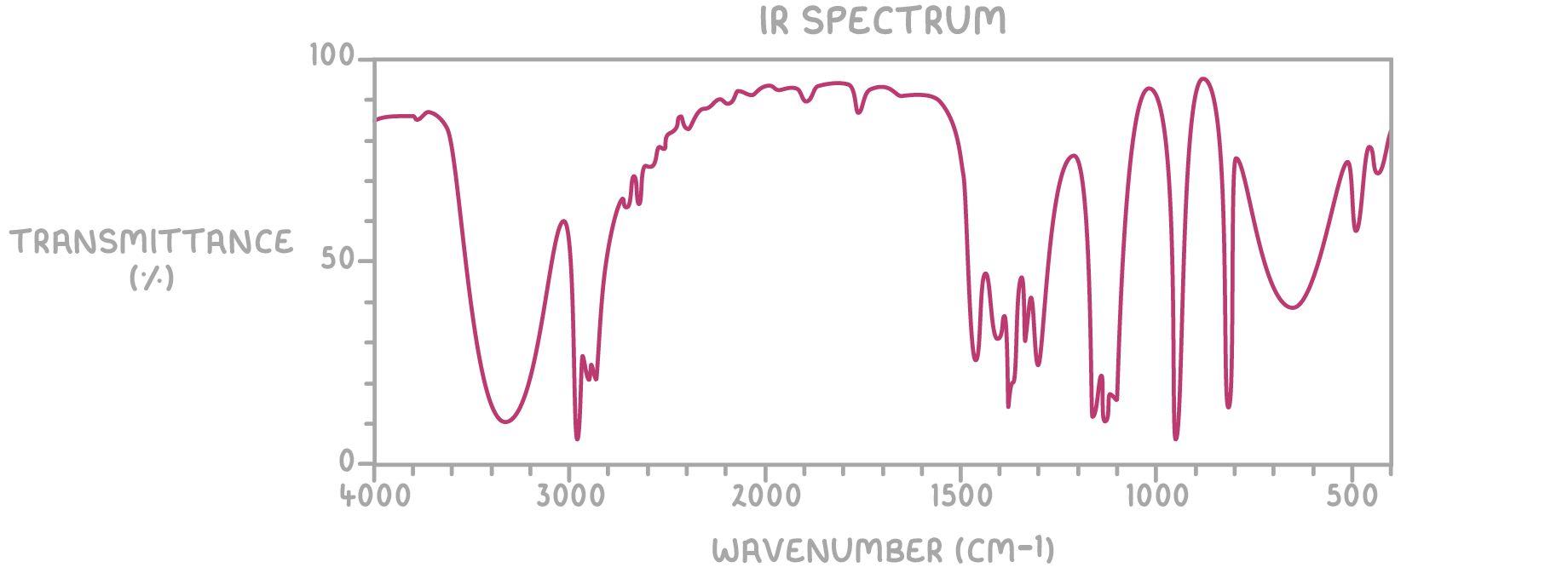
- IR spectrum:
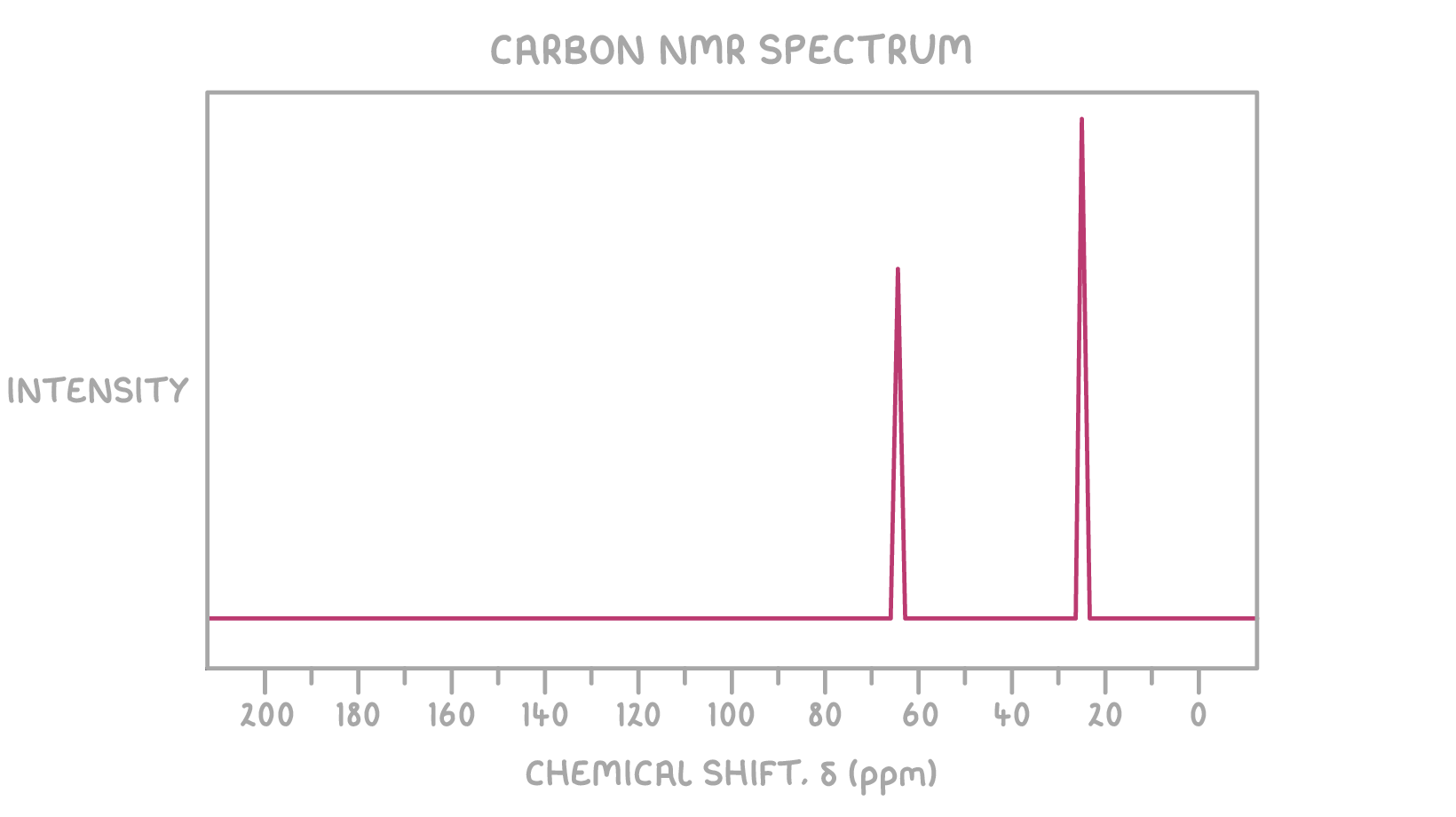
- 13C NMR spectrum:
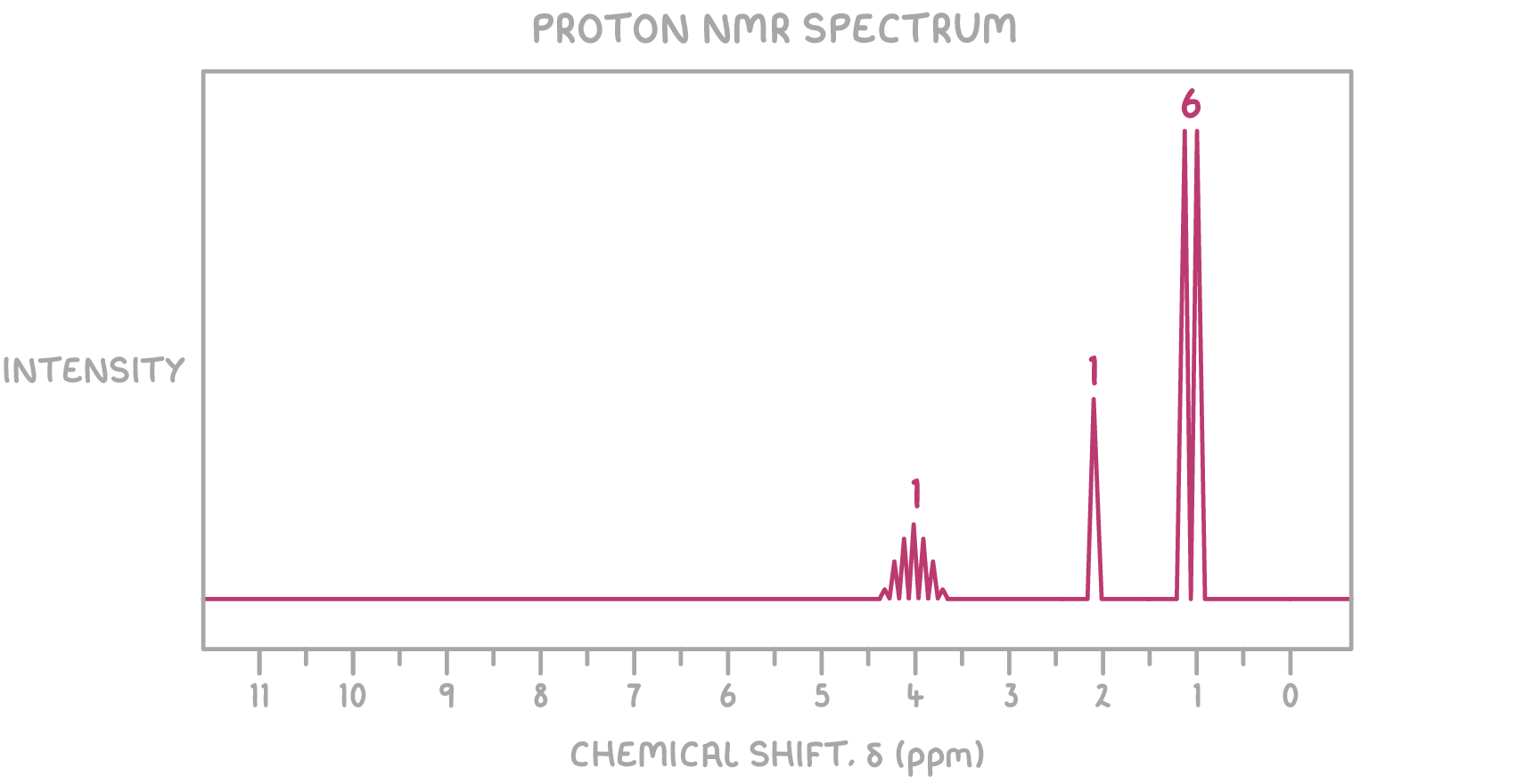
- 1H NMR spectrum:
Step 1: Elemental analysis and empirical formula calculation
Assuming 100 g of the compound for simplicity, convert the mass percentages to moles:
- Carbon:
- Hydrogen:
- Oxygen:
The smallest number of moles is 1.67. Dividing all by 1.67 gives:
- C: 3, H: 8, O: 1
Empirical formula is C3H8O.
Step 2: Molecular formula calculationThe molecular ion peak at m/z = 60 corresponds to the molecular weight of the compound, confirming the empirical formula C3H8O as the actual molecular formula.
Step 3: IR spectrum analysisThe broad absorption at 3340 cm-1 indicates the presence of an -OH group, characteristic of alcohols.
Step 4: NMR spectrum analysis13C NMR:
- The peak at δ 64 ppm suggests a carbon bonded to oxygen (C-O).
- The peak at δ 25 ppm suggests a carbon bonded to carbon (C-C).
1H NMR:
- The septet at δ 4.00 ppm with a relative peak area of 1 is characteristic of a single proton in a unique environment, likely attached to a carbon that is bonded to an OH group.
- The doublet at δ 1.20 ppm with a relative peak area of 6 is characteristic of six protons, suggesting the presence of two methyl groups.
Step 5: Structure determination
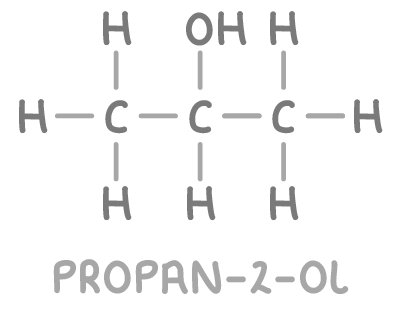
Based on all the evidence, the structure can be determined as propan-2-ol.
Worked example 4 - Determining the structure of an organic molecule
Using the following information provided, determine the structure of the unknown organic compound.
- Elemental analysis: C: 54.55%, H: 9.09%, O: 36.36%
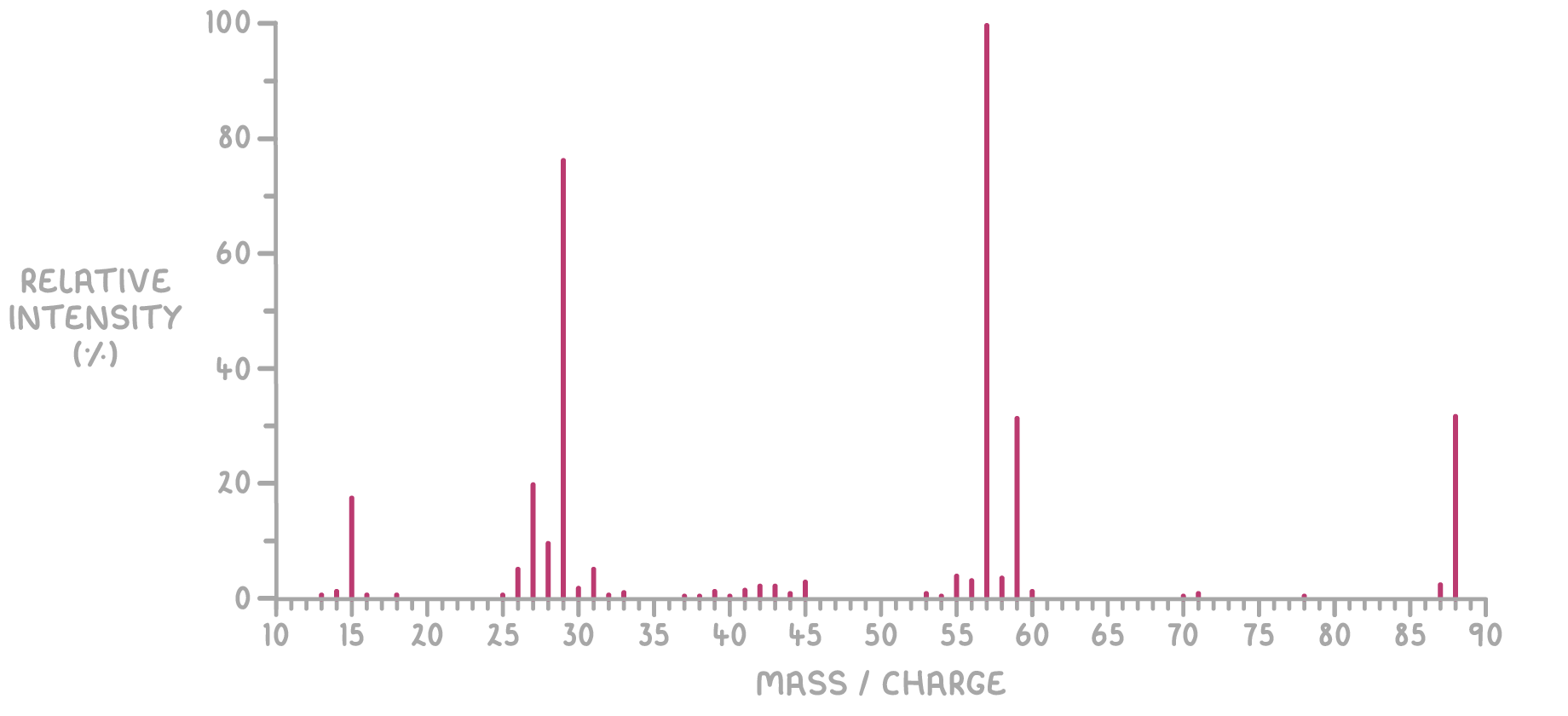
- Mass spectrum:
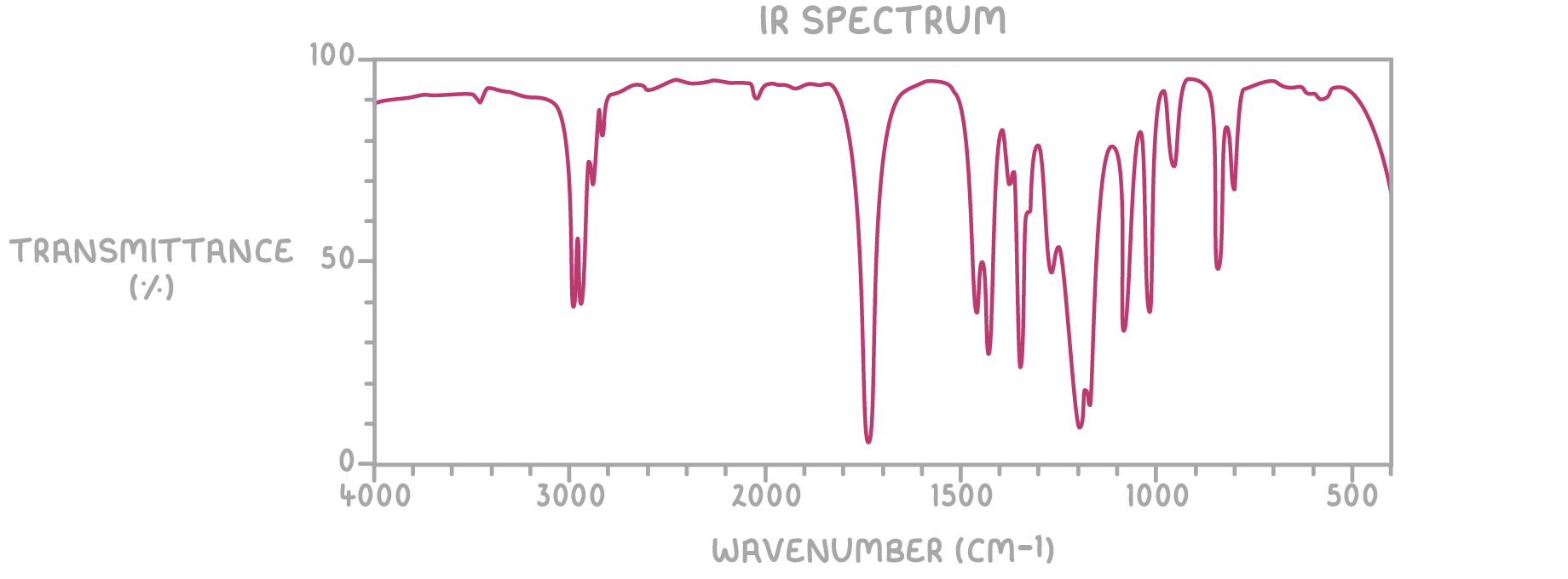
- IR spectrum:
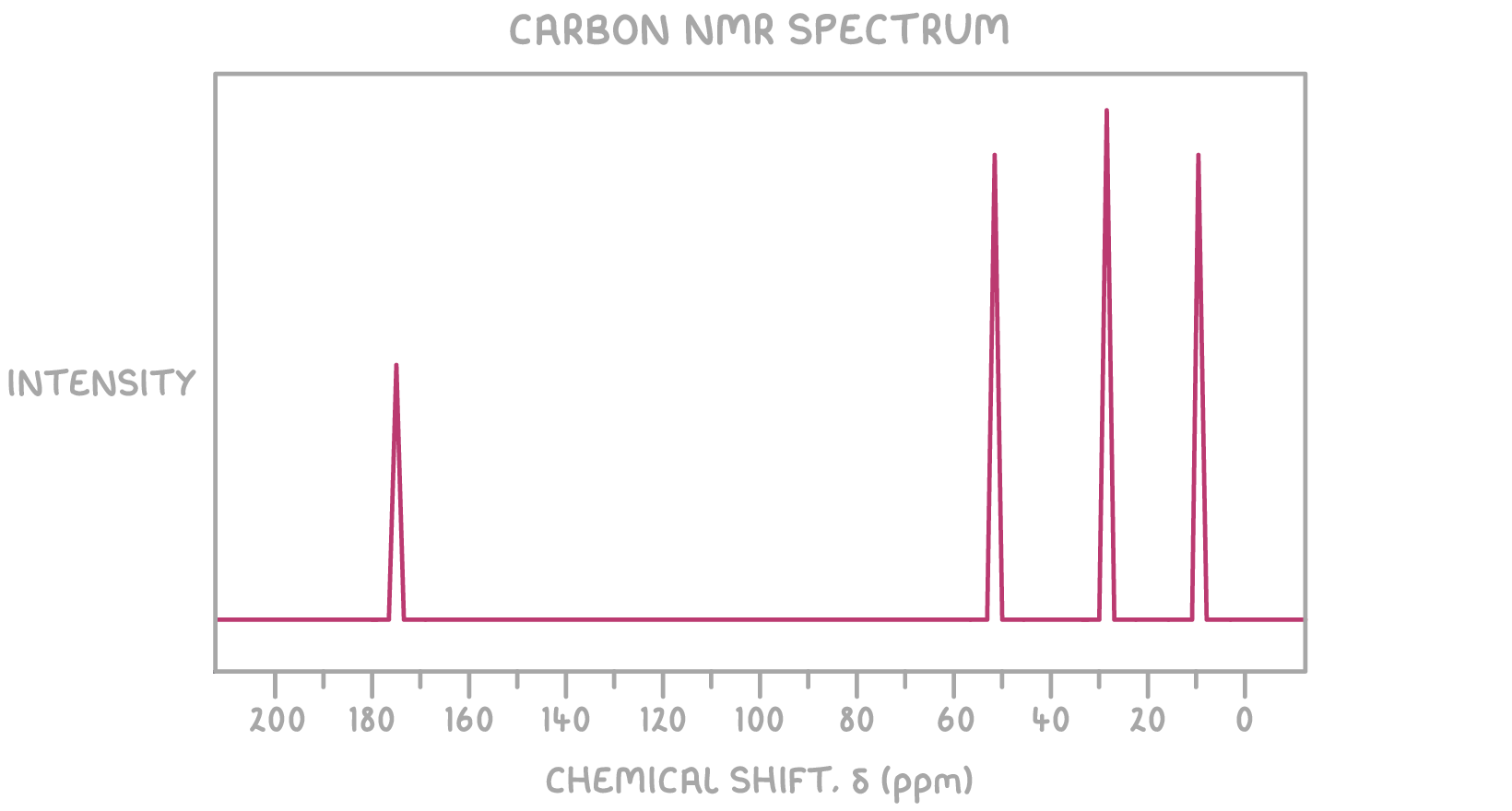
- 13C NMR spectrum:
- 1H NMR spectrum:
Step 1: Elemental analysis and empirical formula calculation
Assuming 100 g of the compound for simplicity, convert the mass percentages to moles:
- Carbon:
- Hydrogen:
- Oxygen:
The smallest number of moles is 2.27. Dividing all by 2.27 gives:
- C: 2, H: 4, O: 1
Empirical formula is C2H4O.
Step 2: Molecular formula calculationThe molecular weight from the molecular ion peak (m/z = 88) matches twice the weight of the empirical formula (2 × 44 = 88). Thus, the molecular formula is C4H8O2.
Step 3: IR spectrum analysisThe strong absorption at 1,740 cm-1 suggests a carbonyl (C=O) group.
Step 4: NMR spectrum analysis13C NMR:
- The peak at δ 175 ppm suggests a carbonyl (C=O) carbon.
- The peak at δ 52 ppm suggests a carbon bonded to oxygen (C-O).
- The peak at δ 9 ppm suggests a carbon bonded to carbon (C-C).
1H NMR:
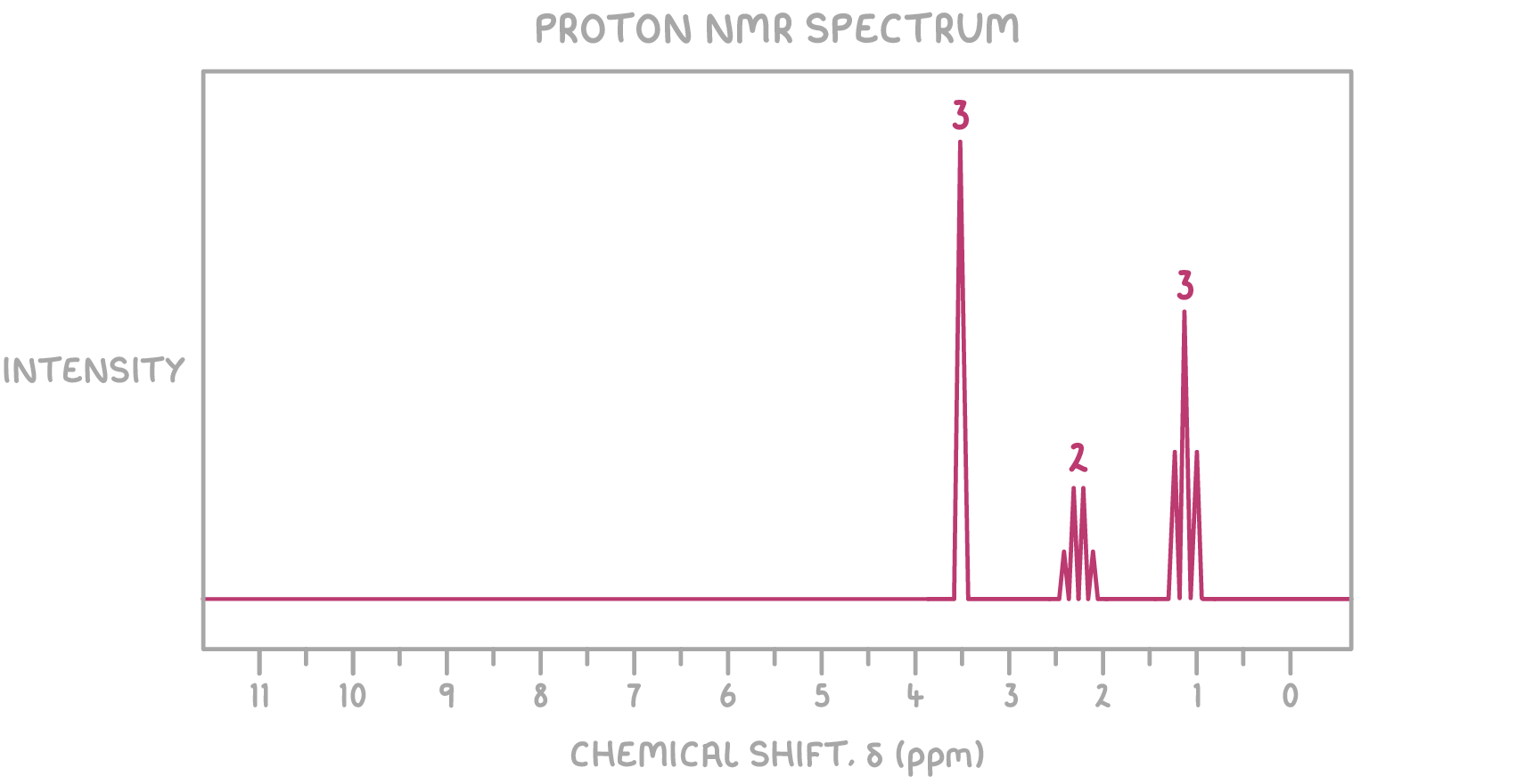
- The singlet at δ 3.70 ppm with a relative peak area of 3 is characteristic of a methyl group (CH3) adjacent to an oxygen atom.
- The quartet at δ 2.32 ppm with a relative peak area of 2 is characteristic of a CH2 group adjacent to a carbonyl group on one side and a methyl group on the other side.
- The triplet at δ 1.15 ppm with a relative peak area of 3 is characteristic of a methyl group (CH3) adjacent to a CH2 group.
Step 5: Structure determination
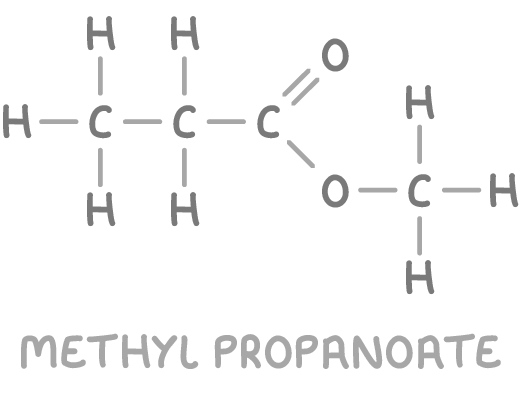
Based on all the evidence, the structure can be determined as methyl propanoate.