15.5 - Properties and Reactions of Carboxylic Acids
- 1
The structure and naming of carboxylic acids
- 2
Properties of carboxylic acids
- 3
Synthesis of carboxylic acids
- 4
Reactions of carboxylic acids
Carboxylic acids contain -COOH group
Carboxylic acids contain the carboxyl functional group -COOH. To name them, find the longest carbon chain, remove the 'e' from the alkane name, and add '-oic acid'.
Some examples of carboxylic acids are:
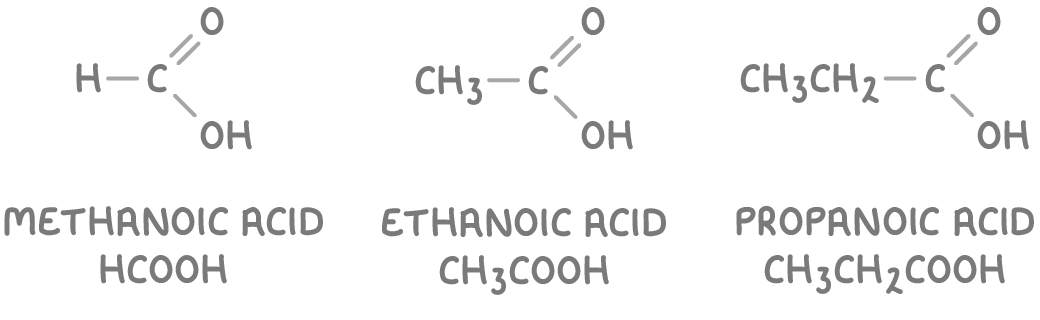
The -COOH group is positioned at the end of the carbon chain and is given priority in naming over other functional groups.
Carboxylic acids are weak acids
In an aqueous solution, carboxylic acids partially dissociate into hydrogen (H+) ions and carboxylate (RCOO-) ions.
For example, ethanoic acid partially dissociates in water:
CH3COOH + H2O ⇌ CH3COO- + H+
This equilibrium lies to the left as most molecules do not dissociate - this makes carboxylic acids weak acids.
Physical properties of carboxylic acids
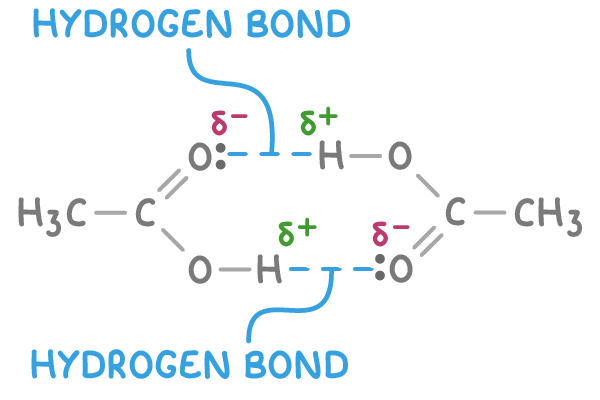
Carboxylic acids have distinct physical properties because of their ability to form hydrogen bonds:
- High boiling points:
- Carboxylic acids exhibit relatively high boiling points compared to other organic compounds with similar molecular masses due to hydrogen bonding between molecules.
- In their pure liquid state, carboxylic acids often form dimers, where two molecules are held together by a pair of hydrogen bonds. This dimerisation effectively doubles the molecular weight, further increasing the boiling point.
- High solubility:
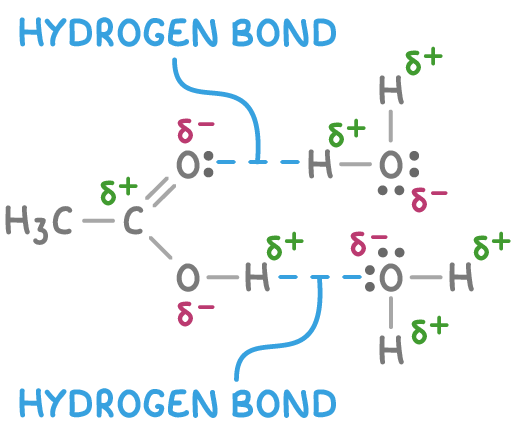
- Small carboxylic acids (up to about 4 carbon atoms) are highly soluble in water due to their ability to form hydrogen bonds with water molecules.
- Solubility decreases as the carbon chain length increases because the hydrophobic hydrocarbon chain interferes with water's hydrogen bonding network.
Forming carboxylic acids
Carboxylic acids can be synthesised through various methods:
-
Oxidation of primary alcohols or aldehydes with oxidising agents such as acidified potassium dichromate (K2Cr2O7). The general reaction is: RCH2OH + [O] ➔ RCHO + H2O + [O]➔ RCOOH
-
Hydrolysis of nitriles involves refluxing nitriles with dilute hydrochloric acid (HCl), then distilling to obtain the carboxylic acid. The general reaction is: RCN + 2H2O + HCl ➔ RCOOH + NH4Cl
Reactions of carboxylic acids
With bases:
- Carboxylic acids are neutralised by bases such as metal oxides and hydroxides to form carboxylate salts and water.
- For example, ethanoic acid reacts with sodium hydroxide to form sodium ethanoate and water: CH3COOH(aq) + NaOH(aq) ➔ CH3COONa(aq) + H2O(l)
With carbonates and hydrogencarbonates:
- Carboxylic acids react with carbonates and hydrogencarbonates to form a carboxylate salt, carbon dioxide and water.
- The carbon dioxide rapidly evolves as bubbles when the reaction occurs. This observable effervescence serves as a simple test to confirm the presence of a carboxylic acid.
- For example, ethanoic acid reacts with sodium carbonate (Na2CO3) and sodium hydrogencarbonate (NaHCO3) to form sodium ethanoate, carbon dioxide and water: 2CH3COOH(aq) + Na2CO3(s) ➔ 2CH3COONa(aq) + CO2(g) + H2O(l)
CH3COOH(aq) + NaHCO3(s) ➔ CH3COONa(aq) + CO2(g) + H2O(l)
With phosphorus(V) chloride
- Carboxylic acids react vigorously with phosphorus(V) chloride, PCl5, at room temperature to form acyl chlorides, phosphoryl chloride and fumes of hydrogen chloride gas.
- For example, ethanoic acid reacts with PCl5 to form ethanoyl chloride, phosphoryl chloride and hydrogen chloride: CH3COOH(l) + PCl5(s) ➔ CH3COCl(l) + POCl3(l) + HCl(g)
Esterification
- Esters, characterised by the -COO- functional group, are made by heating carboxylic acids with alcohols in the presence of concentrated H2SO4 catalyst.
- For example, ethanoic acid reacts with ethanol to form the ester ethyl ethanoate and water: CH3COOH(aq) + CH3CH2OH(aq) ⇌ CH3COOCH2CH3(aq) + H2O(l)
Reduction
- Using strong reducing agents like LiAlH4 in dry ether, carboxylic acids can be reduced completely down to primary alcohols.
- For example, ethanoic acid is reduced to ethanol by LiAlH4: CH3COOH(l) + 4[H] ⇌ CH3CH2OH(l) + H2O(l)