11.1 - Rate Equations, Rate Constants and Orders of Reaction
- 1
Defining reaction rate and methods for measurement
- 2
What a rate equation is
- 3
How orders of reaction relate to reactant concentrations
- 4
What the rate constant (k) represents
- 5
Calculations involving the rate equation
Reaction rate measures the speed of a chemical change
The reaction rate measures how quickly reactants are used up or products are formed during a chemical reaction. It is defined as the change in the amount of reactants or products per unit time. Typically, it is expressed in units of mol dm-3 s-1.
Various methods can be used to monitor reaction rates
To measure a reaction rate, you need to observe a property that changes as the reaction proceeds. Several continuous monitoring methods are used:
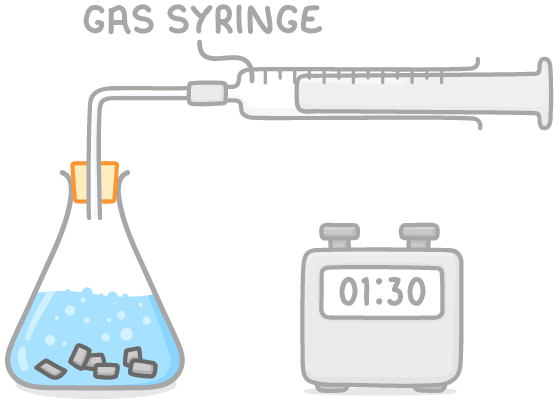
- Measuring gas volume
- If a gas is produced, it can be collected in a gas syringe.
- Record the volume of gas at regular intervals (e.g., every 15 seconds).
- Convert gas volume to moles using the ideal gas equation, then determine reactant concentration using stoichiometry.
- Measuring mass change
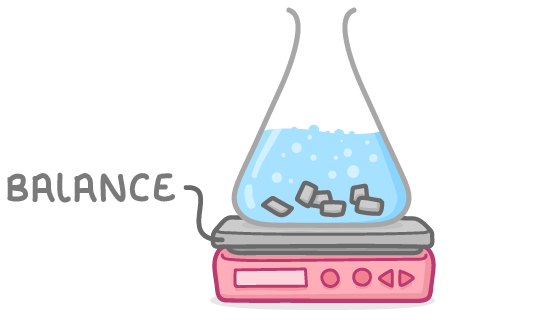
- If a gas is released, the reaction system will lose mass.
- Measure the mass at regular intervals using a balance.
- Calculate moles of gas lost and remaining reactant concentration using mole calculations.
- Tracking colour change
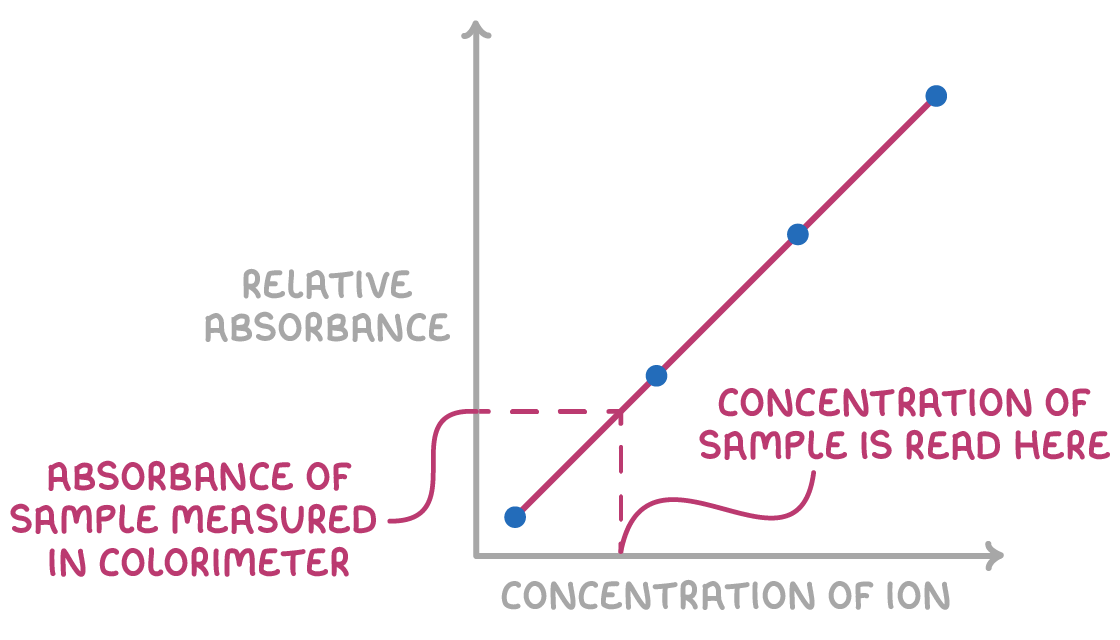
- A colorimeter measures the absorbance (light absorption) of a solution.
- More concentrated coloured solutions have higher absorbance.
- Create a calibration curve by plotting known concentrations against absorbance.
- During the reaction, measure absorbance of samples at regular intervals.
- Determine sample concentrations using the calibration curve by locating their absorbance on the y-axis and reading the corresponding concentration from the x-axis.
- Monitoring pH changes
- If H+ ions are produced or consumed, the pH of the solution will change.
- Measure pH at regular intervals and calculate [H+] using the relationship: pH = log[H+].
- Performing titrations
- Take small samples of the reaction mixture at regular intervals.
- Titrate each sample with a standard solution.
- Calculate reactant or product concentration from titration data.
- Measuring electrical conductivity
- Changes in the number of ions in solution affect electrical conductivity.
- Measure conductivity at regular intervals to track the progress of the reaction.
Rate equations relate reaction rate to reactant concentrations
A rate equation is a mathematical expression that shows how the rate of a chemical reaction depends on the concentrations of the reactants.
For a general reaction: A + B ➔ C + D
The rate equation takes the form:
Rate = k[A]m[B]n
Where:
- Rate is the reaction rate (mol dm-3 s-1).
- k is the rate constant.
- [A] and [B] are the concentrations of reactants A and B (mol dm-3).
- m and n are the orders of reaction with respect to A and B.
Reaction orders show how reactant concentrations affect the rate
The values of m and n in the rate equation are the reaction orders with respect to each reactant.
They indicate how changing the concentration of a reactant influences the reaction rate.
-
Zero order (m or n = 0) - The rate is independent of the reactant concentration. Doubling or tripling the concentration has no effect on the rate. [A]0 = 1, so zero order terms are often written without the concentration term.
-
First order (m or n = 1) - The rate is directly proportional to the reactant concentration. Doubling the concentration doubles the rate, tripling the concentration triples the rate.
-
Second order (m or n = 2) - The rate is proportional to the square of the reactant concentration. Doubling the concentration quadruples the rate (22 = 4), tripling the concentration increases the rate ninefold (32 = 9).
The overall order of the reaction is the sum of m and n.
Importantly, reaction orders can only be determined experimentally, not from balanced chemical equations.
The rate constant k relates reactant concentrations to rate at a given temperature
The rate constant, k, is a proportionality constant that relates the rate of a reaction to the concentrations of the reactants at a specific temperature.
- A larger k value indicates a faster rate of reaction.
- k remains constant for a given reaction at a fixed temperature.
- Increasing the temperature exponentially increases the value of k, as collisions between reactant molecules are more frequent and more energetic.
The units of k depend on the overall order of the reaction.
Worked example 1 - Calculating the rate of an acid-catalysed reaction
Calculate the rate of the acid-catalysed reaction between propanone and iodine, given that the reaction is first order with respect to propanone, zero order with respect to iodine, and first order with respect to H+.
CH3COCH3 + I2 ➔ CH3COCH2I + HI
The rate constant (k) at a certain temperature is 630 mol-1 dm3 s-1 and the concentrations of propanone, iodine, and H+ are each . Give your answer to 3 significant figures.
Step 1: Write the rate equation
Step 2: Substitution and correct evaluation
Thus, at this temperature, the rate of the acid-catalysed reaction between propanone and iodine is .
Worked example 2 - Calculating the rate constant for a gas-phase reaction
The following reaction is second order with respect to NO and zero order with respect to CO and O2:
NO(g) + CO(g) + O2(g) ➔ NO2(g) + CO2(g)
At a certain temperature, the reaction rate is mol dm-3 s-1, with the concentrations of NO, CO, and O2 each at mol dm-3.
Calculate the rate constant (k) for the reaction. Give your answer to 3 significant figures.
Step 1: Write the rate equation
Step 2: Rearrange rate equation
Step 3: Substitution and correct evaluation
Step 4: Determine the units of k
Given that the rate is expressed in mol dm-3 s-1 and the concentration squared in (mol dm-3)2, solving for k in the equation results in units of mol-1 dm3 s-1.
Thus, at this temperature, the rate constant is 198 mol-1 dm3 s-1 for the given gas-phase reaction.