2.1 - Structure of the Atom and Isotopes
- 1
The subatomic particles that make up atoms
- 2
How nuclear symbols represent the composition of atoms
- 3
The difference between atoms and ions
- 4
What elements and isotopes are
- 5
Comparing chemical and physical properties of isotopes
Atoms are composed of protons, neutrons and electrons
All elements and compounds are made of atoms. These atoms consist of three fundamental subatomic particles: protons, neutrons, and electrons.

Protons and neutrons, collectively called nucleons, are located in the atom's nucleus. Protons have a positive charge, while neutrons are electrically neutral. The nucleus is extremely small and dense, containing the majority of an atom's mass.
Electrons, which have a negative charge, orbit the nucleus in shells or orbitals. Although electrons occupy a large region of space around the nucleus, most of an atom's volume is actually empty space.
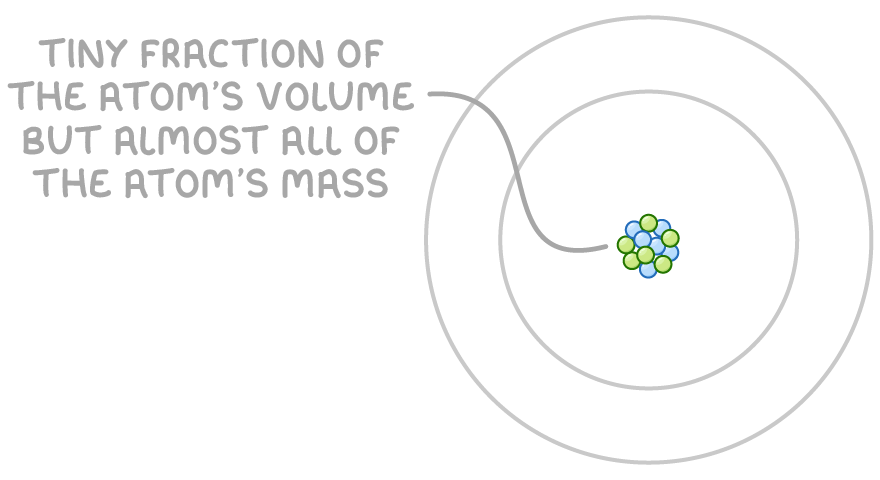
The properties of these subatomic particles are expressed using relative mass and relative charge:
| Subatomic particle | Relative mass | Relative charge |
|---|---|---|
| Proton | 1 | +1 |
| Neutron | 1 | 0 |
| Electron | 0.0005 | -1 |
Nuclear symbols represent atomic composition
Nuclear symbols provide a concise way to represent the composition of an atom. They indicate the number of protons, neutrons, and electrons in an atom using two key numbers:
- Mass number (A) - The total number of nucleons (protons and neutrons) in the nucleus.
- Atomic number (Z) - The number of protons in the nucleus, which uniquely identifies the element.
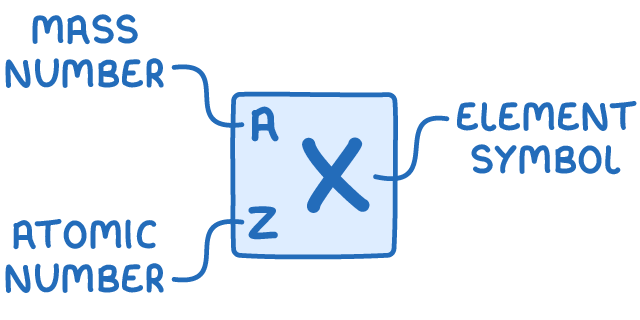
To determine the number of protons, electrons, and neutrons in a neutral atom:
- The number of protons is equal to the atomic number (Z).
- In a neutral atom, the number of electrons is equal to the number of protons.
- The number of neutrons is calculated by subtracting the atomic number (Z) from the mass number (A).
For example, let's consider the neutral atom 7Li:
- The atomic number (Z) is 3, so there are 3 protons.
- Since it is a neutral atom, the number of electrons is also 3.
- The mass number (A) is 7, so the number of neutrons is 7 - 3 = 4. Therefore, a neutral 7Li atom has 3 protons, 3 electrons, and 4 neutrons.
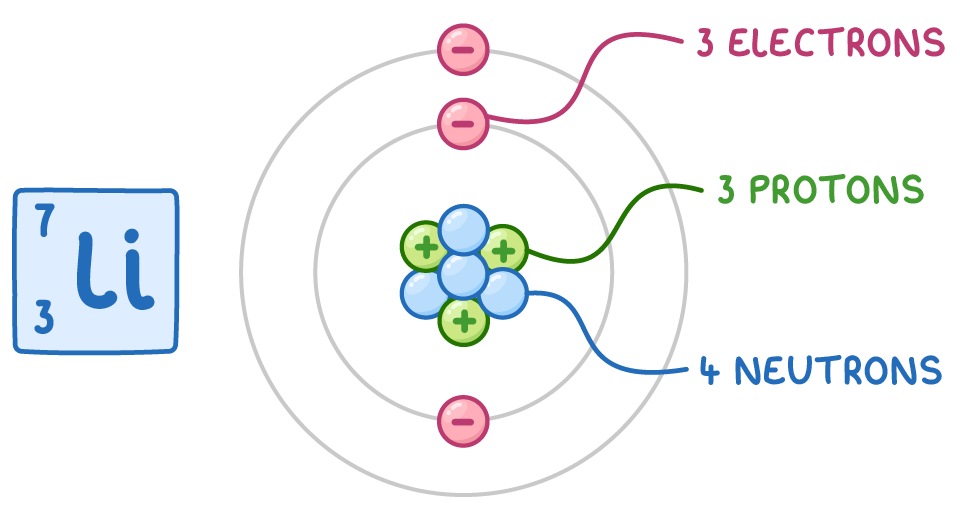
The table below provides additional examples of how to use nuclear symbols to determine the number of protons, electrons, and neutrons in various neutral atoms:
| Ion | Atomic number | Mass number | Number of protons | Number of electrons | Number of neutrons |
|---|---|---|---|---|---|
| ^19^F^-^ | 9 | 19 | 9 | 9 + 1 = 10 | 10 |
| ^24^Mg^2+^ | 12 | 24 | 12 | 12 - 2 = 10 | 12 |
| ^32^S^2-^ | 16 | 32 | 16 | 16 + 2 = 18 | 16 |
Ions have unequal numbers of protons and electrons
Ions are atoms that have gained or lost electrons, resulting in an overall positive or negative charge.
- Negative ions (anions) have more electrons than protons. For example, a particle with 1 proton and 2 electrons would be a negative ion with an overall charge of -1.
- Positive ions (cations) have fewer electrons than protons. For example, a particle with 3 protons and 2 electrons would be a positive ion with an overall charge of +1.
To determine the number of protons, electrons, and neutrons in an ion:
- The number of protons is equal to the atomic number.
- The number of electrons is calculated by subtracting the ion's charge from the atomic number (for cations) or adding the ion's charge to the atomic number (for anions).
- The number of neutrons is calculated by subtracting the atomic number from the mass number.
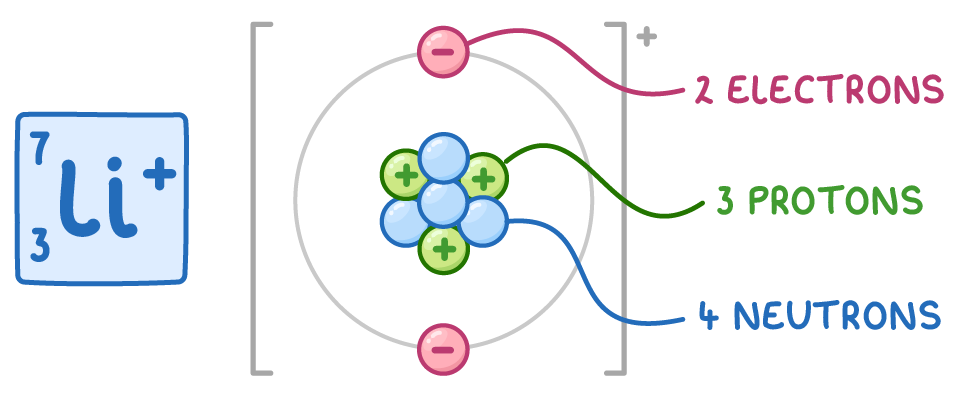
For example, in the 7Li+ ion:
- The atomic number is 3, so there are 3 protons.
- The ion has a + charge, so the number of electrons is 3 - 1 = 2.
- The mass number is 7, so the number of neutrons is 7 - 3 = 4. Therefore, a 7Li+ ion has 3 protons, 2 electrons, and 4 neutrons.
The table below provides additional examples of how to calculate the numbers of protons, neutrons, and electrons for various positive and negative ions:
| Ion | Atomic number | Mass number | Number of protons | Number of electrons | Number of neutrons |
|---|---|---|---|---|---|
| ^19^F^-^ | 9 | 19 | 9 | 9 + 1 = 10 | 10 |
| ^24^Mg^2+^ | 12 | 24 | 12 | 12 - 2 = 10 | 12 |
| ^32^S^2-^ | 16 | 32 | 16 | 16 + 2 = 18 | 16 |
Isotopes have different numbers of neutrons
Elements are defined as:
Substance made up of only one type of atom, where all the atoms of a substance have the same number of protons.
Isotopes are defined as:
Atoms of the same element that have the same number of protons but different numbers of neutrons.
Most elements are made up of a mixture of isotopes.
For example, chlorine has two main naturally occurring isotopes: 35Cl and 37Cl:
Both isotopes have the same number of protons (17) and electrons (17) but different mass numbers due to the different numbers of neutrons.

Chemical vs physical properties of isotopes
Chemical properties:
- Isotopes have the same electron configuration.
- This means they have the same chemical properties (e.g. reactivity).
Physical properties:
- Isotopes have slightly different physical properties (e.g. mass and density).
- This is because physical properties depend on atomic mass.