18.3 - Phenol
- 1
The structure of phenols
- 2
Why phenols are more reactive than benzene
- 3
Bromination of phenol
- 4
The synthesis of aspirin from salicylic acid
Phenols contain benzene rings with -OH groups
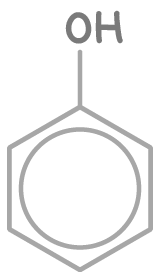
Phenol has the formula C6H5OH. The key structural feature of a phenol is an aromatic benzene ring attached to a hydroxyl (-OH) group.
Other phenolic compounds have additional substituents bonded to the benzene ring.
The skeletal formula of phenol is:
Phenol is more reactive than benzene
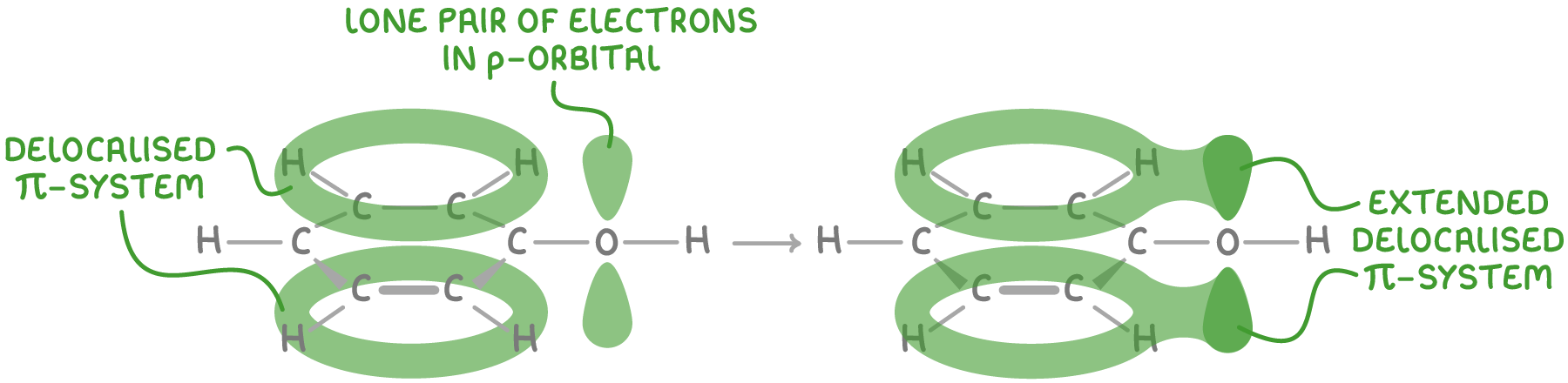
Phenol is more reactive towards electrophilic substitution than benzene because:
- The electron-donating -OH group activates the aromatic ring, making it more susceptible to electrophilic attack.
- One of the lone pairs of electrons in a p-orbital of the oxygen atom overlaps with the delocalised π system of electrons in the benzene ring.
- This allows the lone pair to partially delocalise into the aromatic π-system, increasing the electron density within the ring.
- A higher electron density makes the ring more reactive towards electrophiles.
Phenol reacts with bromine water
A classic example of phenol's increased reactivity is its reaction with bromine water. When phenol is shaken with orange bromine water, it rapidly reacts, decolourising the solution.
The high electron density of the ring, due to the -OH group, makes it very attractive to the electrophilic bromine. As a result, multiple substitutions occur, producing 2,4,6-tribromophenol.
The equation for this reaction is:
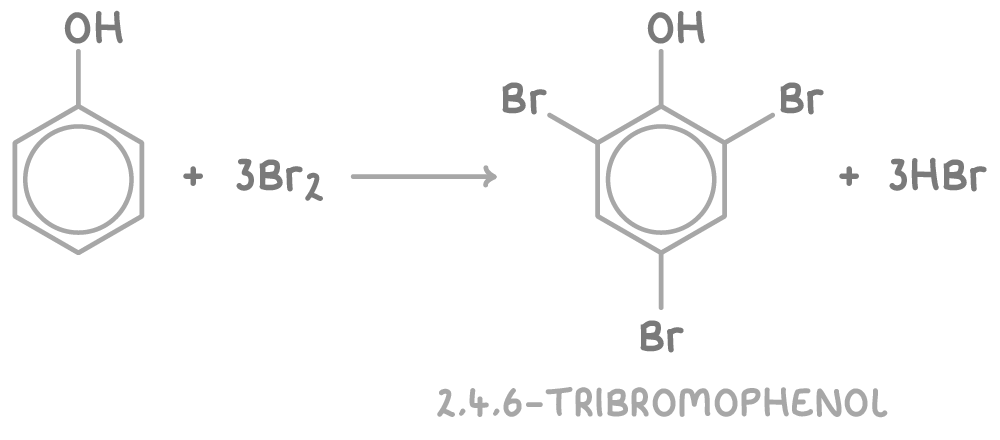
The product, 2,4,6-tribromophenol, is insoluble in water and precipitates out of the solution. The white precipitate has a characteristic antiseptic smell.
Synthesising aspirin from salicylic acid
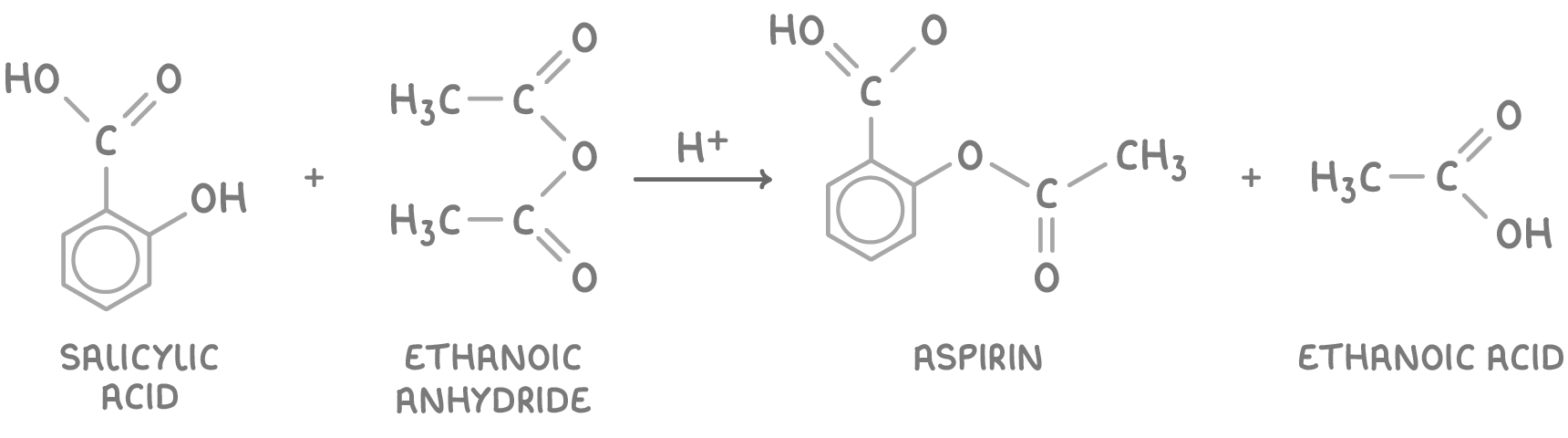
The -OH group in phenols can also participate in esterification reactions, similar to alcohols. This reaction is utilised in the synthesis of aspirin (acetylsalicylic acid) from salicylic acid, which is a phenol derivative.
The equation representing this reaction is:
To synthesise aspirin in the lab:
- In a test tube, combine salicylic acid with ethanoic anhydride and a few drops of phosphoric acid catalyst.
- Warm the reaction mixture to around 50°C and allow it to react for approximately 15 minutes.
- Quench the reaction by adding cold water to the mixture, then cool it further by placing the test tube in an ice bath. Aspirin crystals will form as the solution cools.
- Collect the aspirin crystals by vacuum filtration.
- Recrystallise the resulting aspirin in a mixed solvent of water and ethanol.
Ethanoic anhydride serves a similar purpose to an acyl chloride in this reaction but is preferred due to its lower cost and improved safety.