14.6 - Buffer Solutions and pH Curves
- 1
What buffers are
- 2
The composition and mechanism of acidic buffers
- 3
The composition and mechanism of basic buffers
- 4
Buffer solutions and titration curves
- 5
The importance of buffer solutions in biological environments
- 6
How to calculate the pH of a buffer solution
Buffers resist changes in pH
A buffer is a solution that minimises alterations in pH when small quantities of acid or base are introduced.
- Buffers do not completely prevent pH changes, but they significantly reduce them.
- Buffers are effective only for limited amounts of added acid or base. When a buffer solution's capacity is exceeded, it loses its ability to resist pH changes, and the pH will change more dramatically with further additions of acid or base.
- There are two types of buffers: acidic buffers and basic buffers.
Acidic buffers contain a weak acid and its conjugate base
Acidic buffers have a pH below 7 and are created by establishing an equilibrium between a weak acid and its conjugate base.
This can be achieved in two ways:
1. Combining a weak acid with the salt of its conjugate base
-
For example, a mixture of ethanoic acid (CH3COOH) and sodium ethanoate (CH3COONa).
-
The salt completely dissociates into its constituent ions on dissolution: CH3COONa(aq) ➔ CH3COO−(aq) + Na+(aq)
-
The weak acid undergoes only partial dissociation: CH3COOH(aq) ⇌ H+(aq) + CH3COO−(aq)
2. Mixing an excess of weak acid with a strong alkali
-
For instance, combining excess ethanoic acid (CH3COOH) with sodium hydroxide (NaOH).
-
The base reacts completely with the acid: CH3COOH(aq) + OH−(aq) ➔ CH3COO−(aq) + H2O(l)
-
Due to the excess of weak acid, some remains in the solution after the base is fully consumed. This remaining acid partially dissociates: CH3COOH(aq) ⇌ H+(aq) + CH3COO−(aq)
In both scenarios, an equilibrium is established between the weak acid and its conjugate base:
CH3COOH(aq) ⇌ H+(aq) + CH3COO−(aq)
The equilibrium solution contains:
- A large amount of undissociated acid (CH3COOH).
- A large amount of the acid's conjugate base (CH3COO-).
- Sufficient H+ ions to make the solution acidic.
How conjugate acid-base pairs stabilise pH
In a buffer system, the conjugate acid-base pair plays a crucial role in regulating the pH by neutralising excess H+ or OH- ions. Let's examine how this works using the example of the CH3COOH ⇌ H+(aq) + CH3COO-(aq) buffer system.
Neutralising additional H+ ions
When a small amount of acid is added to the buffer:
-
The H+ concentration increases.
-
The majority of these additional H+ ions react with CH3COO- to form CH3COOH.
-
This shifts the equilibrium to the left: CH3COOH(aq) ⇌ H+(aq) + CH3COO-(aq)
-
The shift in equilibrium reduces the H+ concentration back towards its initial value.
-
As a result, the pH change is minimal.
Neutralising additional OH- ions
Conversely, when a small amount of base (e.g., NaOH) is added to the buffer:
-
The OH- concentration rises.
-
Most of these extra OH- ions react with H+ to form water: OH-(aq) + H+(aq) ➔ H2O(l)
-
This reaction lowers the H+ concentration.
-
To compensate, more CH3COOH dissociates to replenish the H+: CH3COOH(aq) ⇌ H+(aq) + CH3COO-(aq)
-
This shifts the equilibrium to the right.
-
The H+ concentration rises back towards its starting value.
-
Consequently, the pH change is small.
Basic buffers contain a weak base and its conjugate acid
Basic buffers, characterised by a pH greater than 7, are created by mixing a weak base with the salt of its conjugate acid. A common example is a solution of ammonia (NH3, a weak base) and ammonium chloride (NH4Cl, a salt of ammonia).
In this solution, the salt fully dissociates:
NH4Cl(aq) ➔ NH4+(aq) + Cl-(aq)
Additionally, some of the ammonia molecules react with water:
NH3(aq) + H2O(l) ⇌ NH4+(aq) + OH-(aq)
As a result, the solution contains a large amount of ammonium ions (NH4+) and ammonia molecules (NH3).
The equilibrium position of this reaction shifts in response to changes in pH:
- When a small amount of base is added, the OH- concentration increases. Most of the extra OH- ions react with NH4+ ions to form NH3 and H2O, shifting the equilibrium to the left and removing OH- ions from the solution. This minimises the change in pH.
- When a small amount of acid is added, the H+ concentration increases. Some of the H+ ions react with OH- ions to form H2O, causing the equilibrium to shift to the right to replace the consumed OH- ions. Additionally, some H+ ions react with NH3 molecules to form NH4+. These reactions remove most of the added H+ ions, minimising the change in pH.
Formation of buffers during titrations
Buffer solutions can form during titrations involving a weak acid and a strong base, or a strong acid and a weak base. As the titration progresses, the salt of the weak acid or base accumulates in the reaction mixture, acting as a buffer and resisting changes in pH.
Consider the example of titrating a weak acid, ethanoic acid, with a strong base, sodium hydroxide:
CH3COOH(aq) + NaOH(aq) ➔ CH3COONa(aq) + H2O(l)
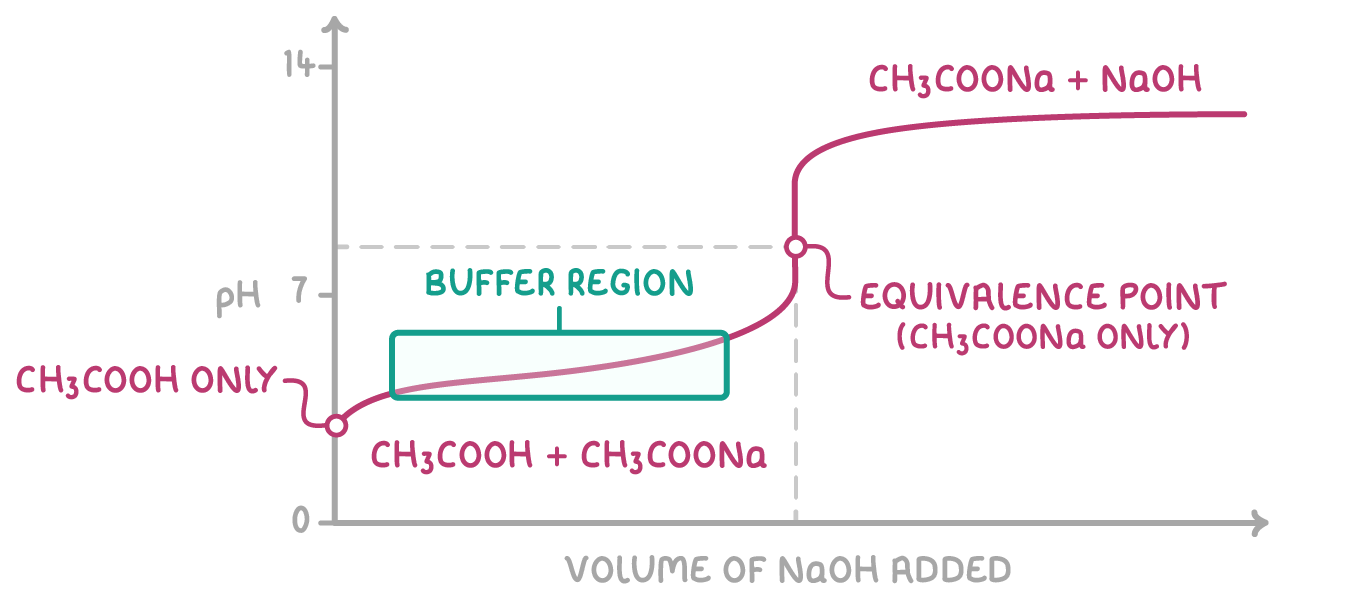
The formation of buffer solutions results in the characteristic shape of the titration curve, which can be divided into three distinct regions:
- Initial rapid change:
- At the start of the titration, the pH changes quickly as sodium hydroxide is added.
- This rapid change is due to the high concentration of OH- ions reacting with H+ ions from ethanoic acid.
- Buffer region:
- As the titration continues, the curve levels off, showing a more gradual pH change.
- This occurs because a buffer solution forms, consisting of ethanoic acid and its conjugate base, sodium ethanoate.
- The buffer solution resists changes in pH, resulting in a more stable pH during this region.
- Equivalence point:
- Eventually, all the ethanoic acid is neutralised, marking the equivalence point.
- This point is characterised by a steep rise in pH.
- After the equivalence point, any excess sodium hydroxide added causes another rapid increase in pH.
To identify the buffer region on a titration curve, look for the portion of the curve where the pH remains relatively stable despite the continued addition of the titrant. This buffering effect is most pronounced in the middle part of the titration, where significant amounts of both the weak acid (or base) and its salt are present in the reaction mixture.
The importance of buffer solutions in blood
Buffer solutions, particularly the carbonic acid-hydrogen carbonate buffer system, play a crucial role in regulating blood pH within the narrow range of 7.35 to 7.45, which is essential for optimal health.
The main equilibrium reaction in this system is:
H2CO3(aq) ⇌ H+(aq) + HCO3-(aq)
The body maintains this equilibrium and stabilises blood pH through two primary mechanisms: regulation of carbonic acid (H2CO3) levels through respiration and regulation of hydrogen carbonate ions (HCO3-) levels by the kidneys.
Regulation of carbonic acid levels through respiration
The levels of carbonic acid (H2CO3) in the blood are primarily controlled by respiration.
When the body produces excess carbon dioxide (CO2), it reacts with water to form carbonic acid:
CO2(aq) + H2O(l) ⇌ H2CO3(aq)
To reduce the concentration of carbonic acid, the body can exhale CO2 through the lungs. As CO2 is removed from the system, the equilibrium shifts to the left, favouring the decomposition of carbonic acid into carbon dioxide and water. This process helps to lower the overall carbonic acid levels in the blood.
Regulation of hydrogen carbonate levels by the kidneys
The levels of hydrogen carbonate ions (HCO3-) in the blood are regulated by the kidneys. When there is an excess of hydrogen carbonate ions, the kidneys filter them out of the blood and excrete them in the urine.
This removal of hydrogen carbonate ions helps to maintain the equilibrium of the buffer system and prevent the blood pH from becoming too basic.
The importance of buffer solutions in food
Buffer solutions are crucial in food preservation by maintaining a stable pH, which prevents deterioration due to bacterial or fungal activity. Most microorganisms thrive in pH ranges close to neutral (pH 6.6 - 7.5), so buffers that maintain food pH outside this range inhibit microbial growth.
The buffer capacity of food is directly related to its protein content:
- Higher protein content means a higher amino acid content.
- Amino acids have both acidic and basic properties and can neutralise small amounts of added acids or bases.
- Thus, foods with higher protein content have higher buffer capacities.
As a result, foods with higher buffer capacities are more resistant to pH changes, slowing the rate at which bacteria can alter the food's pH. This results in longer shelf lives and better stability against spoilage.
Calculating the pH of a buffer solution
To calculate the pH of an acidic buffer, you need to know the Ka of the weak acid and the concentrations of the weak acid and its salt.
The calculation requires the following assumptions:
- The salt of the conjugate base is fully dissociated, so assume that the equilibrium concentration of A- is equal to the initial concentration of the salt.
- HA is only slightly dissociated, so assume that its equilibrium concentration is equal to its initial concentration.
Here's an example of how to calculate the pH of a buffer solution.
Worked example 1 - Calculating the pH of a buffer solutionA buffer solution is made by adding 0.50 mol of ethanoic acid (CH3COOH) and 0.50 mol of sodium ethanoate (CH3COONa) to enough water to make 1.0 dm3 of solution. The Ka for ethanoic acid is 1.8 × 10⁻⁵ mol dm-3.
Calculate the pH of this buffer. Give your answer to 2 decimal places.
Step 1: Ka equation
Step 2: Rearrange Ka equation
Step 3: Calculate [H+]
Since [CH3COOH] = [CH3COO-], the Ka equation simplifies to:
[H+] = Ka = 1.8 x 10⁻⁵ mol dm-3
Step 4: Calculate pH
Therefore, the pH of the buffer solution is 4.74.
You can also calculate the pH of a buffer solution using the Henderson-Hasselbalch equation as shown in the following sections.
The Henderson-Hasselbalch equation
The pH of a buffer depends on:
- The ratio of the conjugate acid and base concentrations - A higher proportion of base to acid gives a higher pH.
- The acid dissociation constant (Ka) - A larger Ka (smaller pKa) means the acid dissociates more, giving a lower pH.
The Henderson-Hasselbalch equation quantifies this relationship:
Where:
- pKa = of the weak acid.
- [A-] = concentration of conjugate base.
- [HA] = concentration of conjugate acid.
The Henderson-Hasselbalch equation allows us to calculate the pH of a buffer if the composition is known.
Worked example 2 - Calculating buffer pH
Calculate the pH of an ethanoate buffer containing 0.150 mol dm^-3^ ethanoic acid (CH3COOH) and 0.250 mol dm^-3^ sodium ethanoate (CH3COONa) at 25°C. The pKa of ethanoic acid at 25°C is 4.76. Give your answer to 2 decimal places.
Step 1: Equation
Step 2: Substitution and correct evaluation
The higher concentration of conjugate base CH_3_COO^-^ compared to CH_3_COOH gives a pH slightly above the pK_a_.
Worked example 3 - Calculating the concentration of ethanoic acid in a buffer
A buffer is made using ethanoic acid (CH_3_COOH) and a 1.50 mol dm-3 solution of sodium ethanoate (CH_3_COONa).
Calculate the concentration of ethanoic acid required so that the buffer has a pH of 5.05. Give your answer to 3 significant figures.
Ka of ethanoic acid = 1.75 × 10⁻⁵ mol dm-3.
Step 1: Calculate pKa of ethanoic acid
pKa = log10Ka = log10(1.75 x 10⁻⁵) = 4.76
Step 2: Equation
Step 3: Rearrange equation
Step 4: Substitution and correct evaluation