3.6 - Non-polar and Polar Molecules
- 1
The concept of molecular polarity
- 2
How molecular shape influences polarity
- 3
Examples of polar and non-polar molecules with different geometries
Understanding molecular polarity
Molecular polarity is a key concept in chemistry that involves how electrical charges are distributed within a molecule.
To understand polarity, we need to consider two key factors:
- Electronegativity differences between bonded atoms
- Molecular geometry
When atoms with differing electronegativities form a bond, the electrons are not shared equally. This uneven sharing of electrons results in a bond dipole - a slight separation of positive and negative charges. The overall polarity of a molecule is determined by how these individual bond dipoles interact, which depends on the shape of the molecule.
Bond dipoles and molecular polarity
A dipole forms when there is a separation of charge within a molecule. We use the symbol → to represent dipoles, with the arrow pointing towards the more electronegative atom.
For example, in hydrogen chloride (HCl):
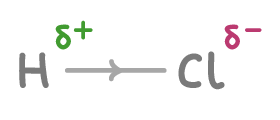
Here, the δ (delta) symbol signifies a partial charge, with δ+ representing a slightly positive charge and δ- indicating a slightly negative charge.
Whether a molecule is polar overall depends on:
- The presence of polar bonds.
- The arrangement of these bonds in space (molecular geometry).
Molecular geometry and polarity
Let's examine how different molecular shapes influence overall polarity:
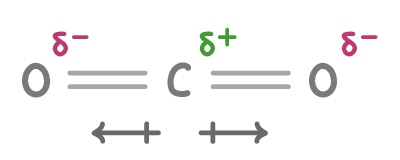
- Linear molecules e.g. CO2 Carbon dioxide (CO2) has two polar C=O bonds, but because of its linear geometry, these dipoles cancel each other out:
Result: CO2 is non-polar.
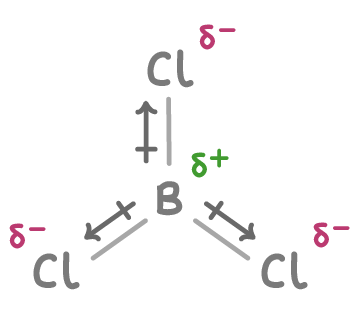
- Trigonal planar molecules e.g. BCl3
Boron trichloride (BCl3) has three polar B-Cl bonds that are arranged symmetrically in a plane. These dipoles cancel each other out due to symmetry.
Result: BCl3 is non-polar.
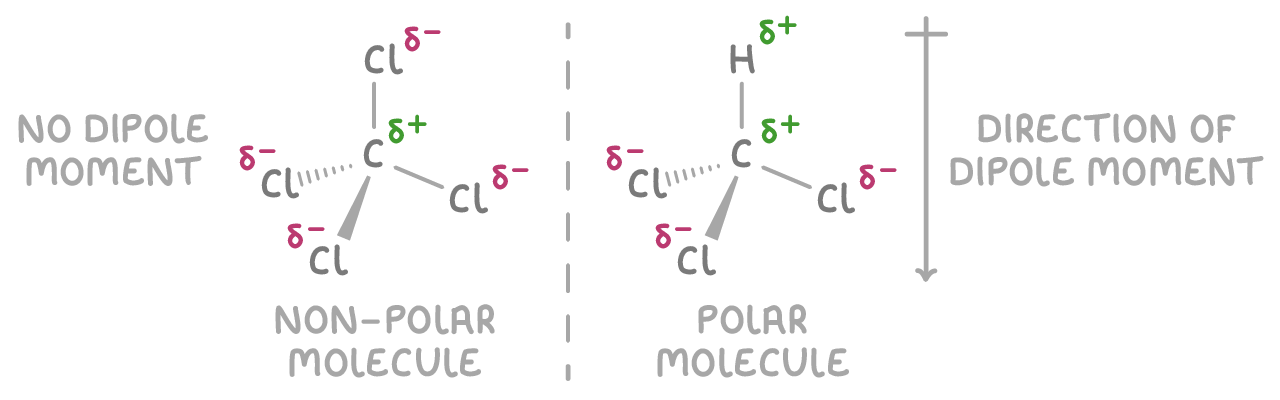
- Tetrahedral molecules e.g. CCl4 and CHCl3
-
Carbon tetrachloride (CCl4) has four polar C-Cl bonds that are arranged symmetrically in a tetrahedral shape. The dipoles cancel each other out. Result: CCl4 is non-polar.
-
Trichloromethane (CHCl3) has three polar C-Cl bonds and one non-polar C-H bond in a tetrahedral arrangement. The dipoles do not cancel out completely. Result: CHCl3 is polar.
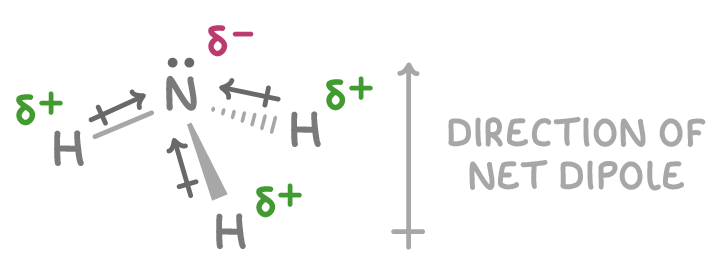
- Trigonal pyramidal molecules e.g. NH3
Ammonia (NH3) has three polar N-H bonds arranged in a pyramidal structure. The dipoles reinforce each other due to the non-symmetrical geometry.
Result: NH3 is polar.
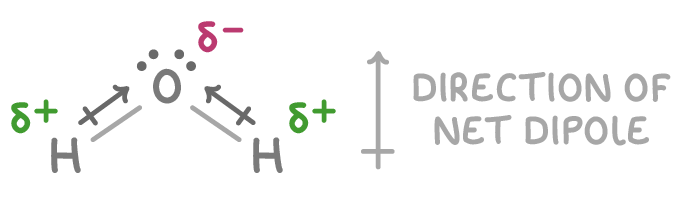
- Bent molecules e.g. H2O
Water (H2O) has two polar O-H bonds arranged in a bent shape. The dipoles reinforce each other due to the non-symmetrical geometry.
Result: H2O is polar.
Predicting molecular polarity
To determine whether a molecule is polar:
- Identify polar bonds - Look for bonds with a significant electronegativity difference between the atoms.
- Determine the molecule's 3D shape - Consider the geometry to understand how the bonds are arranged.
- Analyse how the bond dipoles combine - If the dipoles cancel each other out completely, the molecule is non-polar. If the dipoles do not cancel, the molecule is polar.