7.1 - Intermolecular Interactions
- 1
The types of intermolecular force
- 2
London (dispersion) forces
- 3
Permanent dipole-dipole forces
- 4
Hydrogen bonding
Intermolecular forces are weak attractions between molecules
Intermolecular forces are weak attractions between molecules. These forces are much weaker than the covalent bonds that hold atoms together within molecules. The nature of the intermolecular force that exists between molecules is determined by the size and polarity of the molecules.
There are four types of intermolecular force, listed in order of increasing strength:
- London (dispersion) forces.
- Dipole-induced dipole forces.
- Dipole-dipole forces.
- Hydrogen bonding. The term "van der Waals' forces" is an inclusive term that encompasses London (dispersion) forces, dipole-induced dipole forces, and dipole-dipole forces.
The key characteristics of these four types of intermolecular force are summarised in the table below:
| Name of intermolecular force | Strength | Where does it occur? |
|---|---|---|
| London (dispersion) forces | Weak | Between all molecules and noble gases |
| Dipole-induced dipole forces | Weak | Between polar and non-polar molecules |
| Dipole-dipole forces | Moderate | Between polar molecules |
| Hydrogen bonding | Strong | Between polar molecules with H-F, H-O or H-N bonds |
London (dispersion) forces occur between all molecules
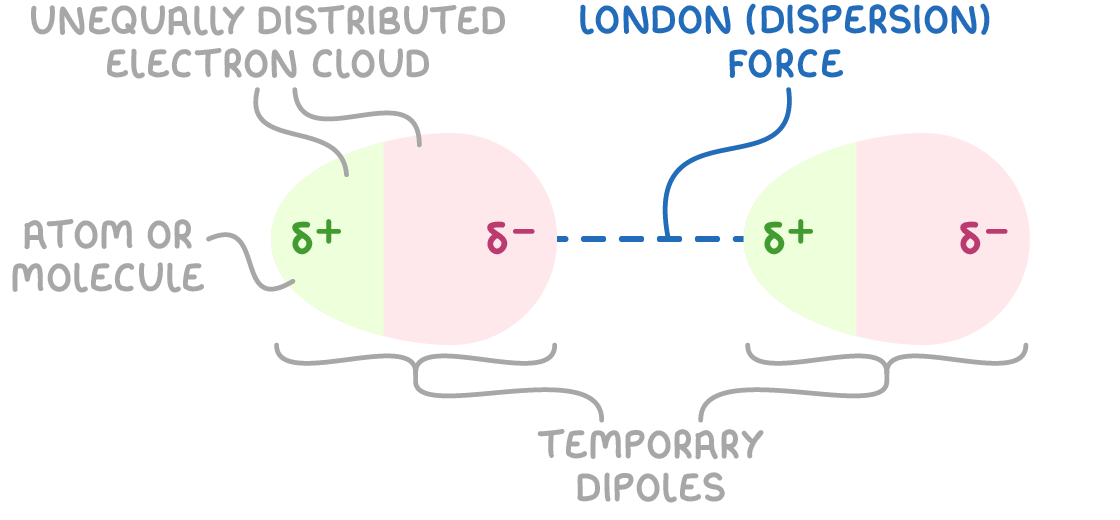
London (dispersion) forces, also known as induced dipole-induced dipole forces, are present between all atoms and molecules, even non-polar ones. They arise due to temporary fluctuations in the electron distribution around atoms:
How London (dispersion) forces arise
- Electrons in atoms are constantly moving. At any instant, there may be more electrons on one side of the atom than the other, creating a temporary dipole.
- This temporary dipole can induce an opposite dipole in a neighbouring atom, causing a weak electrostatic attraction between the atoms.
- This induced dipole can then induce further dipoles in other nearby particles.
- Although these dipoles are constantly forming and disappearing as the electrons move, the overall effect is a net attraction between the atoms or molecules.
Polar molecules experience permanent dipole-dipole forces
Polar molecules have permanent dipoles arising from unequal sharing of electrons in covalent bonds. The partial positive (δ+) and partial negative (δ-) charges on polar molecules enable them to experience permanent dipole-dipole forces.
How permanent dipole-dipole forces arise
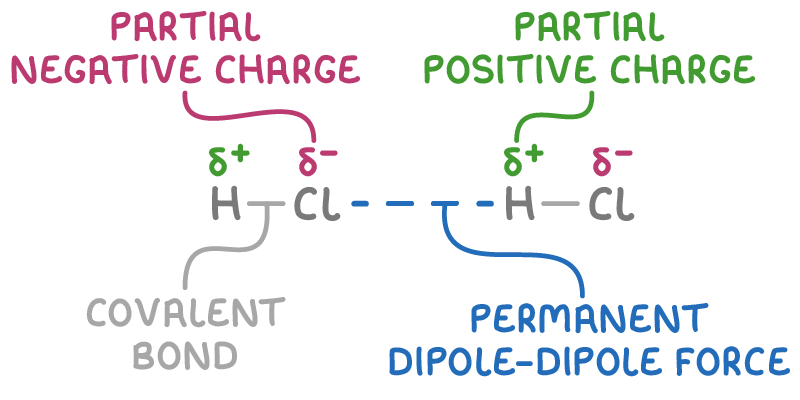
Permanent dipole-dipole forces are electrostatic attractions between the partial positive end of one polar molecule and the partial negative end of another.
For example, in gaseous hydrogen chloride (HCl):
- The H-Cl bond is polar due to the greater electronegativity of chlorine compared to hydrogen.
- The hydrogen atom bears a partial positive charge (δ+) and the chlorine a partial negative charge (δ-).
- HCl molecules align so the δ+ hydrogen of one molecule is attracted to the δ- chlorine of a neighbouring molecule.
Hydrogen bonding is the strongest type of intermolecular force
Hydrogen bonding is a special type of (permanent) dipole-dipole force that occurs when hydrogen is bonded to the highly electronegative elements fluorine, oxygen or nitrogen.
Requirements for hydrogen bonding
For hydrogen bonding to occur, two criteria must be met:
- The molecule must contain a hydrogen atom covalently bonded to either fluorine (F), oxygen (O), or nitrogen (N).
- There must be a lone pair of electrons on the F, O, or N atom of an adjacent molecule available to interact with the hydrogen.
How hydrogen bonds form
- The H-F, H-O, and H-N bonds are highly polar due to the large electronegativity differences between hydrogen and these elements. This leads to a significant partial positive charge (δ+) on the hydrogen atom and a partial negative charge (δ-) on the F, O, or N atom.
- The small size of the hydrogen atom allows it to get close to the lone pair of electrons on an adjacent F, O, or N atom.
- The lone pairs on F, O, and N atoms are regions of high electron density and therefore high partial negative charge.
- The positively charged hydrogen is strongly attracted to the negatively charged lone pair, forming a hydrogen bond between the molecules.
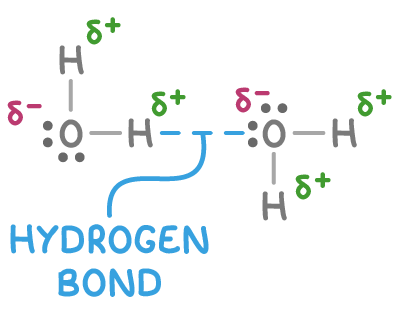
Hydrogen bonding occurs in molecules containing N-H, O-H and H-F bonds, such as water (H2O), ammonia (NH3) and hydrogen fluoride (HF).