5.2 - Geometric Isomerism
- 1
Why double bonds restrict rotation in alkenes
- 2
Definition of stereoisomers
- 3
E-Z geometric isomerism in alkenes
- 4
Assigning E-Z configuration using Cahn-Ingold-Prelog rules
- 5
When E-Z geometric isomers can also be called cis-trans
Double bonds restrict rotation in alkenes
Alkenes are characterised by the presence of carbon-carbon double bonds, which significantly influence their molecular structure:
- The atoms connected to each of the doubly bonded carbons are positioned in the same plane as these carbon atoms. This planar arrangement results from the sideways overlap of p orbitals, which forms the π bond.
- Around the carbon-carbon double bonds, rotation is restricted due to the stable overlapping of the p orbitals that form the π bond.
- It's important to note that while double bonds restrict rotation, single bonds in the molecule can still rotate freely.
Stereoisomers have different spatial arrangements of atoms.
Stereoisomers are compounds that have the same molecular formula and connectivity but differ in their three-dimensional arrangement of atoms.
There are two sub-categories of stereoisomerism:
- Geometric isomerism.
- Optical isomerism. This lesson will focus solely on geometric isomerism, which typically occurs in alkenes where each of the carbon atoms in the double bond has two different groups attached.
For example, the geometric isomers of but-2-ene are shown below:
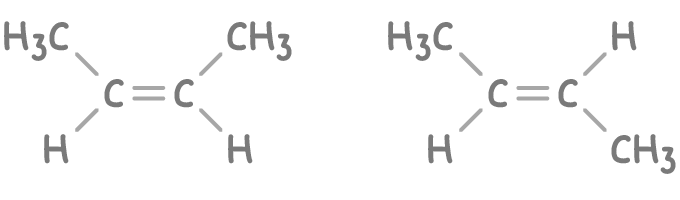
The E-Z system classifies geometric isomers in alkenes
Alkene geometric isomers can be classified into two types:
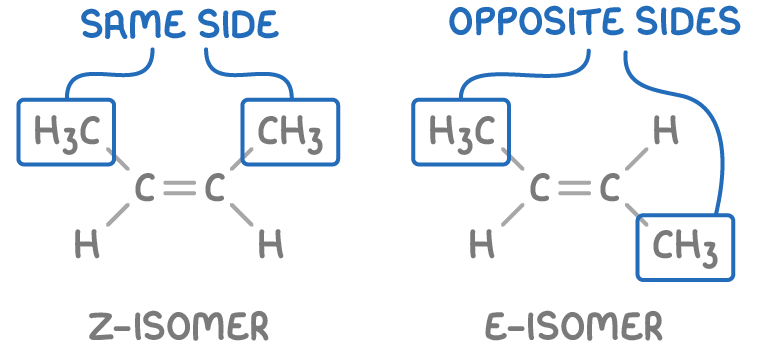
- Z-isomer - Groups of interest are on the same side of the double bond.
- E-isomer - Groups of interest are positioned across from each other on opposite sides of the double bond.
Explanation:
- "Z" stands for Zusammen, a German word meaning “together”.
- "E" stands for Entgegen, a German word meaning “opposite”.
The Z- and E- geometric isomers of but-2-ene are shown below:
Worked example 1 - Assigning E-Z configurations
Assign an E-Z configuration to the stereoisomer of 1-bromo-2-chloroethene shown below.
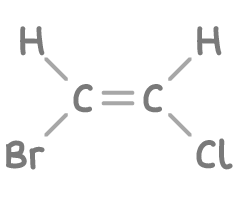
Step 1: Priority ranking
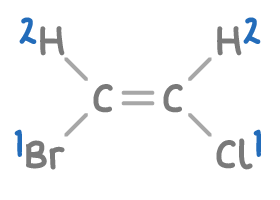
- On the left side of the double bond, compare the Br atom with the H atom. Bromine (Br) has a higher atomic number than hydrogen (H), so Br gets higher priority.
- On the right side of the double bond, compare the Cl atom with the H atom. Chlorine (Cl) has a higher atomic number than hydrogen (H), so Cl gets higher priority.
Step 2: Assign E-Z configuration
- With Br and Cl as the highest priority groups, we check their positions.
- Since the high-priority groups (Br and Cl) are on the same side of the double bond, this molecule is assigned the Z-configuration.
Worked example 2 - Assigning E-Z configurations
Assign an E-Z configuration to the stereoisomer of 1-bromo-1-fluoro-2-methylbut-1-ene shown below.
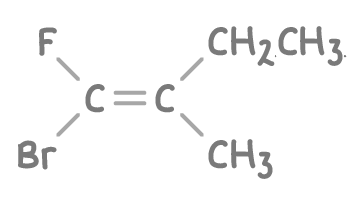
Step 1: Priority ranking
- On the left side of the double bond, compare the Br atom with the F atom. Bromine (Br) has a higher atomic number than fluorine (F), so Br gets higher priority.
- On the right side of the double bond, compare the methyl (CH3) group with the ethyl (CH2CH3) group. The methyl carbon is attached only to hydrogen atoms whereas the ethyl carbon is bonded to another carbon. Carbon (C) has a higher atomic number than hydrogen (H), so CH2CH3 gets higher priority.
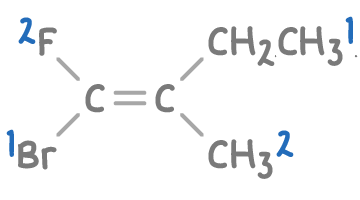
Step 2: Assign E-Z configuration
- With Br and CH2CH3 as the highest priority groups, we check their positions.
- Since the high-priority groups (Br and CH2CH3) are on opposite sides of the double bond, this molecule is assigned the E-configuration.
The cis-trans system applies when groups are identical
The cis-trans naming system is an alternative to the E-Z system for E-Z stereoisomers, applicable when at least one of the groups attached to the double-bonded carbons is identical.
- Cis - Identical groups are on the same side.
- Trans - Identical groups are on opposite sides.
Thus, Z-but-2-ene equates to cis-but-2-ene, and E-but-2-ene to trans-but-2-ene.
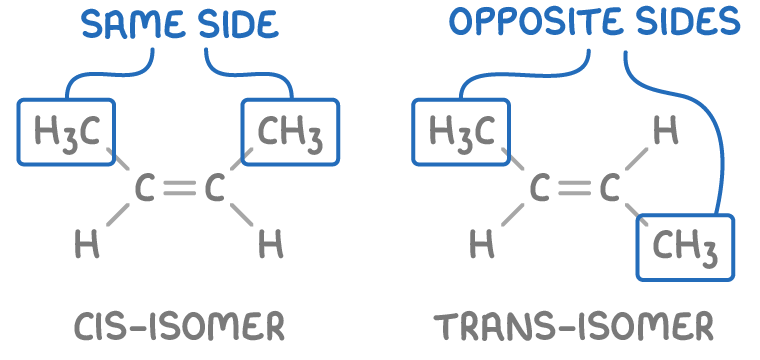
Note: The cis/trans system is not applicable when the groups attached to the double-bonded carbons are completely different.