19.2 - Reactions of Amines
- 1
Reaction of amines with halogenoalkanes
- 2
Reaction of amines with ethanonyl chloride
- 3
Reaction of amines with copper(II) ions
- 4
How phenylamine is used to synthesise azo dyes
Reacting halogenoalkanes with amines
Amines can be produced by reacting a halogenoalkane with primary amines, secondary amines, or tertiary amines in a nucleophilic substitution reaction.
- Reaction with primary amines to form secondary amines: Secondary amines can be produced by reacting a halogenoalkane with a primary amine.
For example, bromoethane reacts with butylamine to give N-ethylbutylamine:
C2H5Br + CH3(CH2)3NH2 ➔ C2H5NH(CH2)3CH3 + HBr
Excess butylamine reacts with the HBr byproduct, forming butylammonium bromide.
Phenylamine reacts with bromoethane via a similar nucleophilic substitution mechanism to form N-ethylphenylamine:
C2H5Br + C6H5NH2 ➔ C2H5NHC6H5 + HBr
- Reaction with secondary amines to form tertiary amines:
Tertiary amines can be produced by reacting a halogenoalkane with a secondary amine.
For example, bromoethane reacts with N-ethylbutylamine to give N,N-diethylbutylamine:
C2H5Br + C2H5NH(CH2)3CH3 ➔ (C2H5)2N(CH2)3CH3 + HBr
Similarly, bromoethane reacts with N-ethylphenylamine to form N,N-diethylphenylamine:
C2H5Br + C2H5NHC6H5 ➔ (C2H5)2NC6H5 + HBr
- Reaction with tertiary amines to form quaternary ammonium salts:
Quaternary ammonium salts can be produced by reacting a halogenoalkane with a tertiary amine.
For example, bromoethane reacts with N,N-diethylbutylamine: to give N,N,N-triethylbutylammonium bromide:
C2H5Br + (C2H5)2N(CH2)3CH3 ➔ (C2H5)3N(CH2)3CH3+Br-
Similarly, bromoethane reacts with N,N-diethylphenylamine to form N,N,N-triethylphenylammonium bromide:
C2H5Br + (C2H5)2NC6H5 ➔ (C2H5)3NC6H5+Br-
Reacting ethanoyl chloride with amines
The reaction between ethanoyl chloride and primary amines produces secondary amides, also known as N-substituted amides.
For example, ethanoyl chloride reacts with butylamine to give N-butylethanamide and HCl:
CH3COCl + CH3(CH2)3NH2 ➔ CH3CONH(CH2)3CH3 + HCl
Similarly, ethanoyl chloride reacts with phenylamine to give N-phenylethanamide and HCl:
CH3COCl + C6H5NH2 ➔ CH3CONHC6H5 + HCl
In these reactions, the HCl produced typically reacts with any excess amine to form ammonium salts.
Amines form complex ions with copper(II) ions
Amines can act as ligands by using their lone pair to form dative covalent bonds with metal ions like Cu2+. This results in the formation of complex ions with distinct colours.
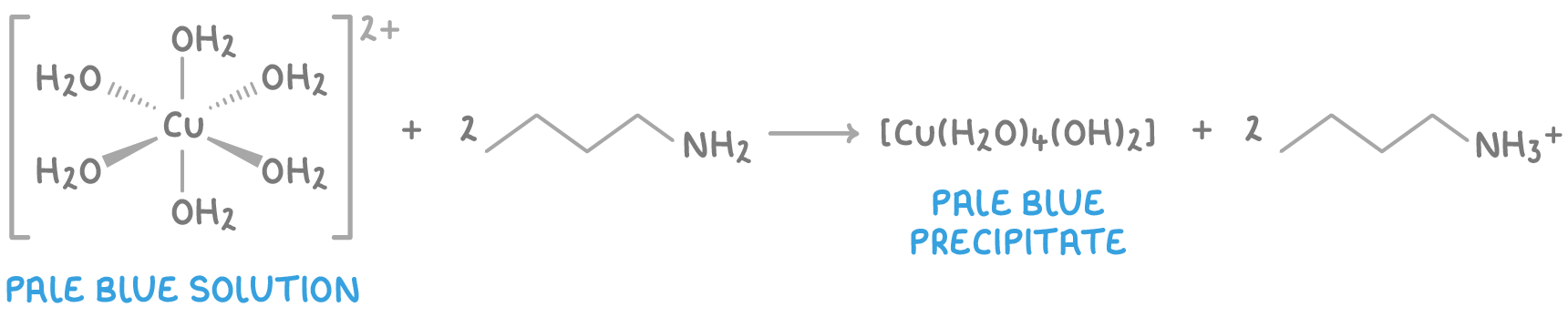
The reaction of butylamine with copper(II) sulfate solution occurs in two stages:
- At low concentrations of butylamine, a pale blue precipitate of copper(II) hydroxide forms as the amine deprotonates the [Cu(H2O)6]2+ complex:
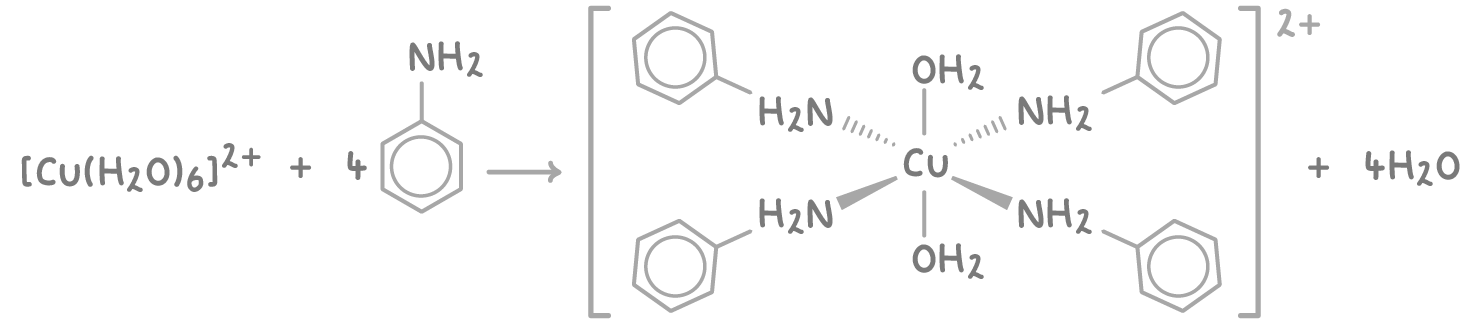
- In excess butylamine, the precipitate dissolves, forming a deep blue solution containing [Cu(CH3(CH2)3NH2)4(H2O)2]2+ as the amine ligands replace the water:

The overall reaction of excess phenylamine with copper(II) sulfate solution is:
Using phenylamine to make azo dyes
Phenylamine is an important starting material for producing brightly coloured dyes called azo dyes.
Azo dye synthesis involves two steps:
- Diazotisation of phenylamine into a benzenediazonium ion.
- Coupling reaction with a phenolate ion to form the dye.
Step 1 - Diazotisation
Initially, nitrous acid (HNO2) is produced in situ by reacting sodium nitrite with dilute HCl at temperatures below 10°C:
NaNO2(s) + HCl(aq) ➔ HNO2(aq) + NaCl(aq)
Subsequently, nitrous acid reacts with phenylamine in an electrophilic substitution to form a diazonium salt, specifically benzenediazonium chloride:
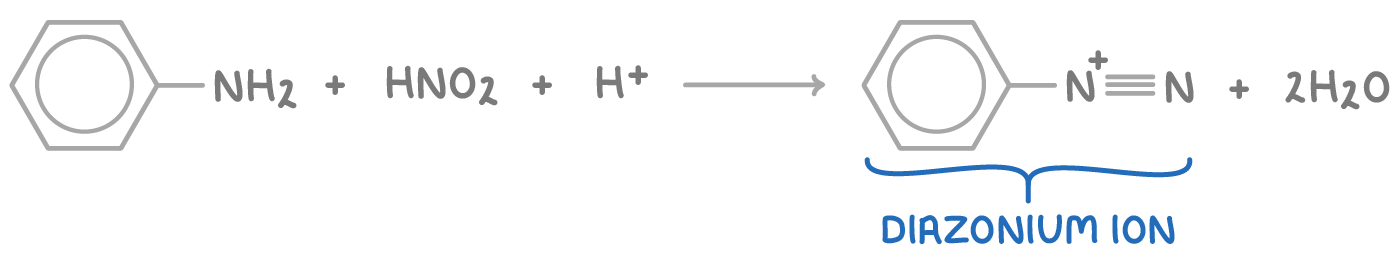
Nitrous acid is generated in situ because it is unstable, and this method allows for better control over the reaction rate and temperature, which must be kept below 10°C to prevent the decomposition of the unstable diazonium ion.
Step 2 - Coupling reaction
Next, the diazonium ion undergoes electrophilic substitution with phenol under alkaline conditions.
This produces an orange azo dye:
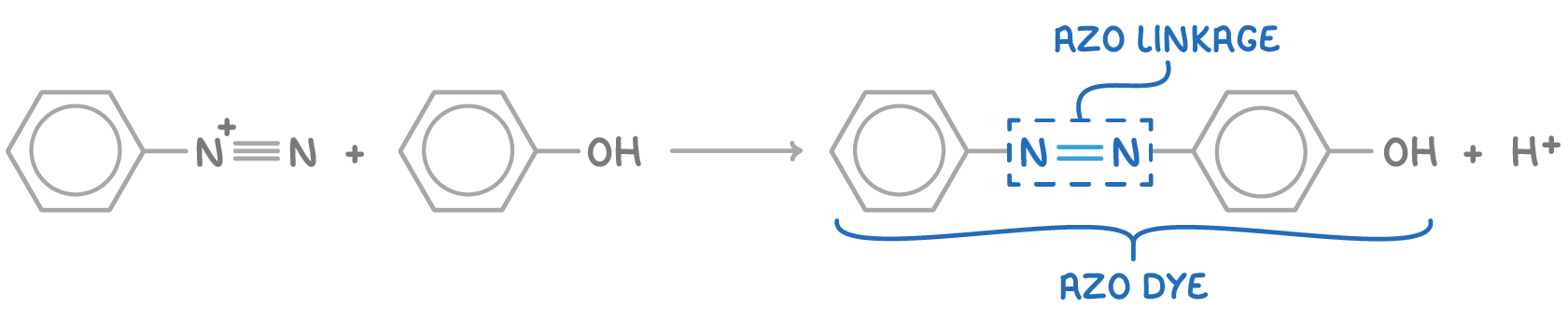
The distinctive feature of azo dyes is the azo linkage (N=N) that connects two aromatic rings. These dyes are characterised by their brightly coloured appearance and stability, which are a result of the extended delocalised π-system spanning the two aromatic rings and the azo linkage. Additionally, by using different aryl compounds in place of phenol, dyes of various colours can be synthesised.