18.1 - Benzene: A Molecule with Two Models
- 1
The structure and bonding in benzene
- 2
The delocalised model of benzene
- 3
Evidence supporting the delocalised model
- 4
Naming aromatic compounds
- 5
Differences in reactivity between benzene and alkenes
Benzene has a planar ring structure
Arenes are aromatic hydrocarbons that contain a benzene ring. Benzene is the simplest arene and has a planar ring structure. Benzene, with the molecular formula C6H6, is composed of a hexagonal ring that includes six carbon atoms.
Each of these carbon atoms is bonded to the following:
- One hydrogen atom.
- Two other carbon atoms adjacent to it within the ring.
To depict benzene's structure, there are two primary models:

- The Kekulé model - This represents the structure with alternating single and double bonds.
- The delocalised model - This shows a ring of electrons that are delocalised.
How the delocalised model is formed
The delocalised model arises from overlap of the p-orbitals on the six carbon atoms in benzene:
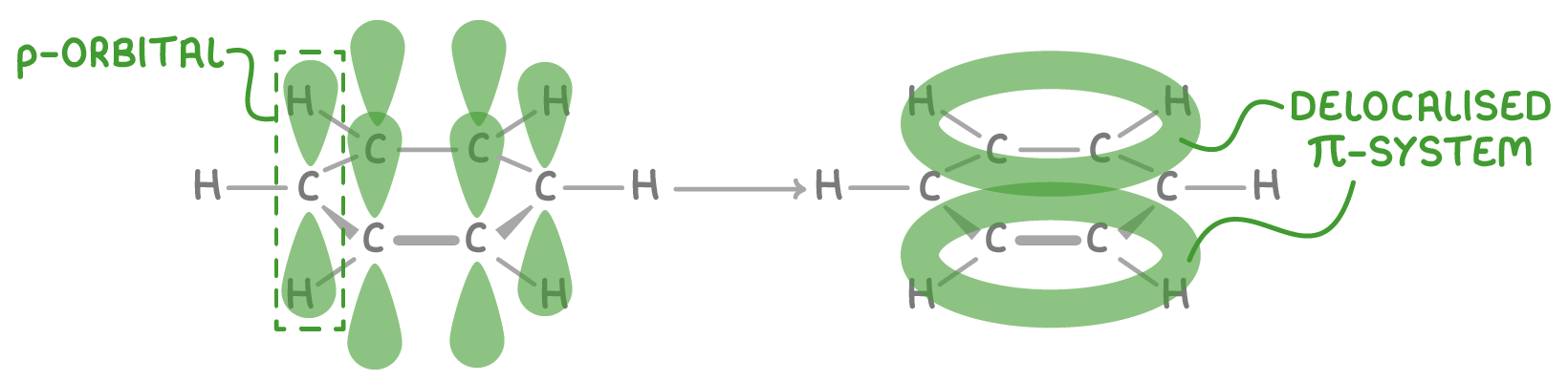
- Each carbon contributes one electron from its 2p orbital to a π-bonding system.
- The p-orbitals overlap side-by-side around the ring, forming a delocalised system of 6 π-electrons.
- This creates an electron density above and below the plane of carbon atoms.
- The electrons are not fixed between specific atom pairs, but rather delocalised over the whole ring.
This delocalisation leads to equal C-C bond lengths between the carbon atoms and enhanced stability of the aromatic ring.
Evidence supports the delocalised model
The delocalised model of benzene is strongly supported by scientific evidence.
- Equivalent carbon-carbon bond lengths
- X-ray diffraction techniques have revealed that all carbon-carbon (C-C) bonds in benzene measure 140 pm in length.
- This measurement sits between the length of a typical C-C single bond (134 pm) and that of a C=C double bond (154 pm).
- Such findings contradict the Kekulé model, which would suggest alternating lengths for single and double bonds.
- Infrared (IR) spectroscopy data
- IR spectra show that cyclohexene has a typical alkene C=C stretch absorption at around 1,650 cm-1.
- If the Kekulé model were correct, benzene should show a similar absorption peak for its proposed alternating double bonds.
- Benzene lacks this isolated alkene peak, instead showing distinctive aromatic C=C stretch absorptions at approximately 1,500 cm-1, 1,580 cm-1, and 1,450 cm-1.
- Enthalpy of hydrogenation
- Hydrogenation of cyclohexene, which has one C=C bond, results in a change in enthalpy (ΔH) of 120 kJ mol-1.
- If benzene had three double bonds, as suggested by the Kekulé model, it would have a ΔH of 360 kJ mol-1 following the same logic.
- However, the actual ΔH for benzene's hydrogenation is only 208 kJ mol-1.
- This indicates that breaking the bonds in benzene requires more energy, suggesting a stability greater than what the Kekulé model predicts.
- Resistance to electrophilic addition reactions
- Unlike alkenes, which readily undergo electrophilic addition reactions (e.g., decolourising bromine water at room temperature), benzene is resistant to such reactions.
- This resistance is due to the delocalised π-electron system, which stabilises the benzene ring and makes it less reactive towards electrophiles.
- The Kekulé model, with its alternating double bonds, would predict benzene to be more reactive, similar to alkenes.
Naming aromatic compounds
Compounds that include a benzene ring are referred to as arenes or aromatic compounds.
There are two main systems used for naming these compounds:
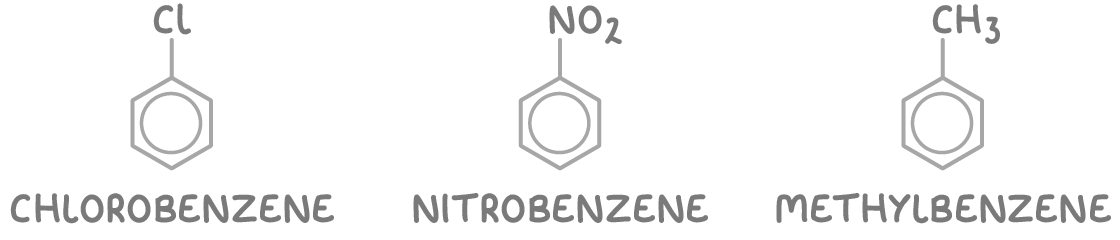
- Substituted benzene - Here, the names of the substituents precede the word "benzene". Examples include chlorobenzene, nitrobenzene, and methylbenzene.
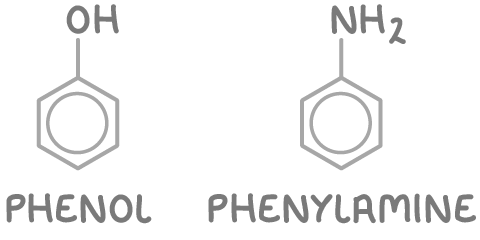
- Phenyl derivatives - These compounds are named as derivatives of the phenyl group (C6H5-). Examples include phenol and phenylamine.
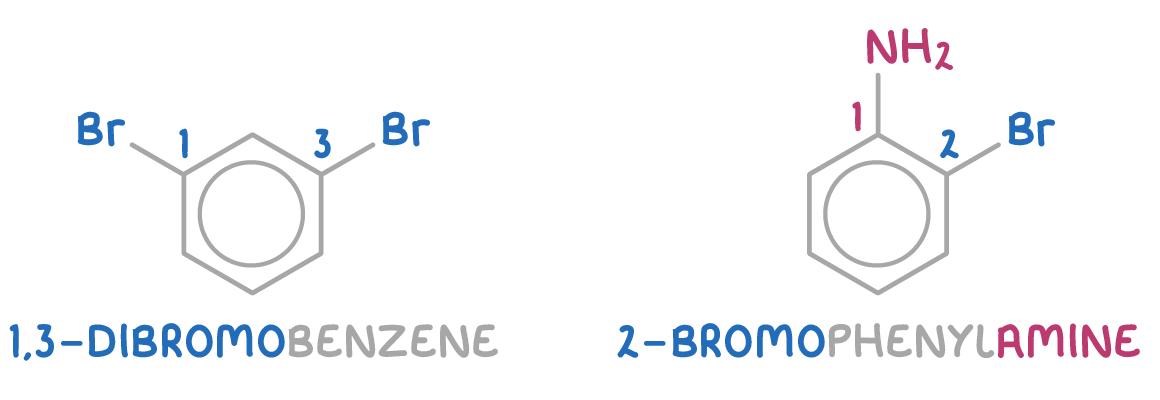
When multiple substituents are present, the positions on the ring are numbered to clarify their locations:
- The numbering begins from the substituent that gives the molecule its suffix (for example, -OH in phenol).
- If all substituents are identical, numbering starts from any position and proceeds to give the lowest possible numbers.
Examples include 1,3-dibromobenzene and 2-bromophenylamine:
Differences in benzene and alkene reactivity
Benzene and alkenes exhibit significant differences in their chemical reactivities.
Alkenes readily undergo addition reactions
- Alkenes are known for their readiness to undergo addition reactions with electrophiles, such as bromine, by breaking the π-bond in the C=C double bond.
- For instance, ethene reacts with bromine at room temperature to produce 1,2-dibromoethane: C2H4 + Br2 ➔ CH2BrCH2Br
Benzene prefers substitution over addition
- Addition reactions in benzene are difficult due to the stability provided by its delocalised π-electron system.
- Instead, benzene is more inclined to participate in substitution reactions, which preserve the aromatic ring's integrity.
- For instance, benzene reacts with bromine when heated in the presence of a catalyst to form bromobenzene and hydrogen bromide: C6H6 + Br2 ➔ C6H5Br + HBr
Delocalisation explains reactivity differences
- In benzene, the delocalised π-system across the ring has insufficient electron density to polarise the Br-Br bond, making addition reactions difficult. Heat and a catalyst are required to initiate the substitution reaction.
- In ethene, the localised π-system around the C=C double bond has sufficient electron density to polarise the Br-Br bond, allowing addition reactions to occur readily at room temperature without the need for a catalyst.