15.4 - Nucleophilic Addition Reactions
- 1
Hydroxynitrile formation
- 2
Why some reactions produce racemic mixtures
- 3
Using 2,4-dinitrophenylhydrazine (2,4-DNPH) to identify aldehydes and ketones
Aldehydes and ketones form hydroxynitriles
Aldehydes and ketones can react with hydrogen cyanide (HCN) in nucleophilic addition reactions to produce hydroxynitriles which contains both the cyano (-CN) and hydroxy (-OH) substituents. This reaction is useful because it increases the length of the carbon chain by 1 carbon atom.
The reactions are:
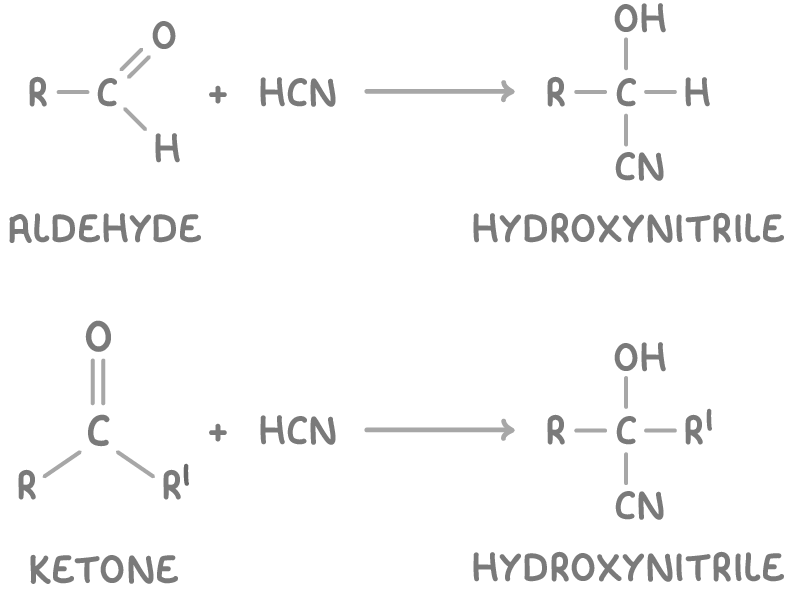
Where
- R and R’ represent alkyl groups.
Hydrogen cyanide is toxic so it is often generated in situ (i.e. within the reaction mixture) by mixing sodium cyanide or potassium cyanide with dilute sulfuric acid. This avoids handling or storing large quantities of gaseous or liquid hydrogen cyanide.
Mechanism of hydroxynitrile formation
The formation of hydroxynitriles from carbonyl compounds, such as ethanal, follows a nucleophilic addition mechanism:
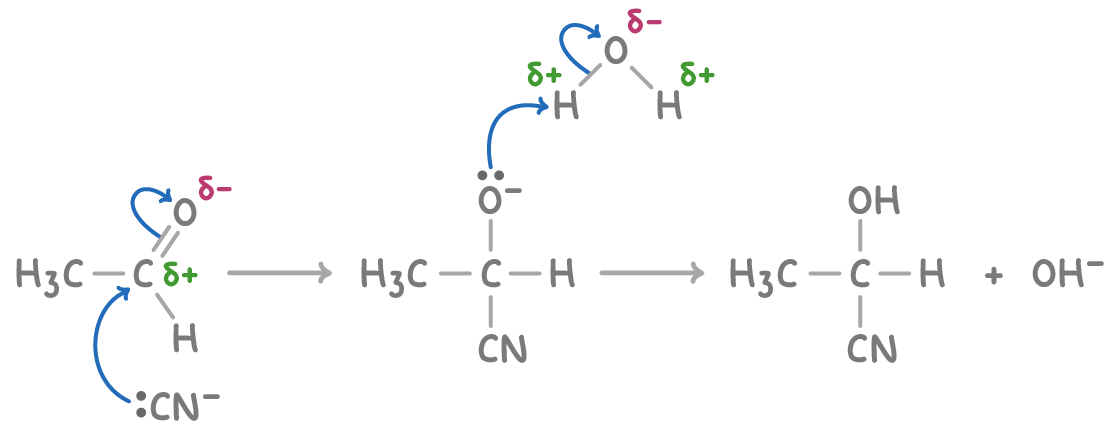
- CN- attacks the partially positive carbonyl carbon, transferring the electrons to oxygen.
- Protonation of oxygen by water (or acid) to give the -OH group.
Aldehydes and unsymmetrical ketones form racemic mixtures
Aldehydes and unsymmetrical ketones contain a planar carbonyl group (C=O) which allows attacking reagents to approach from either side with equal likelihood. This leads to the formation of racemic mixtures containing both enantiomers in equal amounts.
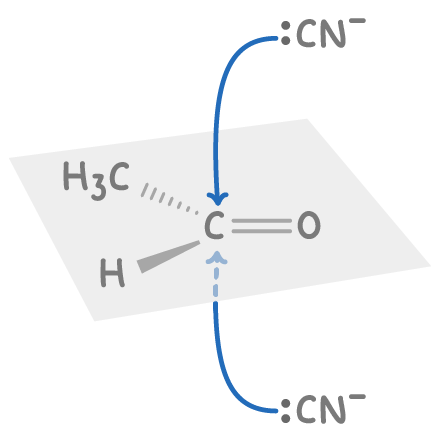
For example, when ethanal reacts with acidified potassium cyanide:
- The planar C=O double bond allows the CN- nucleophile to attack from either side of the plane.
- Attacking from above or below the plane produces two different enantiomers.
- Since both directions of attack are equally likely, the reaction yields equal amounts of both enantiomers of 2-hydroxypropanenitrile, resulting in a racemic mixture.
In contrast, symmetrical ketones do not form racemic mixtures when attacked by nucleophiles. Due to their symmetry, attack from either side of the carbonyl group produces the same product rather than two different enantiomers. For instance, when propanone reacts with acidified potassium cyanide, the product is the non-chiral molecule 2-hydroxy-2-methylpropanenitrile.
2,4-DNPH derivatives identify carbonyls
When 2,4-dinitrophenylhydrazine (2,4-DNPH) is dissolved in methanol and concentrated sulfuric acid, it reacts with carbonyl groups (C=O) found in aldehydes and ketones to form a bright orange precipitate.
This reaction only occurs with aldehydes and ketones due to their C=O group. Other carbonyls like carboxylic acids (COOH) and esters (COO) do not react.
The orange derivative crystals produced are filtered and then purified by recrystallisation. After purification, the melting point of the derivative is measured and compared to known values in a database. By matching the measured melting point to a known value, the original carbonyl compound can be identified.