7.2 - Physical Properties
- 1
The trend in boiling points of alkanes and hydrogen halides
- 2
Comparing the boiling points of alcohols and alkanes
- 3
The anomalous properties of water
- 4
Solubility principles and types of solvents
- 5
Solubility of ionic compounds and alcohols in water
- 6
Solubility of substances in non-polar solvents
How structure affects the boiling points of alkanes
The boiling point of an alkane is influenced by the strength of its intermolecular induced dipole-dipole forces, which vary based on the length of the carbon chain and the extent of branching.
- Carbon chain length
- A longer carbon chain means more electrons are present, creating stronger temporary inducible dipoles.
- These stronger dipoles result in stronger London forces between molecules.
- Consequently, more energy is needed to overcome these forces and boil the alkane.
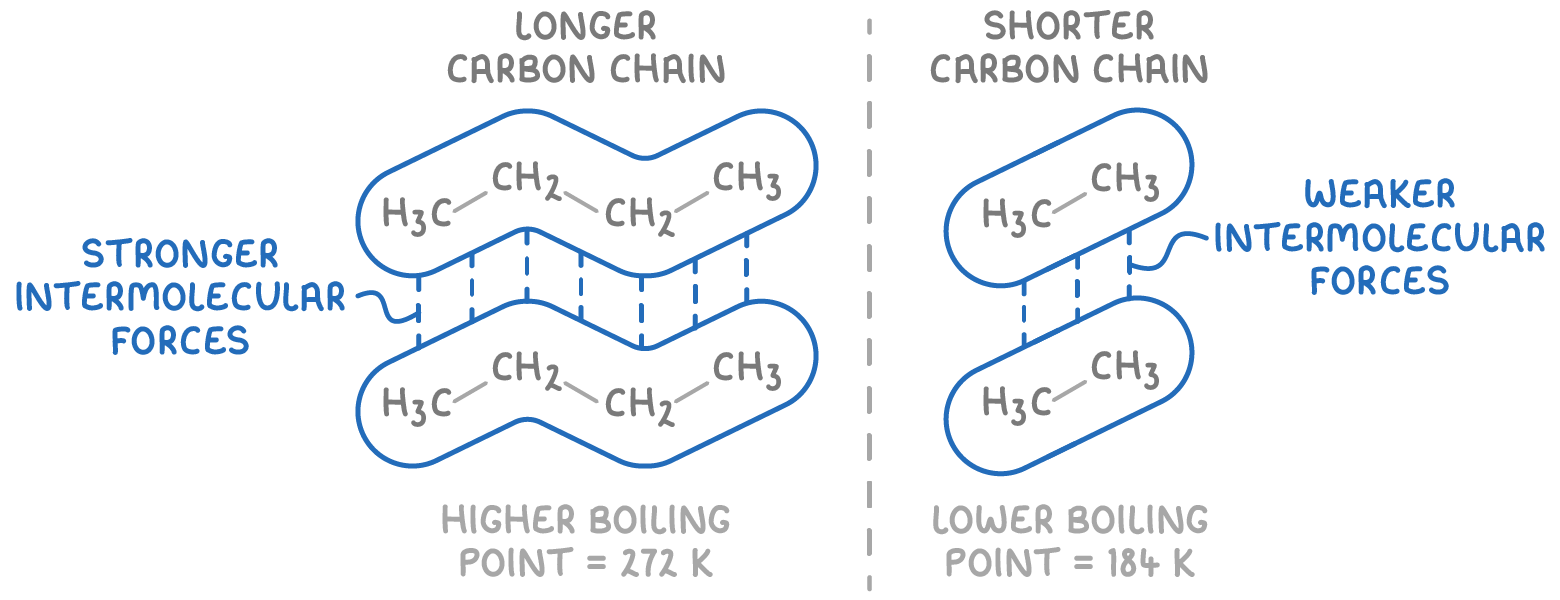
The example above shows that butane (C4H10) has a higher boiling point than ethane (C2H_6_) due to butane's longer chain which contains more electrons, creating stronger intermolecular forces.
- Branching:
- Straight chain alkanes can pack together more closely, maximising interaction between their electron clouds. Conversely, branched alkanes have a less efficient packing, reducing electron cloud contact.
- This leads to stronger London forces in straight chain alkanes.
- Therefore, more energy is required to separate these molecules.
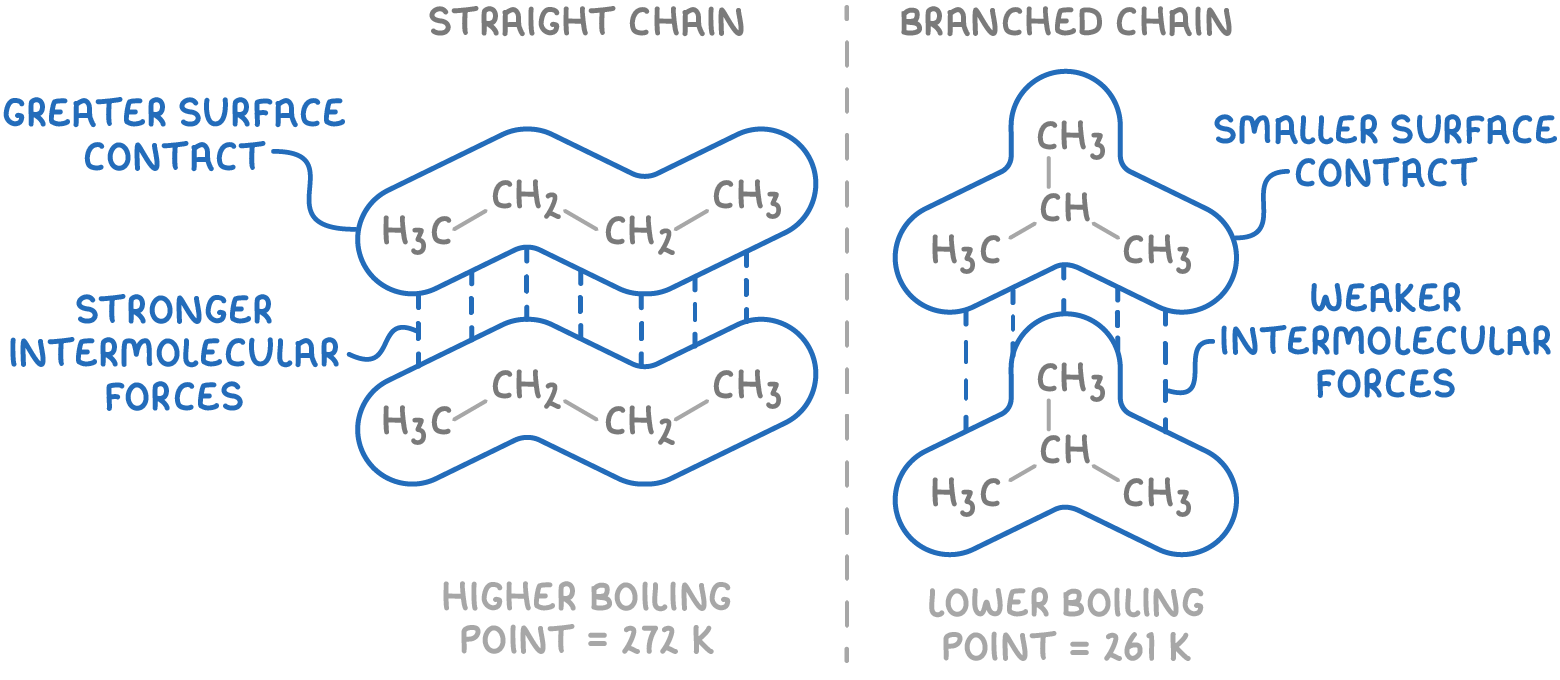
The example above shows that butane has a higher boiling point than its branched isomer, methylpropane due to butane's straight chain which allows greater surface contact between molecules, creating stronger intermolecular forces.
Alcohols have higher boiling points than alkanes
Alcohols have lower volatility (higher boiling temperatures) compared to alkanes with a similar number of electrons. This is due to the stronger intermolecular forces present in alcohols.
Alcohols exhibit stronger overall intermolecular forces compared to similarly sized alkanes as they experience hydrogen bonding in addition to permanent dipole-dipole forces and London forces.
For example, methanol (CH3OH) has a higher boiling point than ethane (C2H6):
| Molecule | Molecular formula | Number of electrons in molecule | Polarity | Boiling point (K) |
|---|---|---|---|---|
| Methanol | CH_3_OH | 18 | Polar | 338 |
| Ethane | C_2_H_6_ | 18 | Non-polar | 184 |
The difference in boiling points can be explained by the types of intermolecular forces present in each substance:
- Methanol is a polar molecule due to the hydroxyl group (-OH), so it experiences hydrogen bonding, permanent dipole-dipole forces and London forces.
- Ethane is a non-polar molecule, so it only experiences London forces. As a result, more energy is required to overcome the stronger intermolecular forces in methanol, leading to a higher boiling point and lower volatility, even though both molecules contain the same number of electrons.
Trend in boiling points of hydrogen halides
The trend in boiling points of hydrogen halides from HF to HI demonstrates the interplay between different types of intermolecular force.
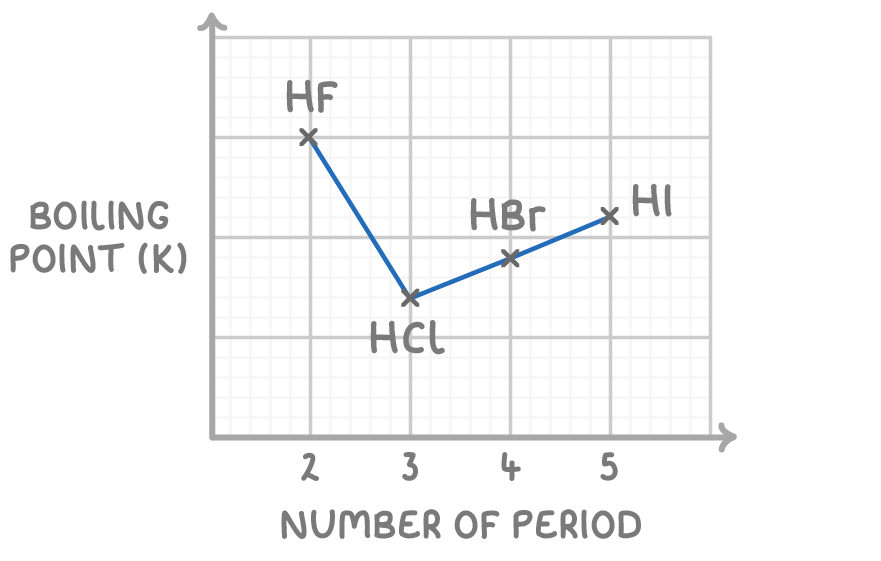
- Hydrogen fluoride (HF) has a significantly higher boiling point than the other hydrogen hydrides due to its ability to form hydrogen bonds. The strong intermolecular forces created by hydrogen bonding require more energy to overcome, resulting in a higher boiling point.
- The trend of increasing boiling points from HCl to HI can be attributed to the increasing molecular mass and size of the molecules. As the molecules become larger, the strength of the London forces increases, leading to higher boiling points.
Hydrogen bonding explains the anomalous properties of water
Hydrogen bonding significantly impacts the structure and properties of water and ice:
-
Ice is denser than water - In solid ice, water molecules are arranged in a 3D lattice held together by hydrogen bonds. Upon melting, some of these hydrogen bonds break. Since hydrogen bonds are relatively long compared to covalent bonds, this causes ice to be less dense than liquid water.
-
Water and ice have high melting and boiling points - Water has relatively high melting and boiling points compared to other molecules of similar size. This is due to the strong hydrogen bonds between H2O molecules, which require more energy to break.
Solubility depends on bond breaking and forming
For a substance to dissolve in a solvent, three key processes must occur:
- Bonds within the substance (solute) molecules must break.
- Bonds between the solvent molecules must break.
- New bonds must form between the solute and solvent molecules. Typically, a substance will only dissolve if the newly formed solute-solvent bonds are of similar strength or stronger than the bonds that are broken in the pure solute and solvent.
Polar and non-polar solvents
Solvents can be categorised as either polar or non-polar:
- Polar solvents - These consist of polar molecules. Water is the most common polar solvent, with water molecules bonding via hydrogen bonds. However, not all polar solvent molecules can form hydrogen bonds. For example, propanone is polar but only forms London dispersion forces and permanent dipole-dipole interactions.
- Non-polar solvents - These are composed non-polar molecules that interact through London dispersion forces. For example, hexane is a common non-polar solvent.
Many substances are soluble in one type of solvent but not the other, due to the types of intermolecular forces involved.
Ionic compounds dissolve in polar solvents
Ionic substances often dissolve in polar solvents like water due to a process called hydration:
- Water molecules are polar, with slightly positive (δ+) hydrogen atoms and slightly negative (δ-) oxygen atoms.
- When an ionic substance is added to water, the ions are attracted to the oppositely charged ends of the water molecules.
- Water molecules surround and separate the ions from the ionic lattice.
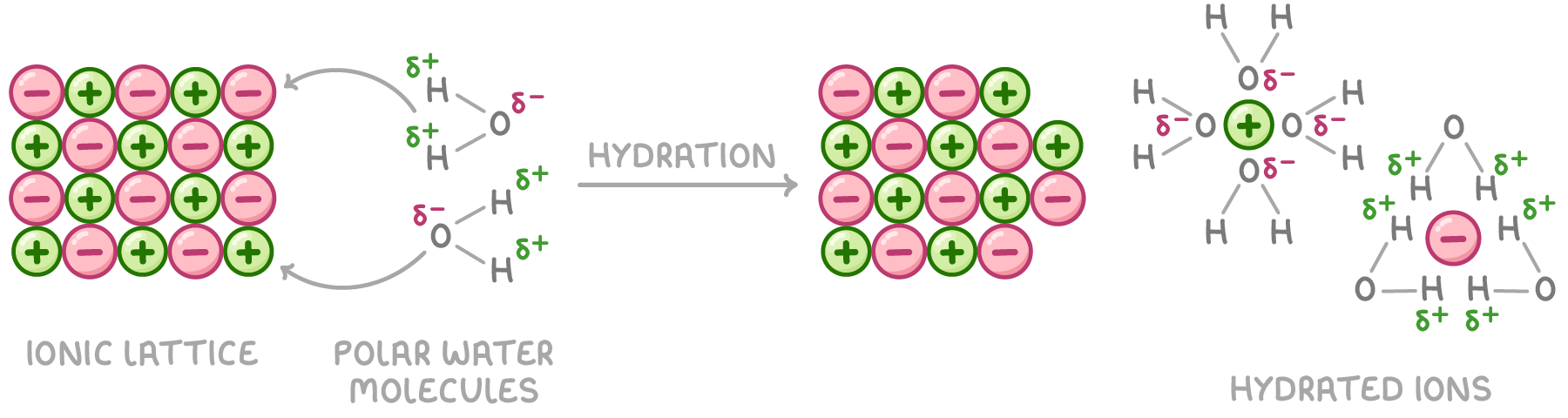
However, some ionic compounds like aluminium oxide (Al2O3) do not dissolve in water because the ionic bonds are stronger than potential bonds with water molecules. The high charge density of the Al3+ ion leads to particularly strong ionic bonding.
Alcohols also dissolve in polar solvents
Alcohols are generally soluble in water due to their ability to form hydrogen bonds:
- The polar O-H bond in alcohols is attracted to the polar O-H bonds in water.
- Hydrogen bonds form between the lone pairs on oxygen atoms (δ-) and hydrogen atoms (δ+).
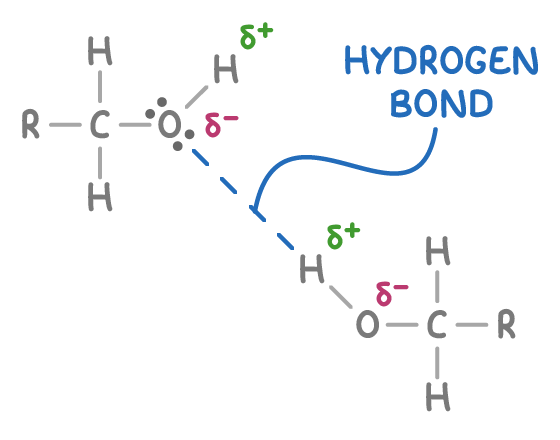
However, the carbon chain part of the alcohol is not attracted to water, so alcohol solubility decreases as the number of carbon atoms increases.
Not all polar molecules dissolve in water
Despite containing polar bonds, some molecules like halogenoalkanes do not readily dissolve in water:
- The dipoles in halogenoalkanes are not strong enough to form hydrogen bonds with water molecules.
- The hydrogen bonding between water molecules is stronger than the potential bonds with halogenoalkanes, preventing dissolution.
For example, chlorobutane and water form two distinct layers when mixed:
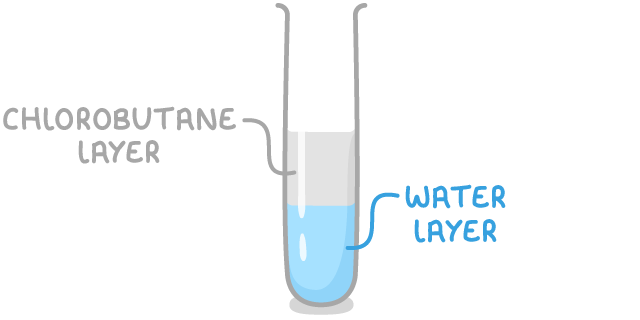
However, halogenoalkanes can form permanent dipole-dipole bonds and thus dissolve in polar solvents that also form such interactions rather than hydrogen bonds.
Non-polar substances dissolve in non-polar solvents
Non-polar substances tend to dissolve best in non-polar solvents:
- Non-polar molecules (e.g., ethene) have London forces between them.
- They form similar London forces with non-polar solvents like hexane, allowing dissolution.
- Water molecules have stronger attractions to each other than to non-polar molecules, so non-polar substances generally don't dissolve well in water.
This phenomenon is often summarised as "like dissolves like" - substances usually dissolve best in solvents with similar intermolecular forces.