2.5 - Ionisation Energies
- 1
What ionisation energy is
- 2
The factors that affect ionisation energy
- 3
Trends in first ionisation energy down groups and across periods
- 4
Successive ionisation energies
Ionisation involves removing electrons
Ionisation refers to the process of removing one or more electrons from an atom or molecule. This process requires an input of energy, so ionisation is an endothermic process and ionisation energy values are always positive.
The first ionisation energy is the energy needed to remove 1 electron from each atom in 1 mole of gaseous atoms to form 1 mole of gaseous 1+ ions.
For example, the equation that represents the first ionisation energy (IE1) of magnesium is:
Mg(g) ➔ Mg+(g) + e− ΔHIE1 = +738 kJ mol−1
The second ionisation energy is the energy needed to remove 1 electron from each ion in 1 mole of gaseous 1+ ions to form 1 mole of gaseous 2+ ions.
For example, the equation that represents the second ionisation energy (IE2) of magnesium is:
Mg+(g) ➔ Mg2+(g) + e− ΔHIE2 = +1,450 kJ mol−1
The third ionisation energy is the energy needed to remove 1 electron from each ion in 1 mole of gaseous 2+ ions to form 1 mole of gaseous 3+ ions.
For example, the equation that represents the third ionisation energy (IE3) of magnesium is:
Mg2+(g) ➔ Mg3+(g) + e− ΔHIE3 = +7,730 kJ mol−1
Factors affecting ionisation energy
The ionisation energy of an atom depends on how strongly its outermost electrons are attracted to the nucleus. There are three key factors that affect this electrostatic attraction:
- Nuclear charge - Atoms with more protons in their nucleus have a stronger positive charge. This creates stronger electrostatic attraction between the nucleus and the outer electrons.
- Atomic radius - Electrostatic attraction drop off steeply with increasing distance. Electrons in smaller atoms are held closer to the nucleus so the attraction is greater.
- Electron shielding - Inner electron shells shield the outermost electrons from the full attractive force of the nucleus, reducing the effective nuclear charge experienced by the outer electrons. More electron shells provide more shielding.
In summary, low shielding and small atomic size lead to high ionisation energies, as the outermost electrons experience strong electrostatic attraction from the nucleus. Removing these tightly-held electrons requires substantial energy input.
Trends in first ionisation energy
Ionisation energies show clear trends down groups and across periods of the periodic table due to the combined effects of nuclear charge, atomic radius, and electron shielding.
Down groups
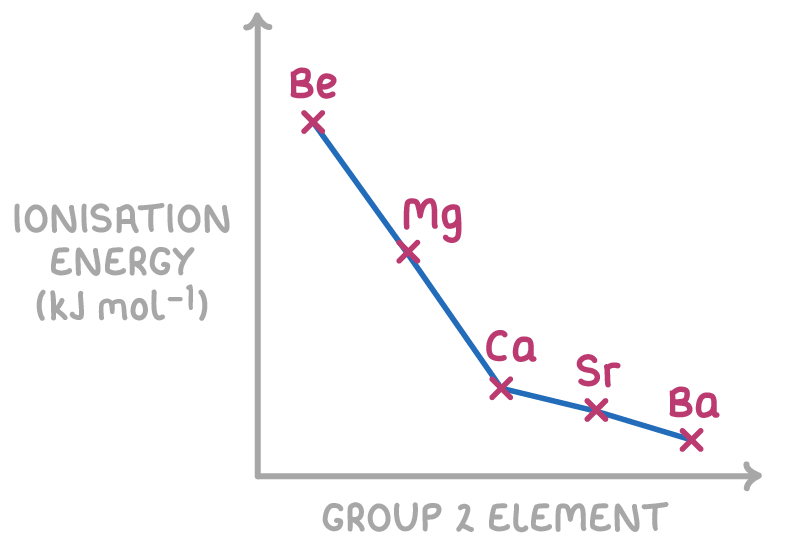
Ionisation energy decreases down a group, as shown by the group 2 elements in the graph above. This is because:
- Nuclear charge increases down the group as more protons are added. This increases attraction for electrons.
- Atomic radius increases down the group as more electron shells are added. This moves electrons away from nucleus.
- Electron shielding increases down group as more inner shells reduce nuclear attraction The increasing atomic radius and shielding effects are greater than the increasing nuclear charge, leading to an overall decrease in ionisation energies down a group.
Across periods
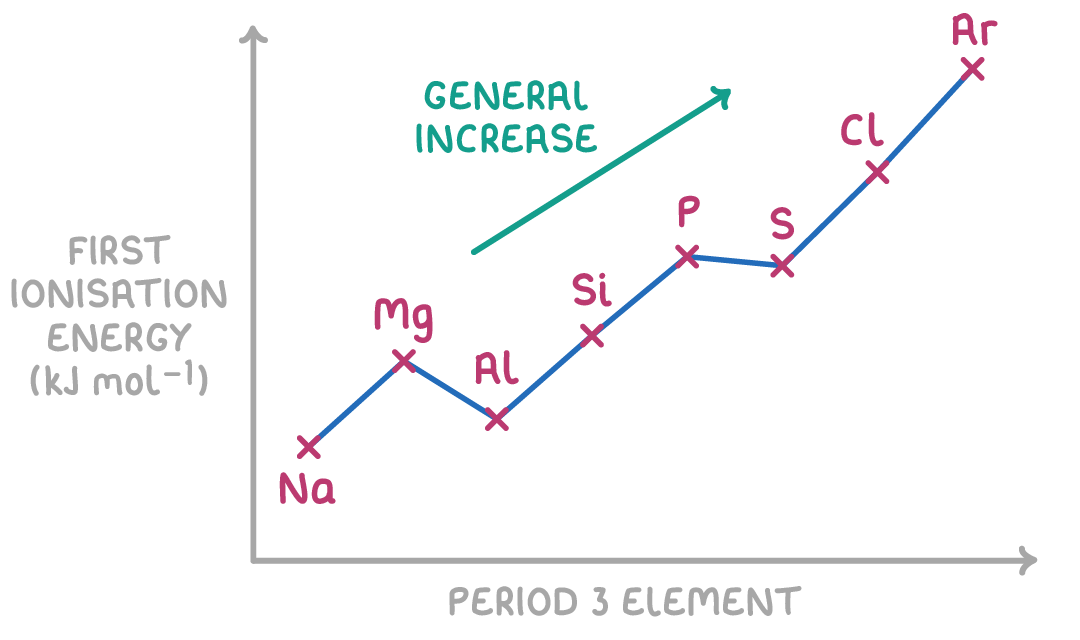
Ionisation energy generally increases across a period, as shown by the period 3 elements in the graph above. This is because:
- Nuclear charge increases as more protons are added across a period.
- Atomic radius decreases across a period as extra electrons are added to the same shell.
- Electron shielding stays similar across a period with no extra inner shells. The increasing nuclear charge effect outweighs the similar shielding across a period, so ionisation energies generally increase across a period.
Successive ionisation energies
Electrons can be sequentially removed until only the nucleus remains. The energy to remove each successive electron is called the successive ionisation energies.
Successive ionisation energies provide evidence for electron shell structure:
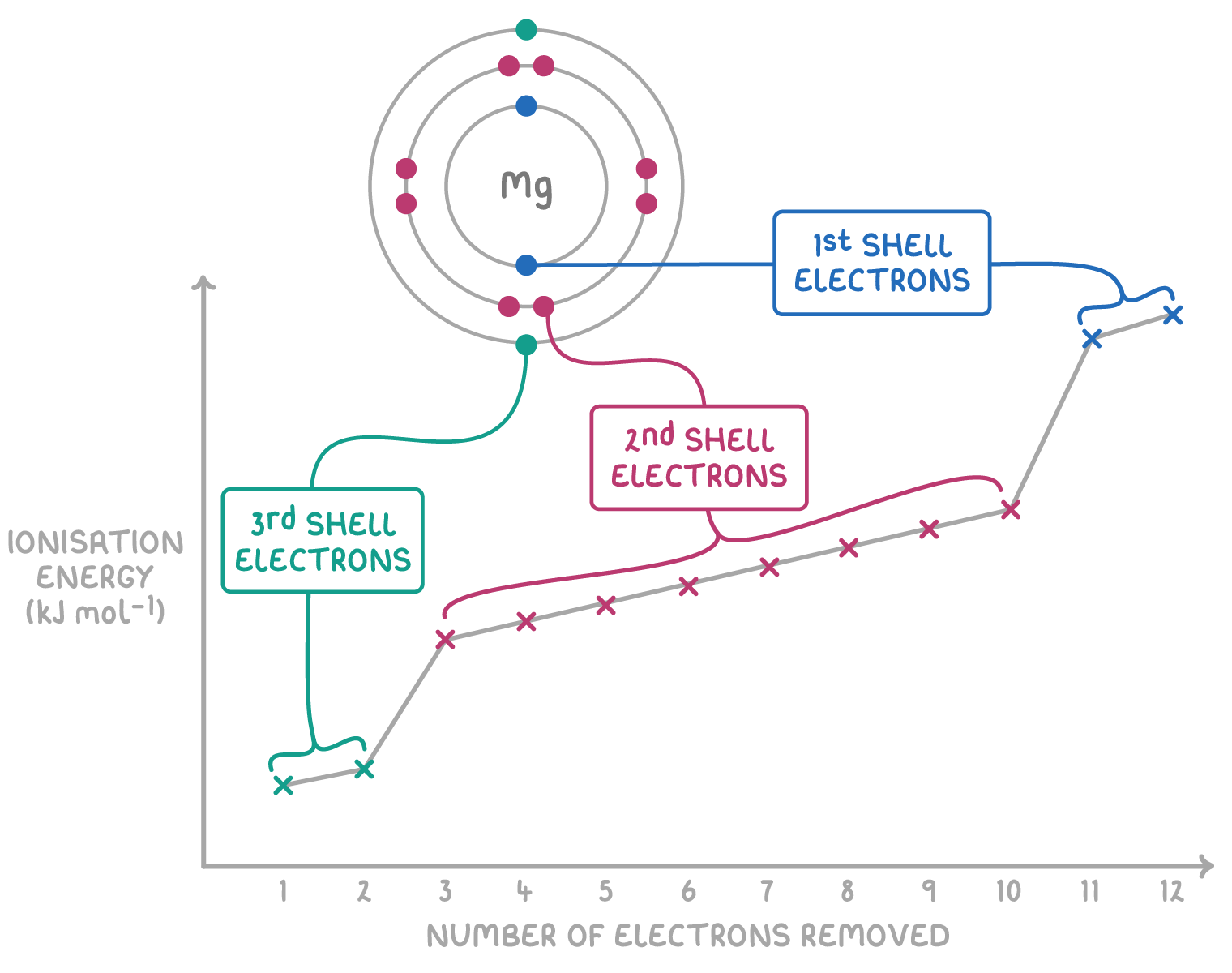
Successive ionisation energies increase within the same shell:
- As successive electrons are removed from the same shell, the remaining electrons experience greater electrostatic attraction to the increasingly positive nucleus. This increased nuclear attraction requires more energy to remove the next electron from that shell.
- For magnesium, the second ionisation energy (1,450 kJ mol^-1^) is slightly higher than the first (740 kJ mol^-1^) as these electrons are both being removed from the 3s subshell.
There are large jumps in successive ionisation energy between shells:
- When reaching a new inner electron shell, there is a big increase in the ionisation energy needed to remove the first electron in that new shell. This happens because the attraction to the nucleus is much greater for inner shell electrons closer to the nucleus.
- For magnesium, there is a large jump from the second ionisation energy (1,450 kJ mol^-1^) to the third (7,730 kJ mol^-1^) as the 3s subshell is now full, requiring the next electron to be removed from the inner 2p subshell.