20.2 - Organic Synthesis
- 1
The formation of Grignard reagents
- 2
Reactions of Grignard reagents with carbon dioxide and carbonyl compounds
- 3
Considerations for planning synthetic routes
- 4
Summaries of key reactions for aliphatic compounds
- 5
Summaries of key reactions for aromatic compounds
- 6
How functional groups determine reactivity
Formation of Grignard reagents
Grignard reagents are crucial in organic chemistry for creating carbon-carbon bonds. They have the general formula RMgX, where:
- R is an alkyl group.
- X is a halogen, typically chlorine (Cl), bromine (Br), or iodine (I).
Grignard reagents are prepared by reacting an alkyl or aryl halide with magnesium metal. The reaction must be conducted under anhydrous conditions, generally using dry ether as the solvent. This is because the presence of water would destroy the Grignard reagent.
For example, ethylmagnesium bromide, a Grignard reagent, can be prepared from bromoethane and magnesium:
CH3CH2Br + Mg ➔ CH3CH2MgBr
Reaction with carbon dioxide to form carboxylic acids
One of the most valuable applications of Grignard reagents is in synthesising carboxylic acids.
This is done through a two-step process:
- The Grignard reagent reacts with carbon dioxide gas (CO2), which is bubbled through the solution of the Grignard reagent in dry ether. This step forms a magnesium carboxylate intermediate.
- The magnesium carboxylate is then hydrolysed with a dilute acid, typically hydrochloric acid, resulting in the formation of the carboxylic acid.
The overall reaction can be represented as follows:
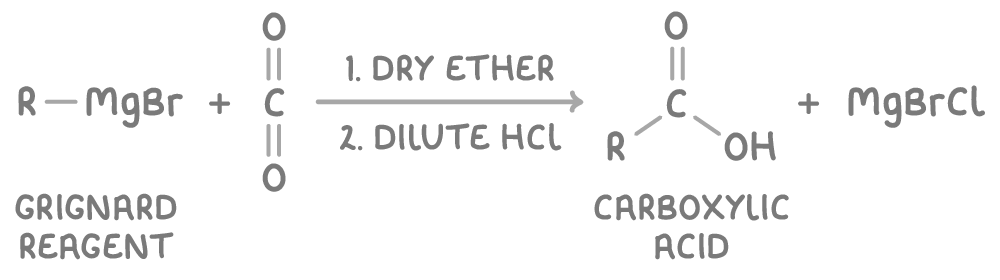
For example, the reaction between ethylmagnesium bromide and carbon dioxide will produce propanoic acid:
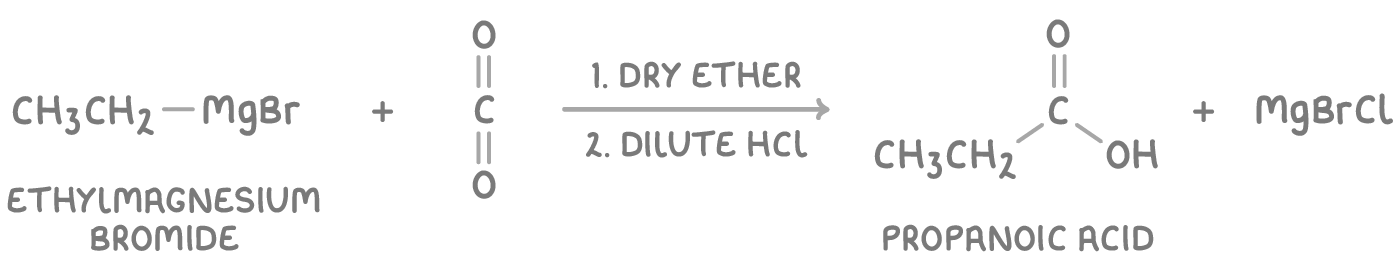
Reaction with aldehydes and ketones to form alcohols
Grignard reagents also react with carbonyl compounds, such as aldehydes and ketones, to produce alcohols. This reaction is another important application in organic synthesis.
The process involves the nucleophilic addition of the Grignard reagent to the carbonyl group, forming a magnesium alkoxide intermediate. This intermediate is then hydrolysed with acid to yield the desired alcohol.
The general reaction can be represented as follows:
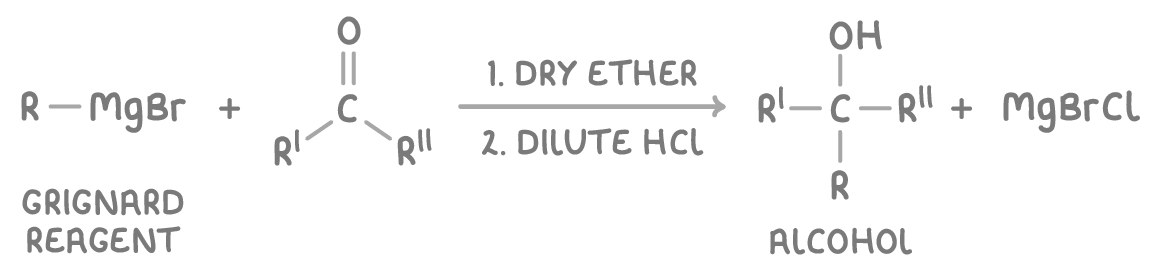
The type of alcohol formed depends on the carbonyl compound involved:
- Methanal (H2CO) yields primary alcohols (RCH2OH).
- Other aldehydes (R'CHO) yield secondary alcohols (R'CH(OH)R).
- Ketones (R'COR") yield tertiary alcohols (R'C(OH)R"R).
For example, the reaction between ethylmagnesium bromide and ethanal will produce butan-2-ol:

Considerations for planning an organic synthesis
When planning the synthesis of an organic molecule, chemists must consider several key factors:
-
Safety: Chemists work to reduce the risk of accidents and environmental damage by using non-hazardous starting materials whenever possible. They also design processes that do not require solvents, particularly flammable or toxic ones, to decrease the potential for harm and environmental impact.
-
Efficiency: To maximise yield while minimising waste, chemists pursue high percentage yield and atom economy. This ensures that the majority of the reactants end up in the desired product, reducing waste. They also design production methods with fewer reaction steps to minimise the use of resources and the generation of byproducts.
-
Cost-effectiveness: By using non-hazardous starting materials, avoiding the use of solvents, and designing processes with fewer steps, chemists can significantly reduce the overall cost of the synthesis. This makes the process more economically viable and sustainable in the long run.
-
Stereochemistry In many cases, especially in the pharmaceutical industry, the synthesis of a specific stereoisomer is crucial to ensure the desired therapeutic effect and minimise toxicity. By understanding reaction mechanisms, chemists can control the stereochemical outcome of a synthesis.
Summary of key organic reactions for aliphatic compounds
Below is an overview of the primary types of organic reactions we've discussed for aliphatic compounds.
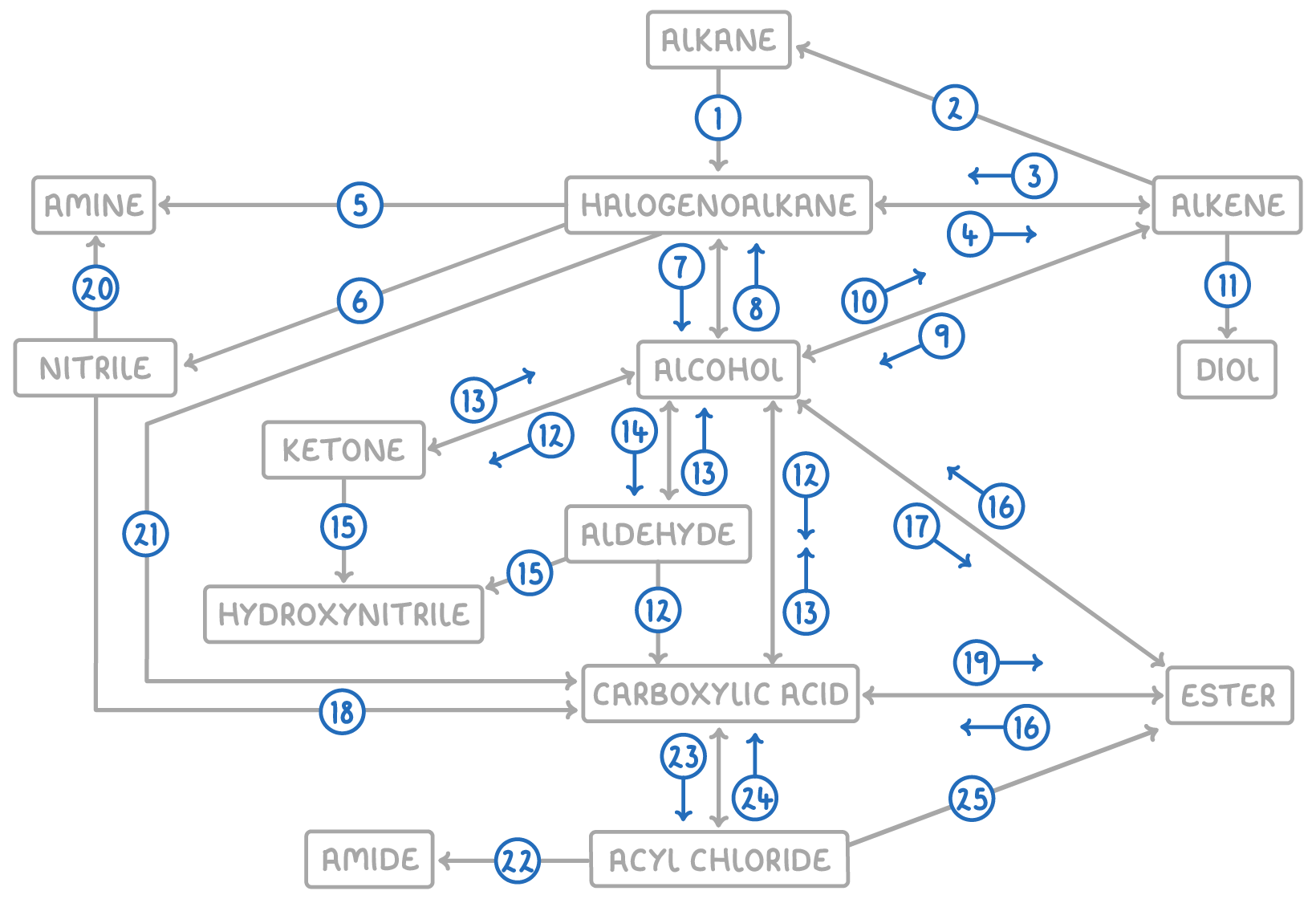
| Reaction | Reagent and conditions | Reaction type |
|---|---|---|
| 1 | Halogen, UV light | Free radical substitution |
| 2 | H_2_, Ni or Pt catalyst, heat | Electrophilic addition |
| 3 | Hydrogen halide or halogen | Electrophilic addition |
| 4 | KOH in ethanol, reflux | Elimination |
| 5 | Conc. NH_3_ in ethanol, heat under pressure | Nucleophilic substitution |
| 6 | KCN in ethanol, reflux | Nucleophilic substitution |
| 7 | NaOH(aq), reflux OR Mg, dry ether, carbonyl, dilute HCl(aq) | Nucleophilic substitution |
| 8 | PCl_5_ OR KBr, 50% conc. H_2_SO_4_ catalyst OR red phosphorus, I_2_, reflux | Nucleophilic substitution |
| 9 | Steam, H_3_PO_4_ catalyst, 300°C, 60 atm | Electrophilic addition |
| 10 | Conc. H_3_PO_4_, heat | Elimination |
| 11 | Acidified KMnO_4_(aq) | Oxidation |
| 12 | K_2_Cr_2_O_7_(aq), H_2_SO_4_ catalyst, reflux | Oxidation |
| 13 | LiAlH_4_ in dry ether, heat | Reduction |
| 14 | K_2_Cr_2_O_7_(aq), H_2_SO_4_ catalyst, distill | Oxidation |
| 15 | KCN, H_2_SO_4_ catalyst, heat | Nucleophilic addition |
| 16 | Dilute HCl(aq) or dilute NaOH(aq), reflux | Hydrolysis |
| 17 | Carboxylic acid, conc. H_2_SO_4_ | Condensation |
| 18 | H_2_O, dilute HCl(aq), heat | Hydrolysis |
| 19 | Alcohol, conc. H_2_SO_4_ | Condensation |
| 20 | H_2_, Ni catalyst, heat OR LiAlH_4_ in dry ether, heat | Reduction |
| 21 | Mg, dry ether, CO_2_, dilute HCl(aq) | Oxidation |
| 22 | NH_3_ or amine | Nucleophilic addition-elimination |
| 23 | PCl_5_ | Substitution |
| 24 | H_2_O | Nucleophilic addition-elimination |
| 25 | Alcohol | Nucleophilic addition-elimination |
Summary of key organic reactions for aromatic compounds
Below is an overview of the primary types of organic reactions we've discussed for aromatic compounds.
Reactions of benzene
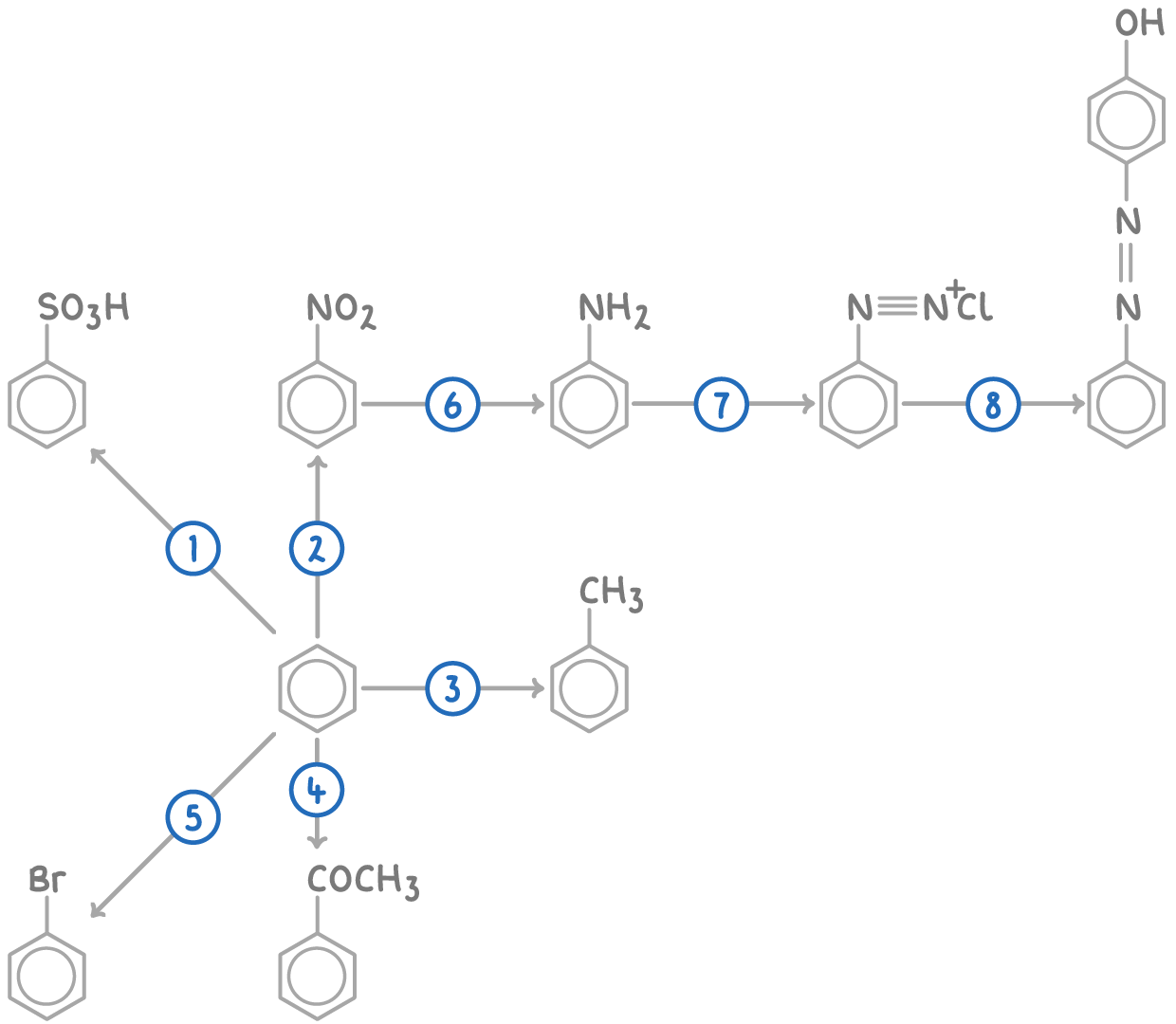
| Reaction | Reagent and conditions | Reaction type |
|---|---|---|
| 1 | Conc. H2SO4, SO3, 40°C | Electrophilic substitution |
| 2 | Conc. HNO3, conc. HCl, 25-60°C | Electrophilic substitution |
| 3 | CH3Cl, AlCl3 catalyst, heat | Friedel-Crafts alkylation |
| 4 | CH3COCl, AlCl3 catalyst, heat | Friedel-Crafts acylation |
| 5 | Br2, AlBr3 or FeBr3 catalyst | Electrophilic substitution |
| 6 | Sn, conc. HCl, reflux, then NaOH(aq) | Reduction |
| 7 | HNO2(aq) or NaNO2(s) and dilute HCl(aq), below 10°C | Diazotisation |
| 8 | Phenol, NaOH(aq), below 10°C | Electrophilic substitution |
Reactions of phenol
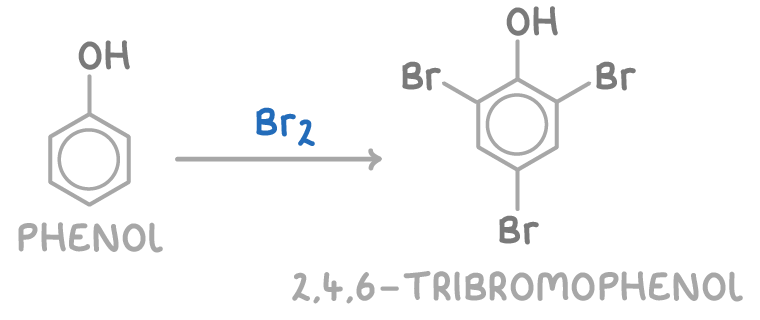
Importance of functional groups
Functional groups are responsible for a molecule's chemical properties and reactivity. Organic molecules are categorised by homologous series based on their functional groups.
Some properties and typical reactions associated with key functional groups are:
| Homologous series | Functional group | Properties | Typical reactions |
|---|---|---|---|
| Alkane | C-C | Nonpolar, unreactive | Free radical substitution |
| Alkene | C=C | Nonpolar, electron-rich | Electrophilic addition, oxidation |
| Alcohol | O-H | Polar O-H bond | Nucleophilic substitution, elimination, oxidation, condensation |
| Halogenoalkane | C-X | Polar bond | Nucleophilic substitution, elimination, oxidation, Friedel-Crafts alkylation |
| Aldehyde/Ketone | C=O | Polar C=O bond | Oxidation (aldehydes only), reduction |
| Carboxylic acid | -COOH | Electron deficient C | Neutralisation, condensation, reduction, substitution |
| Acyl chloride | -COCl | Electron deficient C | Friedel-Crafts acylation |
| Ester | RCOOR’ | Electron deficient C | Hydrolysis |
| Amine | C–NR2 | Lone pair on nitrogen is basic and can act as a nucleophile | Neutralisation, nucleophilic substitution |
| Nitrile | C≡N | Electron deficient C | Reduction, hydrolysis |
| Aromatic compounds | C6H5- | Stable delocalised ring of electrons | Electrophilic substitution |
So by recognising functional groups, organic chemists can predict the likely behaviour and reactivity of compounds. This allows them to design effective syntheses.