15.1 - Optical Isomerism
- 1
What optical isomers are
- 2
How to identify chiral centres and optical isomers
- 3
How optical isomers rotate plane polarised light
- 4
What racemic mixtures are
- 5
Using optical activity to deduce reaction mechanisms
Optical isomers are mirror images
Optical isomerism is a type of stereoisomerism where isomers have the same structural formula but different arrangements of atoms in space.
A chiral carbon is a carbon with four different groups attached to it. When the groups around a chiral carbon are arranged differently, it results in two non-superimposable mirror image structures called enantiomers.
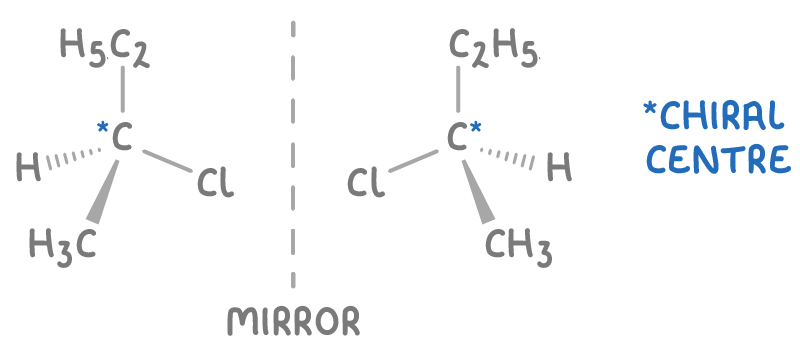
For instance, 2-chlorobutane has a chiral centre on its second carbon, bonded to a chlorine atom, a methyl group, an ethyl group, and a hydrogen atom, resulting in two optical isomers.
To identify and draw enantiomers, follow these steps:
- Identify the chiral carbon - Carefully draw all hydrogen atoms to clearly identify each attachment. Look for the carbon atom connected to four different groups.
- Sketch the enantiomers - Illustrate one enantiomer with its groups arranged tetrahedrally around the chiral carbon. Next, draw its mirror image.
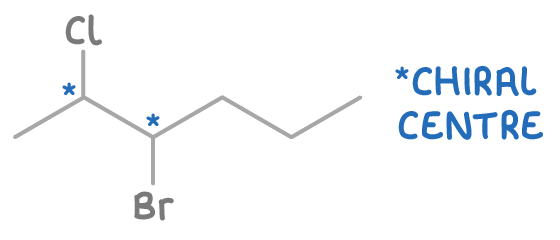
Molecules with multiple chiral centres can have more than two optical isomers, increasing the complexity and number of possible isomers.
For instance, 3-bromo-2-chloropentane has two chiral carbons and hence four optical isomers:
Optical isomers rotate plane polarised light
Optical isomers differ in their effect on plane polarised light:
- Normal light vibrates in all directions while plane polarised light vibrates in one direction only.
- Optical isomers are optically active meaning they rotate plane polarised light.
- One enantiomer rotates plane-polarised light clockwise, while the other enantiomer rotates it anticlockwise by the same angle.
Racemic mixtures contain equal amounts of enantiomers
A racemic mixture, or racemate, is an equimolar mixture containing equal amounts of two enantiomers.
Racemates exhibit no net optical activity as the opposing rotations cancel out.
Using optical activity to determine reaction mechanisms
Optical activity can be used to deduce reaction mechanisms, especially in nucleophilic substitution reactions. The two primary mechanisms to consider are:
- SN1 mechanism:
- Starting with a reactant that is a single enantiomer results in a racemic mixture of products.
- The reaction involves a planar carbocation intermediate.
- The nucleophile can attack this planar intermediate from either side with equal probability, resulting in a racemic mixture of enantiomeric products.
The S_N_1 mechanism for the reaction of 2-iodo-2-methylpropane with hydroxide is:

- SN2 mechanism:
- A single enantiomer reactant yields a single enantiomer product.
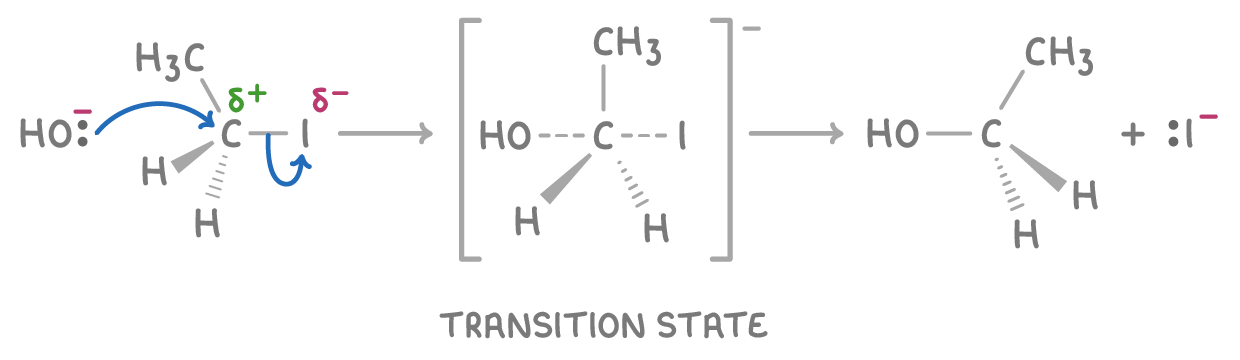
- The reaction occurs in one step, with the nucleophile attacking from the side directly opposite to the leaving group.
- This results in an inversion of stereochemistry, causing the product to rotate plane-polarised light differently than the reactant.
The S_N_2 mechanism for the reaction of iodoethane with hydroxide is:
By measuring the optical activity of both reactants and products, chemists can gather valuable information about the mechanism of a reaction.