Carboxylic Acids - exam practice
Carboxylic Acids
Question 1 of 12
Name the carboxylic acid shown in the diagram below.
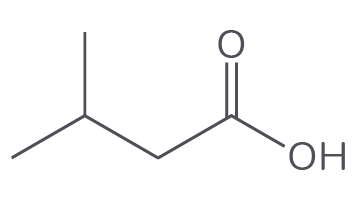
Explain, using a labelled diagram, why the carboyxlic acid in part a) is soluble in water.
Write an equation for the reaction between the carboxylic acid in part a) and ethanol in the presence of a concentrated sulfuric acid catalyst.
Write an equation for the reaction between the carboxylic acid in part a) and sodium carbonate.
Name the ester shown in the diagram below.
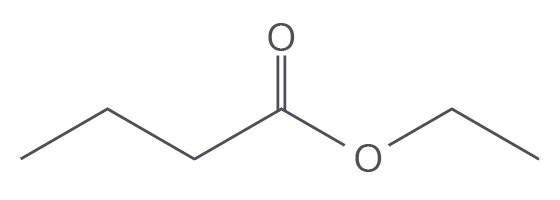
Complete the diagram below to show the organic products of the reactions of the ester in part a).
Name the type of reaction occurring in part b).
Which two products are formed in the acid hydrolysis of phenyl methyl ethanoate?
The molecule 2,6-dimethylphenylamine is used as a starting material in the synthesis of lidocaine, an anaesthetic used in dentistry.
Complete the diagram below to show the structure of the organic product formed when 2,6-dimethylphenylamine is reacted with ethanoyl chloride.
Draw the structure of the organic product formed when ethanoyl chloride is reacted with 2-methylpropan-1-ol.
Give a suitable reagent for converting ethanoic acid into an acyl chloride.
This question is about carboxylic acids and esters.
Complete the flowchart below to show the organic products formed when benzoic acid undergoes the following reactions.
Name the ester with the structural formula (CH3)3CCOOCH3.
Write an equation for the alkaline hydrolysis of the ester in part b) showing the structure of the organic products.
Write an equation for the complete combustion of the ester in part b).
Acyl chlorides are important compounds in organic synthesis.
Write an equation for the reaction between propanol and ethanoyl chloride.
Name the organic product formed in part a).
Name a suitable reagent, and write an equation for, the preparation of ethanoyl chloride from ethanoic acid.
Propenoic acid is a carboxylic acid that contains a carbon-carbon double bond (C=C).
Draw the displayed formula of propenoic acid.
Propenoic acid reacts with ethanol in the presence of concentrated sulfuric acid.
Name and draw the product of this reaction.
The same product in part b) can be prepared using an acyl chloride instead of propenoic acid.
Draw the structure of this acyl chloride.
Identify three differences in the esterification reaction of ethanol when an acyl chloride is used instead of a carboxylic acid.
This question is about acylation.
Write an equation for the reaction between propanoyl chloride and ammonia.
Name the type of compound produced in the reaction in part a).
Write an equation for the reaction between propanoyl chloride and methanol.
Name the type of compound produced in the reaction in part c).
Esters have many commercial uses including as flavourings in food.
Ethyl butanoate is used as pineapple flavouring in cakes.
Write an equation for the formation of ethyl butanoate from an alcohol and a carboxylic acid, showing the structures of all the organic compounds.
Name a suitable catalyst for the reaction in part a).
Ethyl butanoate could also be formed in the reaction between an alcohol and an acyl chloride.
Write an equation for this reaction.
This question is about esters.
Draw the skeletal formula of the ester ethyl 2-methylpropanoate.
Write an equation for the reaction between the ester HCOOCH2CH2CH3 and NaOH.
Which two products are formed in the acid hydrolysis of the ester CH3CH2COOCH2CH3?
The diagram below shows the repeat unit of a polyester.
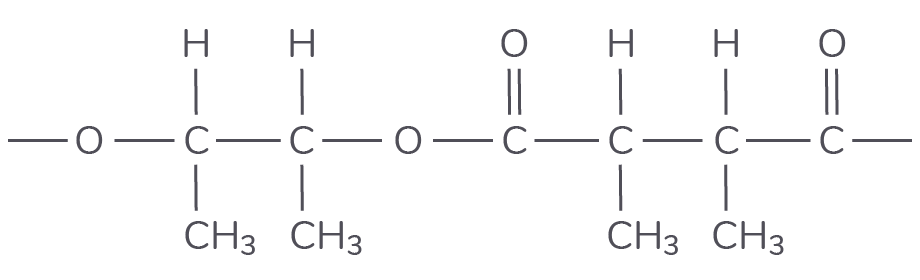
Draw the structures of the two monomers that could form this polyester.
Name this type of polymerisation.
Suggest a compound that could break down this polyester.
The diagram below shows two organic compounds, a diol and a dicarboxylic acid.
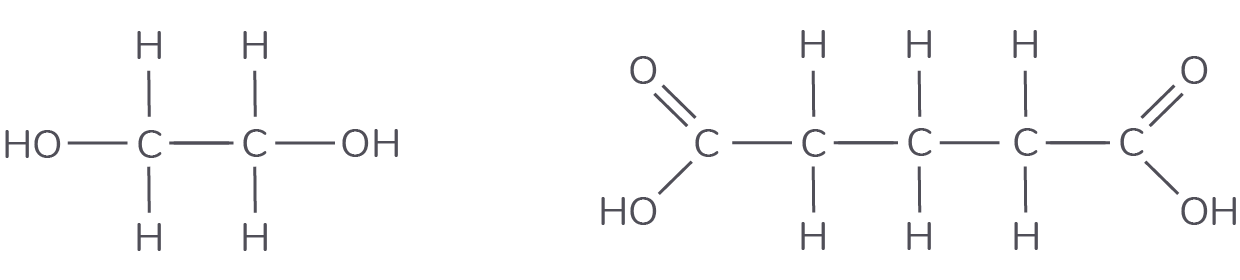
Name the diol.
Draw the repeat unit of the polymer that can form from the reaction between the two compounds.
State the type of reaction that has occurred to form the polymer in part b).
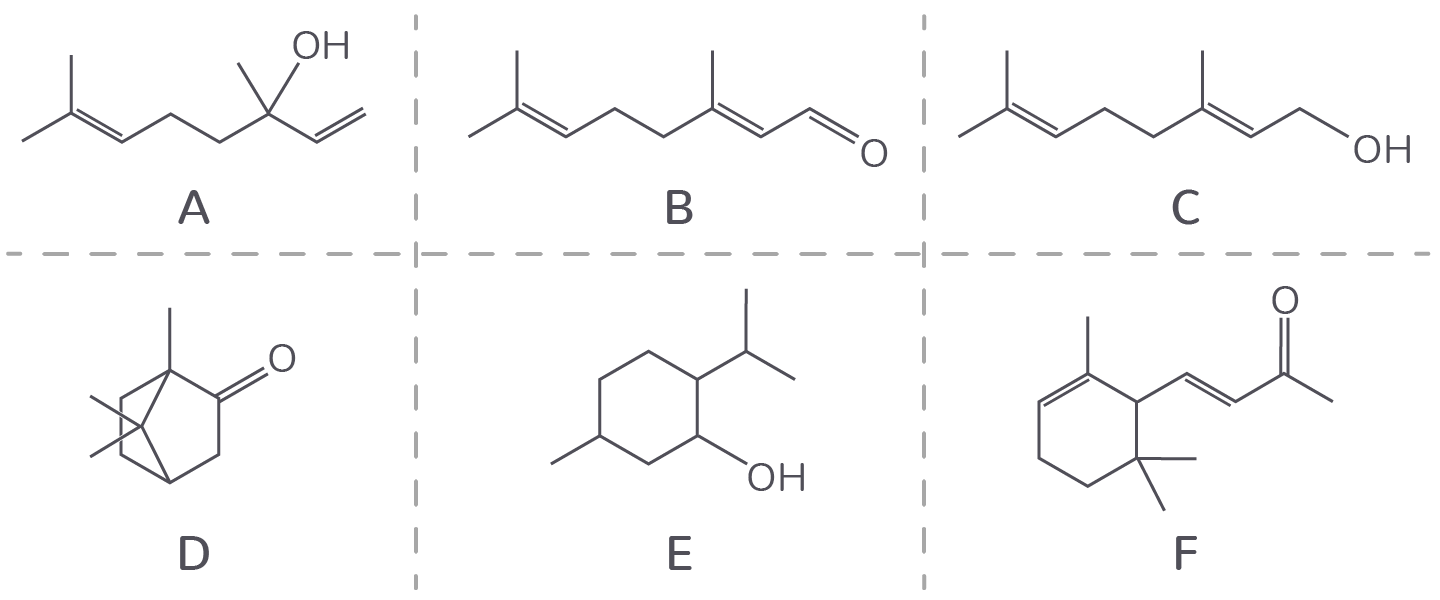
The structures for six naturally occurring organic compounds with pleasant smells, A–F, are shown below.
Identify the isomer(s) that would react when warmed with acidified potassium dichromate(VI).
State the expected observation when acidified potassium dichromate(VI) reacts.
Identify the isomer(s) that would react with Tollens' reagent.
State the expected observation when Tollens' reagent reacts.
Separate samples of A-F are warmed with ethanoic acid and a few drops of concentrated sulfuric acid. In each case the mixture is then poured into a solution of sodium hydrogencarbonate.
Identify the isomer(s) that would react with ethanoic acid.
Suggest a simple way to detect if the ethanoic acid reacts with each organic compound.
Give a reason why the mixture is poured into sodium hydrogencarbonate solution.