Ionic, Covalent and Metallic Bonding - exam practice
Ionic, Covalent and Metallic Bonding
Question 1 of 9
This question is about elements in period 3 of the periodic table.
The table below shows some properties of magnesium, chlorine and magnesium chloride.
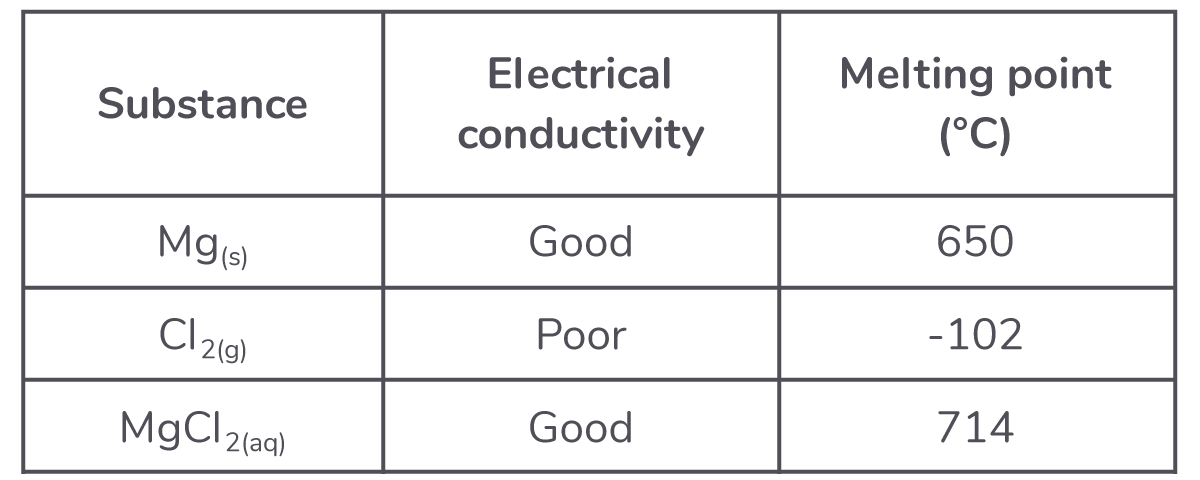
Use your knowledge of structure and bonding to explain the electrical conductivity and melting point of the three substances in the table above.
Graphene is an extremely strong and thin material used in electronics. It is an excellent conductor of electricity and it has a very high melting point.
Graphene is made from carbon atoms.
The diagram below shows part of the structure of graphene.
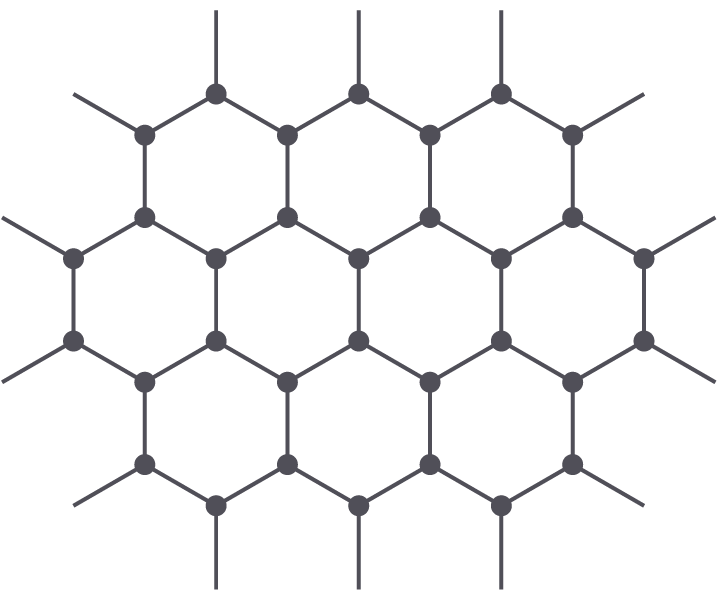
Deduce the type of crystal structure shown by graphene.
Explain why graphene is an excellent conductor of electricity.
Explain why graphene has a high melting point.
Carbon atoms can also bond to each other to produce a range of other structures, including graphite, diamond and nanotubes.
Describe two features of the structure and bonding in graphite that are similar to diamond.
Describe two features of the structure and bonding in graphite that are different to diamond.
This question is about the element copper.
Describe the metallic bonding in copper.
Explain why copper can conduct electricity.
The melting points of some copper halides are shown in the table below.
| Substance | Melting point (°C) |
|---|---|
| CuF_2_ | 836 |
| CuCl_2_ | 630 |
| CuBr_2_ | 498 |
Suggest why the melting point of copper(II) fluoride is higher than that of copper(II) bromide.
Hydrazine is a colourless liquid at room temperature. It has the formula N2H4 in which two nitrogen atoms are covalently bonded together.
State what is meant by the term covalent bond.
Complete the dot and cross diagram for a molecule of hydrazine showing the outer electrons only.
Use crosses (x) to represent the electrons from nitrogen and dots (⸱) to represent the electrons from hydrogen.
Explain why hydrazine does not conduct electricity in any state.
Hydrazine is very soluble in water.
Explain, using a labelled diagram and naming the relavent intermolecular interactions, why hydrazine is very soluble in water.
Calcium nitride has a giant ionic lattice structure.
Describe what is meant by the term giant ionic lattice, in terms of the type and arrangement of particles present.
Write the equation, including state symbols, for the reaction between calcium and nitrogen to form calcium nitride.
State all the conditions under which calcium nitride conducts electricity.
Explain your answer in terms of the particles involved.
Potassium and calcium are consecutive s-block metals.
Describe the bonding in metals.
Outline why metals can conduct electricity.
Suggest why calcium has a higher melting point than potassium.
Suggest two reasons why solid calcium has a greater density than solid potassium.
Magneisum and fluorine react together to form the ionic compound, magnesium fluoride.
Write the equation, including state symbols, for the reaction between magnesium and fluorine to produce magnesium fluoride.
Draw a dot-and-cross diagram to show the bonding in magnesium fluoride.
Include the outer-shell electrons only.
State what is meant by the term ionic bond.
The table shows the ionic radius and charge of six ions.
| Ion | Ionic radius (nm) |
|---|---|
| A^+^ | 0.14 |
| B^+^ | 0.18 |
| C^2+^ | 0.15 |
| X^-^ | 0.14 |
| Y^-^ | 0.18 |
| Z^2-^ | 0.15 |
The ionic solids AX, BY and CZ have the same lattice structure.
Deduce the order of magnitude of their lattice energies, giving the most exothermic first.
Explain your answer.
Ammonia reacts with aluminium chloride as shown by the equation:
NH3 + AlCl3 ➔ H3NAlCl3
Name the type of bond formed between N and Al in H3NAlCl3.
Explain how this bond is formed.
Draw the structure of H3NAlCl3.
Show each covalent bond as a line and each co-ordinate bond as an arrow.
Many properties of substances can be explained using structure and bonding.
Iodine, magneisum oxide, copper, diamond and ice are all crystalline solids.
Complete the table below with:
- the name of the type of bonding found in each crystalline solid,
- the type of lattice structure for each crystalline solid.