Redox Equilibria - exam practice
Redox Equilibria
Question 1 of 15
A chemist does an experiment to determine the percentage of copper in an alloy.
The chemist;
- reacts 874 mg of the alloy with concentrated nitric acid acid to form a solution (all of the copper in the alloy reacts to form aqueous Cu2+ ions)
- pours the solution into a volumetric flask and makes the volume up to 250 cm3 with distilled water
- shakes the flask thoroughly
- transfers 25.0 cm3 of the solution into a conical flask and adds an excess of potassium iodide
- uses exactly 8.00 cm3 of 0.0950 mol dm-3 sodium thiosulfate (Na2S2O3) solution to react with all the iodine produced. The equations for the reactions are
2Cu2+ + 4I- ➔ 2CuI + I2
2S2O32- + I2 ➔ 2I- + S4O62-
Calculate the percentage of copper by mass in the alloy.
Give your answer to 3 significant figures.
The dichromate ion, Cr2O72−, can be used to oxidise iodide ions to iodine.
What is the oxidation state of chromium in Cr2O72−?
Write the following equations:
- A half equation for the oxidation of iodide ions to iodine
- A half equation for the reduction of Cr2O72− to Cr3+ in acidic conditions
- An overall redox equation for the reaction
MnO2 is another oxidising agent that can be used to oxidise iodide ions to iodine.
2I− + MnO2 + 4H+ ➔ Mn2+ + 2H2O + I2
Give the oxidation state changes of Mn and I and show that this is a redox reaction.
The percentage purity of a 0.850 g sample of impure iodine can be determined using a titration. The iodine is dissolved in potassium iodide solution and titrated with sodium thiosulfate according to the reaction below.
2S2O32− + I2 ➔ 2I− + S4O82−
The titration requires 28.85 cm3 of 0.200 mol dm−3 sodium thiosulfate.
Calculate the percentage purity of the sample of iodine, giving your answer to 3 significant figures.
Potassium sulfite, K2SO3, is used as a preservative in some foods and drinks.
Food safety laws permit a maximum of 0.500 g of K2SO3 per kg of sausage meat.
A scientist uses a manganate(VII) titration to determine how much K2SO3 a sample of sausage meat contains.
Step 1: the K2SO3 from 1.00 kg of sausage meat is extracted to form a solution containing aqueous SO32- ions.
Step 2: the solution from step 1 is made up to 250.0 cm3 in a volumetric flask with water. 25.0 cm3 of this diluted solution is pipetted into a conical flask.
Step 3: the pipetted solution from step 2 is acidified with dilute sulfuric acid and then titrated with 1.20 x 10⁻² mol dm-3 solution of potassium manganate(VII), KMnO4.
The equation for this titration is:
2MnO4-(aq) + 6H+(aq) + 5SO32-(aq) ➔ 2Mn2+(aq) + 3H2O(l) + 5SO42-(aq)
10.40 cm3 of KMnO4(aq) is required to reach the endpoint.
Analyse the results to determine whether the amount of potassium sulfite in sausage meat is above or below the legal limit.
Compound Y is an iodate(V) salt of a group 1 metal.
The iodate(V) ion has the formula IO3-.
A scientist carries out a titration to find the formula of compound Y.
Step 1: the scientist dissolves 1.39 g of Y in water and makes up the solution to 250.0 cm3 in a volumetric flask.
Step 2: the scientist pipettes 20.00 cm3 of the solution of Y into a conical flask, followed by 10 cm3 of dilute sulfuric acid and an excess of KI(aq).
The iodate(V) ions are reduced to iodine, as shown below.
IO3-(aq) + 6H+(aq) + 5I-(aq) ➔ 3I2(aq) + 3H2O(l)
Step 3: the resulting mixture is titrated with 0.200 mol dm-3 Na2S2O3(aq).
2S2O32-(aq) + I2(aq) ➔ S4O62-(aq) + 2I-(aq)
The scientist's titration readings are shown in the table below.
Complete the table.
Calculate the mean titre, in cm3, that the scientist should use for analysing the results.
Describe and explain how the student should determine the end point of this titration accurately.
Determine the relative formula mass and formula of the group 1 iodate(V), Y.
Define the term standard electrode potential.
The table below shows the standard electrode potentials, E⦵. of two half-equations.
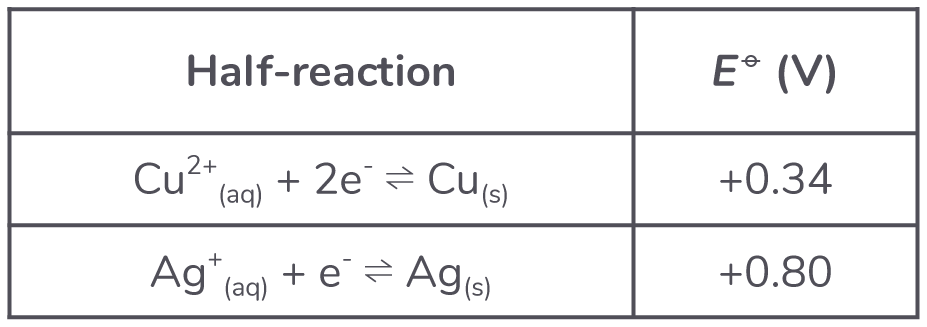
Write the conventional representation of the cell used to measure the standard electrode potential for the Ag+/Ag electrode.
A standard Cu2+(aq)/Cu(s) half-cell is connected to a standard Ag+(aq)/Ag(s) half-cell. The potential of the cell is measured.
Write down the equation for the overall cell reaction.
Include state symbols.
Give the value of E⦵ cell for the cell in part c).
Water is then added to the half-cell.
Explain, in terms of equilibrium, how the cell potential changes when water is added.
Chlorine dioxide, ClO2, has several uses including in the purification of water.
ClO2 is made by reacting ClO3- with concentrated hydrochloric acid.
2ClO3- + 4H+ + 2Cl- ⇌ 2ClO2 + 2H2O + Cl2
The table below shows some electrode potential data.
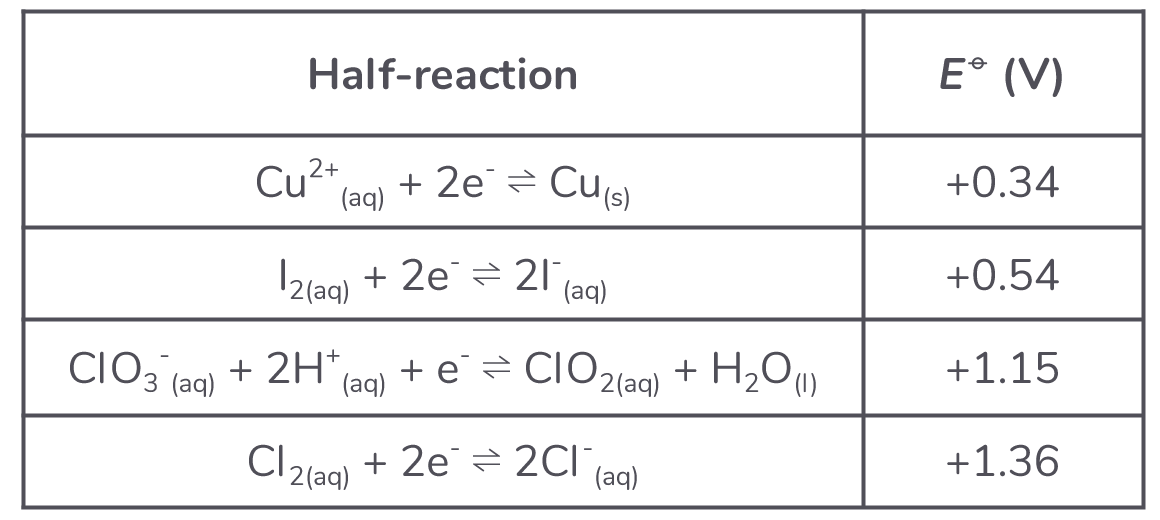
Use data in the table above to explain why the formation of ClO2 via the equation above does not occur under standard conditions.
Suggest why the forward reaction for the formation of ClO2 does occur in the presence of concentrated hydrochloric acid.
A Cu2+(aq)/Cu(s) half-cell is used to confirm the E⦵ of a Cl2(aq)/Cl-(aq) half-cell.
Complete and label the diagram of the apparatus the student would set up.
Include state symbols.
Give the value of E⦵ cell for the cell in part c).
State and explain which way the electrons move when the cell in part c) delivers a current.
State the meaning of the term electochemical series.
Standard electrode potentials for three redox systems are shown in the table below.
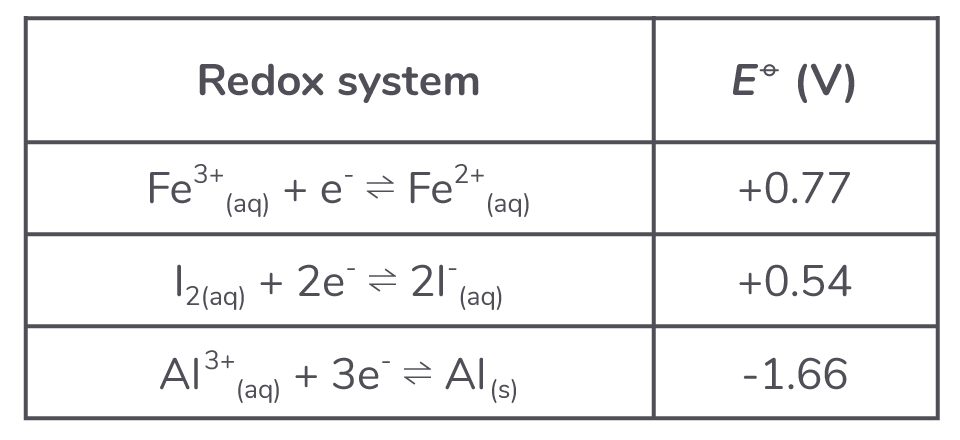
Use information in the table below to predict three reactions that might be feasible.
Write the overall equation for each predicted reaction.
Give two reasons why it is uncertain whether reactions predicted from E⦵ values may actually take place.
In the table above, state the strongest reducing agent and the strongest oxidising agent.
Explain your reasoning.
The table below shows two standard electrode potentials, E⦵.
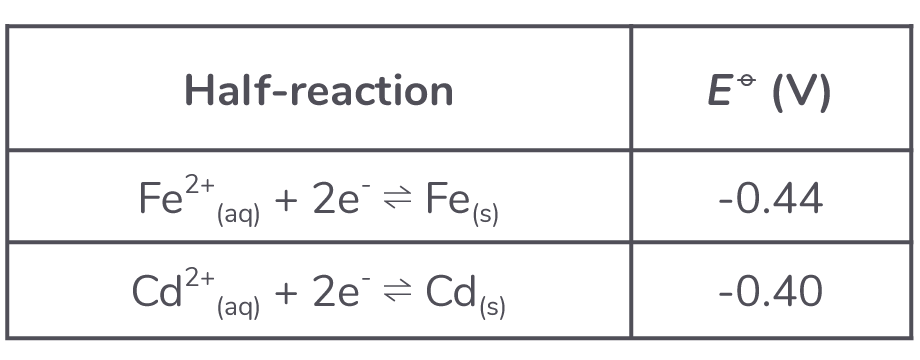
Calculate E⦵cell.
Write the cell equation that produced the E⦵cell value calculated in part a).
Hydrogen–oxygen fuel cells are used to provide electrical energy for electric motors in vehicles.
In an alkaline hydrogen–oxygen fuel cell, a current is generated that can be used to drive an electric motor.
The reactions that occur are:
2H2(g) + 4OH-(aq) ➔ 4H2O(l) + 4e-
O2(g) + 2H2O(l) + 4e- ➔ 4OH-(aq)
Use these half-equations to explain how an electric current can be generated.
Explain why a fuel cell does not need to be recharged.
To provide energy for a vehicle, hydrogen can be used either in a fuel cell or in an internal combustion engine.
Suggest one advantage and one disadvantage of using hydrogen in a fuel cell rather than in an internal combustion.
Direct-ethanol fuel cells (DEFCs) are being developed in which the fuel is ethanol rather than hydrogen.
Suggest two advantages of using ethanol as the fuel in a fuel cell rather than hydrogen.
Draw a fully labelled diagram of the experimental set-up you could use to measure the standard electrode potential of the V3+(aq)/V2+(aq) electrode. Include the necessary chemicals.
State the three standard conditions needed for this measurement.
The salt bridge typically contains a solution of potassium nitrate.
Give two reasons why potassium nitrate can be used as a salt bridge.
The table below shows some standard electrode potentials.
| Redox system | Electrode half-equation | E^⦵^ (V) |
|---|---|---|
| 1 | V^2+^(aq) + 2e^-^ ⇌ V_(s)_ | -1.18 |
| 2 | V^3+^(aq) + e^-^ ⇌ V^2+^(aq) | -0.26 |
| 3 | VO^2+^(aq) + 2H^+^(aq) + e^-^ ⇌ V^3+^(aq) + H_2_O_(l)_ | +0.34 |
| 4 | I_2(aq)_ + 2e^-^ ⇌ 2I^-^(aq) | +0.54 |
| 5 | VO_2_^+^(aq) + 2H^+^(aq) + e^-^ ⇌ VO^2+^(aq) + H_2_O_(l)_ | +1.00 |
Suggest how the E for the V3+(aq)/V2+(aq) electrode would differ from its E⦵ value if the concentration of V2+(aq) ions is reduced.
Explain your answer.
A solution containing iodide ions, I-, was added to an acidified solution containing vanadium(V) ions, VO2+.
Predict the oxidation state of the vanadium ions left at the end of the reaction.
Justify your prediction by calculating the E⦵cellfor any relevant reactions.
Write the ionic equation for any reaction(s) occurring.
Explain, using information in the table, whether the dispropotionation of V2+(aq) into V3+(aq) and V(s) is feasible under standard conditions.
The diagram below shows an unlabelled voltaic cell for the reaction:
Pb2+(aq) + Fe(s) ➔ Fe2+(aq) + Pb(s)
Label the diagram with the species in the equation.
Identify the components labelled X and Y.
State the function of component Y.
The diagram shows a voltaic cell with a light bulb in the circuit.
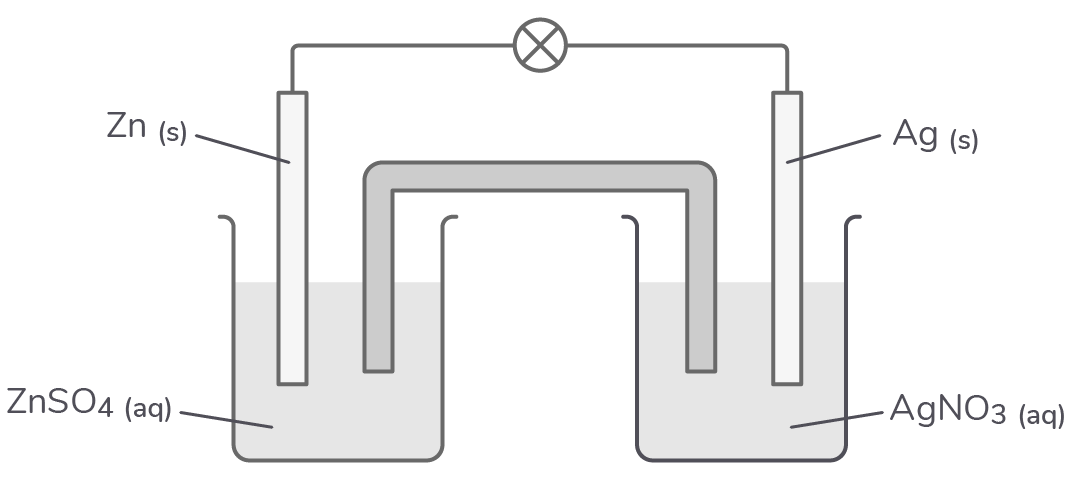
Deduce the half-equations for the reaction at each electrode when current flows.
Write the equation for the expected overall chemical reaction for the voltaic cell.
Annotate the diagram with the location and direction of electron movement when current flows.
Hydrogen–oxygen fuel cells are used to provide electrical energy for electric motors in vehicles.
In an acidic hydrogen–oxygen fuel cell, a current is generated that can be used to drive an electric motor.
The reactions that occur are:
H2(g) ➔ 2H+(aq) + 2e-
1⁄2O2(g) + 2H+(aq) + 2e- ➔ H2O(l)
Use these half-equations to explain how an electric current can be generated.
The standard reduction potentials for Sn2+ and VO2+ are shown below.
Sn2+(aq) + 2e- ⇌ Sn(s) E⦵ = 0.14 V
VO2+(aq) + 2H+(aq) + e- ⇌ V3+(aq) + H2O(l) E⦵ = +0.34 V
Calculate the cell potential, E⦵, for the reaction between the VO2+(aq) ions and Sn(s), using the data above.
Deduce, giving your reason, whether a reaction between Sn(s) and VO2+(aq) would be spontaneous.
The standard total entropy change, ΔS⦵total, for the reaction between the VO2+(aq) ions and Sn(s) is 311 J K-1 mol-1.
Calculate a value for the equilibrum constant, K, at 298 K, giving your answer to 3 significant figures.
R = 8.31 J K-1 mol-1
Ethanedioic acid, (COOH)2, is the active ingredient in a spray to treat infections of the outer ear.
A chemist carries out a redox titration using aqueous cerium(IV) sulfate, Ce(SO4)2(aq), to determine the percentage, by mass, of ethanedioic acid in the spray.
In the titration, Ce4+(aq) ions oxidise ethanedioic acid in acidic conditions, as shown by the equation below
2Ce4+(aq) + (COOH)2(aq) → 2Ce3+(aq) + 2CO2(g) + 2H+(aq)
Ce4+(aq) ions have a yellow colour. Ce3+(aq) ions are colourless.
Dilute sulfuric acid is added to 5.00 g of the spray to form a colourless solution which is made up to 250.0 cm3 with distilled water.
25.00 cm3 of this solution is titrated with 1.00 x 10⁻² moldm-3 Ce(SO4)2 from the burette.
The titration is repeated until concordant titres are obtained.
The mean titre is 22.25 cm3.
What colour change would the chemist observe at the end point?
Calculate the percentage, by mass, of ethanedioic acid, (COOH)2, in the spray.
Give your answer to 3 significant figures.
A chemist uses the following procedure to analyse iron tablets containing iron in the form of iron(II) sulfate, FeSO4.
- Crush 1 iron tablet and transfer the resulting powder to a 250.0 cm3 volumetric flask.
- Rinse the apparatus used with dilute sulfuric acid transferring all washings to the volumetric flask.
- Add dilute sulfuric acid to make up the solution to exactly 250.0 cm3. Stopper the flask and invert it several times.
- Titrate 25.00 cm3 of this solution with 2.00 x 10⁻³ mol dm-3 potassium manganate(VII) solution.
- Repeat the titration until concordant results are obtained. The overall equation for the reaction occurring in the titration is:
MnO4-(aq) + 8H+(aq) + 5Fe2+(aq) ⇌ Mn2+(aq) + 4H2O(l) + 5Fe3+(aq)
The table below shows some standard electrode potential data.
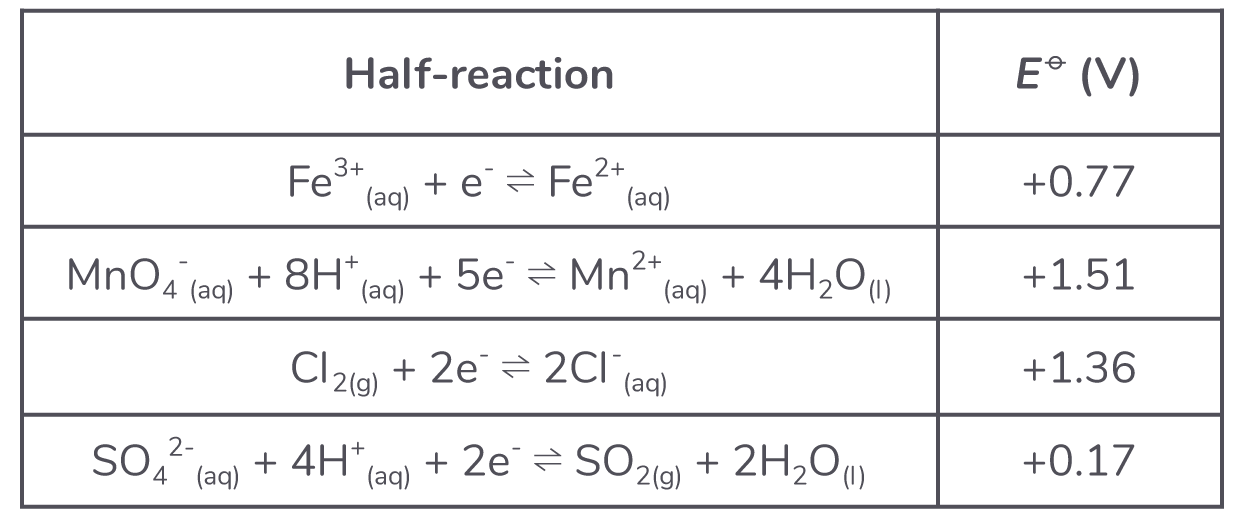
Using data in the table, explain why the chemist used sulfuric acid and not hydrochloric acid in their titration.
Suggest why this titration does not require the addition of an indicator.
State the colour change at the end-point of this titration.
The chemist decides to take burette readings from the top of the meniscus rather than from the bottom.
Explain the effect of this, if any, on the titre values.
The chemist's titration readings are shown in the table below.
Complete the table.
Use the titration results in part e) and information from the procedure to calculate the mass of FeSO4 in 1 iron tablet.
Give your answer to 3 significant figures.