Introductory Organic Chemistry - exam practice
Introductory Organic Chemistry
Question 1 of 8
Crude oil undergoes fractional distillation to produce a number of different fractions containing saturated hydrocarbons.
Explain the meaning of the term saturated hydrocarbon.
The saturated hydrocarbons obtained from crude oil include the homologous series of alkanes.
State two characteristics of a homologous series.
One example of an alkane is octane which has the molecular formula C8H18.
Explain what is meant by the term molecular formula.
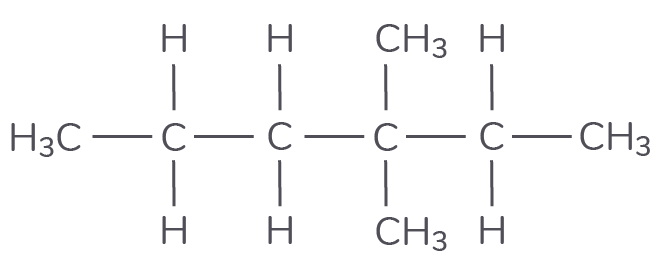
The structure below represents one of the structural isomers of octane.
State the meaning of the term structural isomerism.
Name the isomer shown below.
This question is about reaction mechanisms.
Mechanisms use curly arrows.
What does a curly arrow represent in a mechanism?
The diagram below shows part of a mechanism for the reaction between a halogenoalkane and sodium hydroxide to produce an alcohol.
Add the missing curly arrow and draw the structure of the products that would form in the reaction below.
Use the mechanism in part b) to explain what is meant by the term heterolytic fission.
The halogenoalkane 1-bromo-2-methylpropane reacts with sodium hydroxide to produce an alcohol as shown in the diagram below.

Name the alcohol and draw its skeletal formula.
This question is about halogenoalkanes.
Draw the structure of the alkene that would react with bromine to form 1,2-dibromo-3-methylpentane.
Add curly arrows to the mechanism below to show the reaction of an alkene with bromine to produce a halogenoalkane.
Name the halogenoalkane formed in the reaction.
The halogenoalkane with the molecular formula C4H9Br has four structural isomers. Two of these isomers have been drawn below.
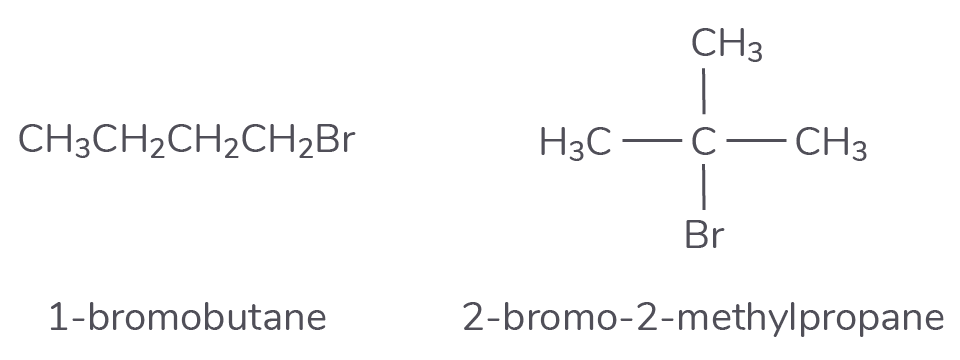
Draw and name the other two isomers.
Explain what is meant by the term displayed formula and draw the displayed formula of 2,3-dichloro-2-methylbutane.
Both butane and butene react with bromine.
State an equation and the condition required for the reaction of 1 mol of butane with 1 mol of bromine.
State an equation for the reaction of 1 mol of butene with 1 mol of bromine.
Identify the type of reaction that occurs between the following pairs of substances:
- butane and bromine;
- butene and bromine.
Explain why the boiling point of butanol is significantly greater than that of butene.
The structural formulae of two organic compounds are shown below.
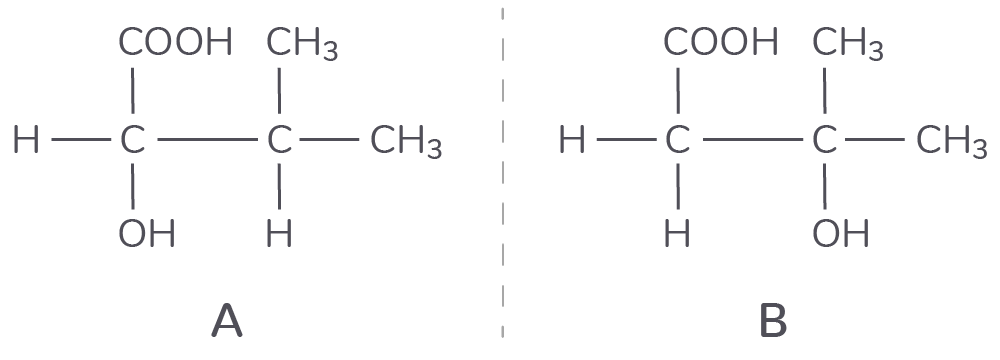
Deduce the type of chemical reaction that could be used to distinguish between these compounds.
Compound Xis a member of a homologous series and its structure is shown below.
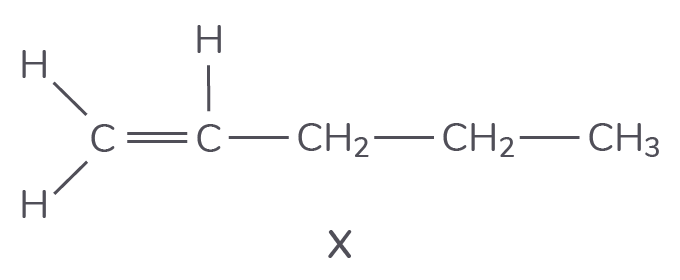
What is the general formula of this homologous series?
Draw and name the position isomer of compound X.
Pentane is a member of the alkane homologous series.
Give the general formula of the alkanes.
One of the structural isomers of pentane is 2,2-dimethylpropane.
Draw the displayed formula of 2,2-dimethylpropane and name the type of structural isomerism shown.
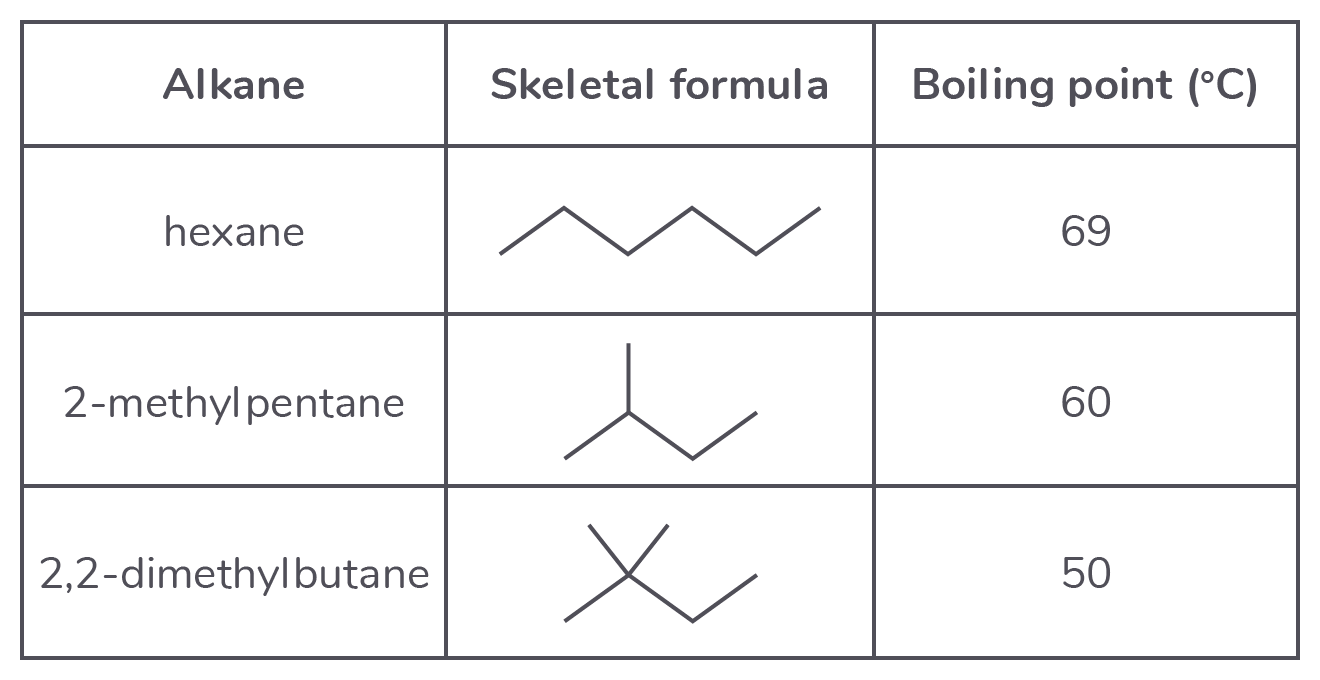
The table below shows the boiling points of some saturated hydrocarbons.
Explain the meaning of the term hydrocarbon.
State and explain the trend in boiling points shown in the table.
All of the alkanes in the table react with halogens in the presence of ultraviolet light to form halogenoalkanes.
Name the mechanism for this reaction.
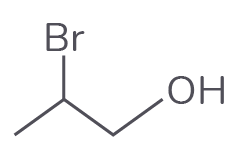
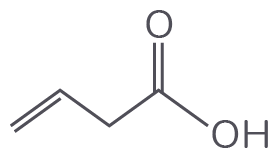
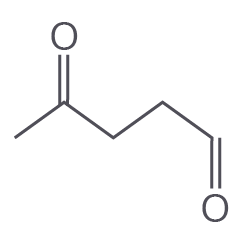
Identify the functional groups in each of the following compounds:
This question is about the compound ammonium dichromate(VI), (NH4)2Cr2O7.
(NH4)2Cr2O7 breaks down at around 180°C, producing an oxide of chromium, nitrogen and water as the only products.
Write an equation for the reaction. State symbols are not required.
Give a name for this type of reaction.
Ammonium dichromate(VI) comes with several warnings on its packaging.
- This compound is toxic when inhaled and by passing through the skin.
- Handle with extreme caution.
- Contact can irritate and burn the skin and eyes, with possible eye damage.
- Inhaling can irritate the nose and throat.
- Ammonium dichromate(VI) is a strong oxidiser that enhances the combustion of other substances.
Some of the symbols shown are used for ammonium dichromate(VI).
Identify the symbols for ammonium dichromate(VI) by placing a tick in the box next to each relevant symbol.
Suggest why ammonium dichromate(VI) is not stored in the same cupboard as alkanes.