Kinetics - exam practice
Kinetics
Question 1 of 12
Collision theory is a principle of chemistry used to predict the rate of a reaction.
State the two conditions in collision theory that must be met for a collision to be successful.
Define the term activation energy.
State two factors that affect the rate of a reaction.
The diagram below shows a Boltzmann distribution curve for a sample of gas molecules.
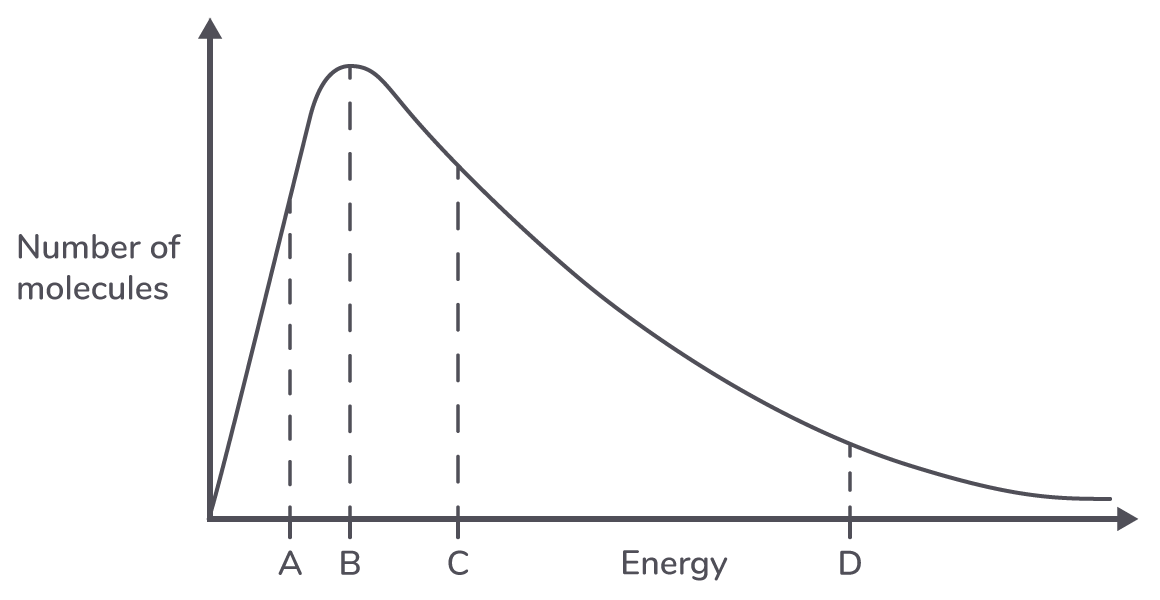
What does the area under the curve represent?
Which letter represents the mean energy of the molecules?
What does the letter D represent?
Why does the curve begin at the origin?
This question is about catalysts and the role they play in reactions.
State the meaning of the term catalyst.
Explain in general terms how a catalyst works.
The diagram below shows the Boltzmann distribution for a sample of ammonia molecules. Ammonia can undergo a decomposition reaction into its elements.
Label the diagram to show the position of the activation energy when a catalyst is used in the decomposition.
Explain how a catalyst increases the rate of a reaction. Refer to the Boltzmann distribution in your answer.
The rate of a reaction is affected by a number of different factors including temperature.
Explain how an increase in temperature affects the rate of reaction, referring to ideas about collision theory in your answer.
The diagram below shows the Boltzmann distribution for a sample of gas molecules.
Sketch a second curve on the diagram to show the distribution at a higher temperature.
Explain with reference to both curves how a small change in temperature can lead to a large increase in the rate of reaction.
The diagram below shows two Boltzmann distribution curves for a sample of gas molecules at two different temperatures.
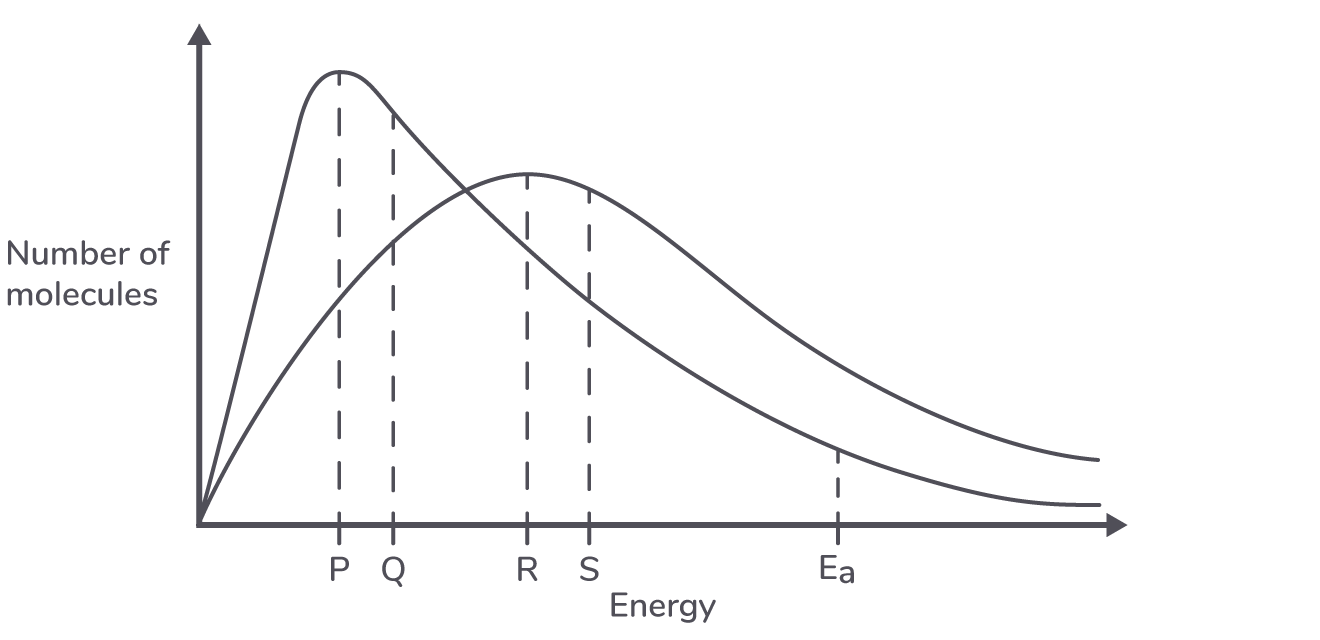
Which letter represents the most probable energy at the lower temperature?
Which letter represents the mean energy of the molecules at the higher temperature?
Give one reason why most collisions in the gas phase do not result in a successful collision.
Hydrogen peroxide solution undergoes a decomposition reaction to form oxygen gas.
Explain how increasing the concentration of hydrogen peroxide affects the rate of reaction.
Explain how adding a catalyst would increase the rate of the reaction.
The diagram below shows the Boltzmann distribution for a sample of hydrogen peroxide molecules.
Add a second curve on the axes to show the distribution at a lower temperature.
Hydrogen gas can be reacted with oxygen to produce water.
Explain how an increase in pressure would affect the rate of reaction.
The diagram below shows the Boltzmann distribution curve for a sample of hydrogen gas molecules at a specific temperature.
Mark the position of the most probable energy of the hydrogen molecules.
The diagram below shows the same distribution.
Sketch a new curve to show the distribution at a lower temperature.
This question is about catalysts and how they can affect the rate of a reaction
Use the idea of activation energy to explain why a catalyst speeds up a reaction.
Draw a labelled Boltzmann distribution curve on the axes below to illustrate the effect of adding a catalyst to a reaction.
Collision theory is used to predict the rate of a reaction.
Explain what must happen for a reaction to occur between molecules of two different gases.
The diagram below shows the Boltzmann distribution for a sample of gas molecules.
Sketch a second curve on the diagram to show the distribution at a higher temperature.
State the effect, if any, of a catalyst on the shape of these distributions.
Other than by increasing the temperature or by using a catalyst, explain another way in which the rate of a reaction could be increased.
The temperature of a reaction can be changed to influence the rate of a reaction.
Other than by increasing the temperature, state one way in which the collision frequency between particles in a gas could be increased.
Explain why a small increase in temperature can lead to a large increase in the rate of a reaction.
Sodium thiosulfate reacts slowly with hydrochloric acid.
Explain why, at constant temperature, the rate doubles if the concentration of hydrochloric acid is doubled.
Excess hydrochloric acid is added to lumps of calcium carbonate.
CaCO3(s) + 2HCl(aq) ➔ CaCl2(aq) + H2O(l) + CO2(g)
The graph shows the results of an experiment using excess calcium carbonate and dilute hydrochloric acid.
Sketch a curve on the graph to show the volume of carbon dioxide produced over time if the same mass of crushed calcium carbonate is used instead of lumps. All other conditions remain constant.
Outline why the rate of the reaction decreases with time.
State and explain the effect on the rate of reaction if ethanoic acid of the same concentration is used in place of hydrochloric acid.
A strip of magnesium ribbon is added to a solution of copper(II) sulfate. The following reaction occurs:
Mg(s) + CuSO4(aq) ➔ MgSO4(aq) + Cu(s)
Sketch a graph of the concentration of magnesium sulfate, MgSO4, against time as the reaction proceeds.
Outline how the initial rate of reaction can be determined frmo the graph in part a).
Explain, using collision theory, why cutting the same mass of magnesium ribbon into smaller pieces increases the rate of the reaction.
Curves A and B were obtained when a magnesium reacted with the same volume of hydrochloric acid under two different conditions.
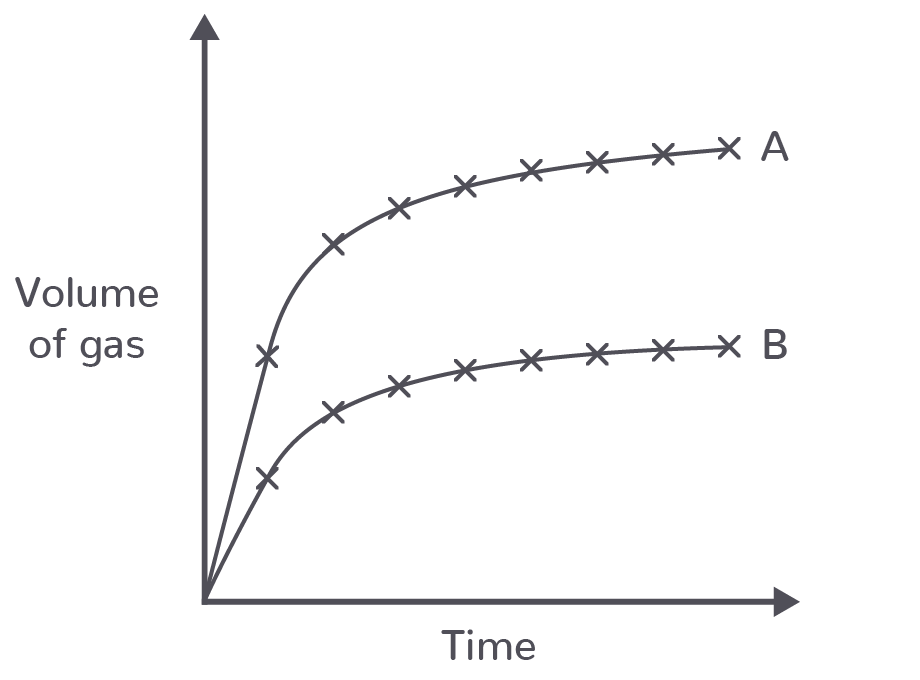
Explain the shape of curve A in terms of the collision theory.
Suggest one possible reason for the difference between curves A and B.