Lattice Energy - exam practice
Lattice Energy
Question 1 of 21
1 of 21
Which of these compounds has the greatest covalent character?
Question 2 of 21
2 of 21
Magnesium chloride, MgCl2, has two lattice energy values quoted in the data booklet.
The first is the experimental value, obtained from the Born-Haber cycle, -2,526 kJ mol-1; the second is the theoretical value, -2,326 kJ mol-1.
Why are the two values different?
Question 3 of 21
3 of 21
Which ionic compound has the largest value of lattice enthalpy?
Question 4 of 21
4 of 21
Which equation represents the lattice enthalpy of magnesium sulfide?
Question 5 of 21
5 of 21
Which of the following compounds has the most polarised anion?
Question 6 of 21
6 of 21
Mg2+ has a higher charge density than Ca2+.
Which statement is correct?
Question 7 of 21
7 of 21
The bond enthalpy for the Cl-Cl bond is +243.0 kJ mol-1.
What is the enthalpy change of atomisation of chlorine in kJ mol-1?
Question 8 of 21
8 of 21
The energy cycle for the dissolving of magnesium chloride in water is
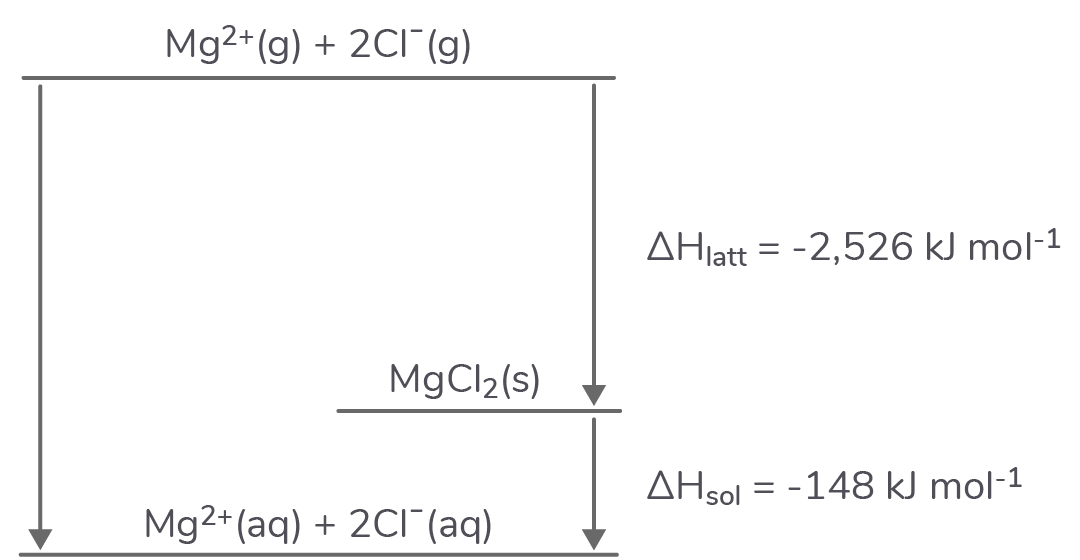
The enthalpy of hydration of the magnesium ion is -1,920 kJ mol-1.
What is the enthalpy of hydration, in kJ mol-1, of the chloride ion?
Question 9 of 21
9 of 21
Energy is given out when one mole of gaseous magnesium ions is hydrated.
Mg2+(g) + aq ➔ Mg2+(aq)
This is more exothermic than the corresponding value for barium ions, Ba2+, because the
Question 10 of 21
10 of 21
Which change would have a negative ΔH value?
Question 11 of 21
11 of 21
Which pair of enthalpy changes will alwaysshare the same sign (i.e. both are always exothermic orboth are always endothermic)?
Question 12 of 21
12 of 21
Which of the following quantities, used in the calculation of the lattice enthalpy of lithium oxide, Li2O, has a negative value?
Question 13 of 21
13 of 21
Which of the equations below represents the first electron affinity for oxygen?
Question 14 of 21
14 of 21
The ionic radii in nm of some ions are given below.
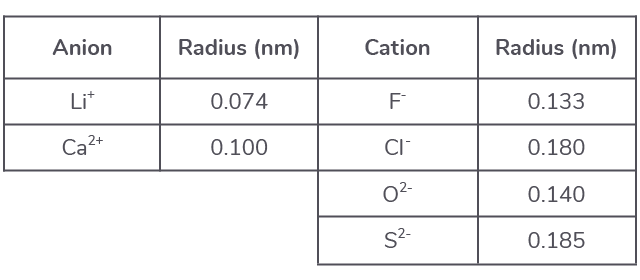
Which of the following compounds has the most exothermic lattice energy? They all have the same crystal structure.
Question 15 of 21
15 of 21
The lattice enthalpy of calcium chloride can be calculated using three of the enthalpy changes below.
Which enthalpy change is notrequired?
Question 16 of 21
16 of 21
Which equation represents the process that occurs when the standard enthalpy of atomisation of iodine is measured?
Question 17 of 21
17 of 21
Which equation represents the average bond enthalpy of the Si-H bond in SiH4?
Question 18 of 21
18 of 21
Which change is exothermic?
Question 19 of 21
19 of 21
Enthalpy data for some reactions are shown in the table below.
| Equation | ΔH |
|---|---|
| C_2_H_4(g)_ + 3O_2(g)_ ➔ 2CO_2(g)_ + 2H_2_O_(l)_ | x |
| C_2_H_6(g)_ + O_2(g)_ ➔ 2CO_2(g)_ + 3H_2_O_(l)_ | y |
| H_2(g)_ + O_2(g)_ ➔ H_2_O_(l)_ | z |
What is the enthalpy change of reaction for the following equation?
C2H4(g) + H2(g) ➔ C2H6(g)
Question 20 of 21
20 of 21
The Born-Haber cycle for potassium oxide is shown below:
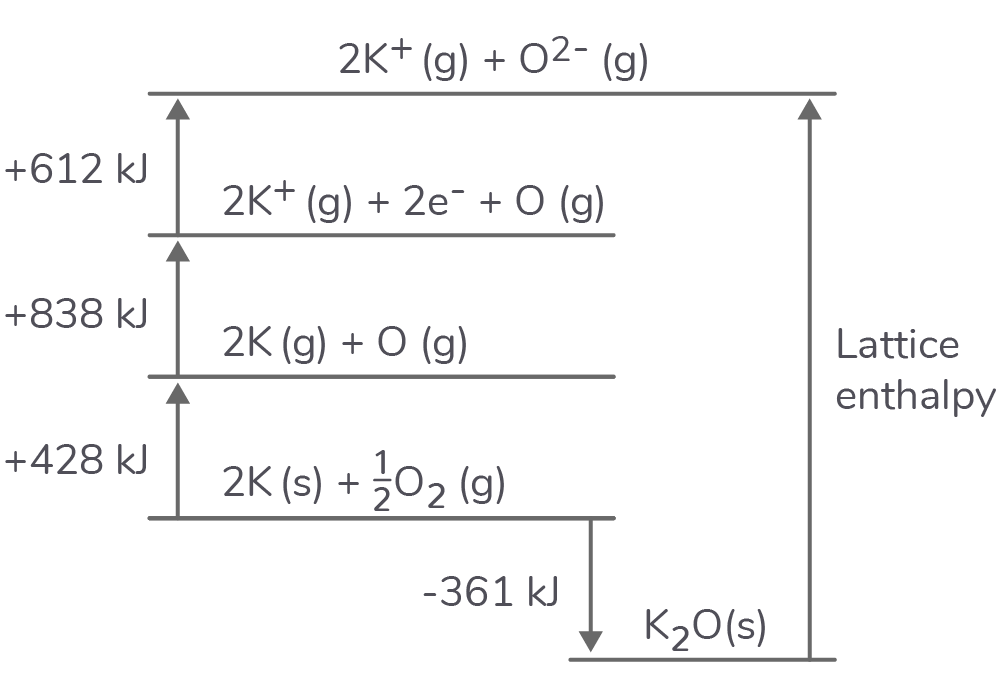
Which expression represents the lattice enthalpy in kJ mol-1?
Question 21 of 21
21 of 21
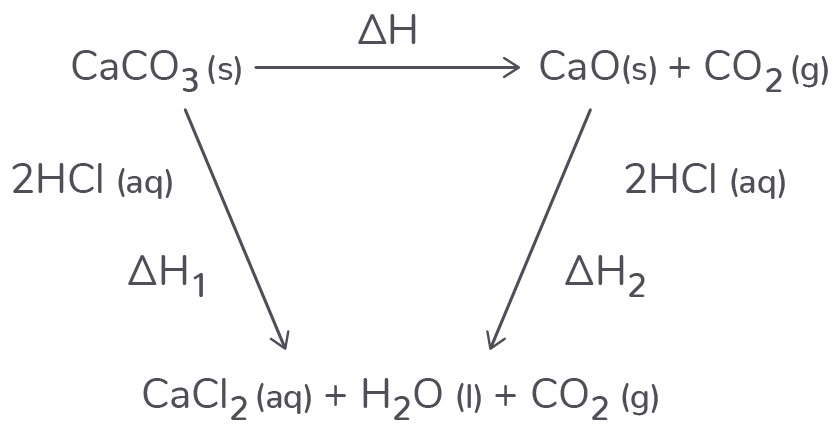
Which expression gives the enthalpy change, ∆H, for the thermal decomposition of calcium carbonate?