Ionic, Covalent and Metallic Bonding - exam practice
Ionic, Covalent and Metallic Bonding
Question 1 of 27
1 of 27
Which of these ions has the smallest ionic radius?
Question 2 of 27
2 of 27
What is the order of decreasing ionic radius?
Question 3 of 27
3 of 27
Which represents the correct order of increasing radius of the ions?
Question 4 of 27
4 of 27
The similarity between metallic elements and ionic compounds is that both
Question 5 of 27
5 of 27
A molecule is
Question 6 of 27
6 of 27
Metals are good conductors of electricity because
Question 7 of 27
7 of 27
Which of these has a dative covalent bond?
Question 8 of 27
8 of 27
The melting temperature of sodium is lower than the melting temperature of magnesium. The best explanation for this is
Question 9 of 27
9 of 27
Which statement about a lattice of sodium chloride is correct?
Question 10 of 27
10 of 27
Which molecule is not able to form a co-ordinate bond with another species?
Question 11 of 27
11 of 27
In which substance do covalent bonds break when it melts?
Question 12 of 27
12 of 27
Which substance contains delocalised electrons?
Question 13 of 27
13 of 27
Which compound contains a co-ordinate bond?
Question 14 of 27
14 of 27
Which is not responsible for conduction of electricity?
Question 15 of 27
15 of 27
What is the formula of magnesium nitride?
Question 16 of 27
16 of 27
Which form of carbon is the poorest electrical conductor?
Question 17 of 27
17 of 27
Which is correct for all solid ionic compounds?
Question 18 of 27
18 of 27
The structural feature that graphene and graphite have in common is that the carbon atoms are arranged in...
Question 19 of 27
19 of 27
Which statement is correct about electronegativity?
Question 20 of 27
20 of 27
Which of these molecules is polar?
Question 21 of 27
21 of 27
Tetrachloromethane, CCl4, is a
Question 22 of 27
22 of 27
Which statement about electronegativity is correct?
Question 23 of 27
23 of 27
Which molecule has an overall dipole?
Question 24 of 27
24 of 27
Which molecule is most polar?
Question 25 of 27
25 of 27
The electronegativity values of four elements are given.
| C | N | O | F |
|---|---|---|---|
| 2.6 | 3.0 | 3.4 | 4.0 |
What is the order of increasing polarity of the bonds in the following compounds?
Question 26 of 27
26 of 27
Which set of elements in the solid state contain a simple molecular lattice, a giant covalent lattice and a giant metallic lattice?
Question 27 of 27
27 of 27
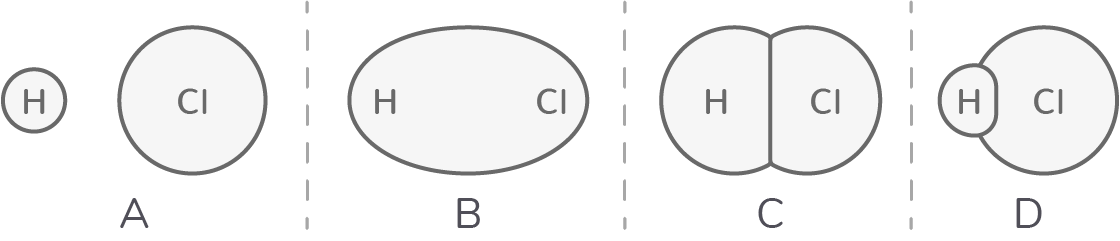
Which diagram best represents the electron density in a molecule of hydrogen chloride?