Atomic Structure - exam practice
Atomic Structure
Question 1 of 24
1 of 24
The 1st to 8th successive ionisation energies, in kJ mol-1, of an element in period 3 are:
1,012 1,903 2,912 4,957 6,274 21,269 25,398 29,855
What is the element?
Question 2 of 24
2 of 24
Which of the following sets of data showing the first four ionisation energies, in kJ mol-1, of four elements is most likely to belong to boron?
Question 3 of 24
3 of 24
How many orbitals are there, in total, in the first three energy levels of an atom?
Question 4 of 24
4 of 24
This question refers to isolated gaseous atoms.
In which atom are all electrons paired?
Question 5 of 24
5 of 24
The electronic configuration of the two outermost shells of an atom is 3s23p63d54s2.
What is this atom?
Question 6 of 24
6 of 24
Which statement about an atom of 23Na is correct?
Question 7 of 24
7 of 24
Which statement about p-orbitals is correct?
Question 8 of 24
8 of 24
What is a possible mass number of a magnesium isotope?
Question 9 of 24
9 of 24
What is the shape of an s-orbital?
Question 10 of 24
10 of 24
Which element has atoms with the greatest number of singly occupied orbitals?
Question 11 of 24
11 of 24
Which ion has a different number of electrons from the other three ions?
Question 12 of 24
12 of 24
A sample of naturally occuring boron contains the isotopes 10B and 11B.
The relative atomic mass of the boron sample is 10.8.
What is the percentage of 11B atoms in the sample of boron?
Question 13 of 24
13 of 24
What is the electron configuration of V2+ in the ground state?
Question 14 of 24
14 of 24
Which atom has the smallest number of neutrons?
Question 15 of 24
15 of 24
Which is the electron configuration of an atom with only two unpaired electrons?
Question 16 of 24
16 of 24
What is correct for the chromium isotope 5324Cr?
Question 17 of 24
17 of 24
Which representation would be correct for a species, Z, which has 31 protons, 4 neutrons and 28 electrons?
Question 18 of 24
18 of 24
What is the number of protons and the number of neutrons in 131I?
Question 19 of 24
19 of 24
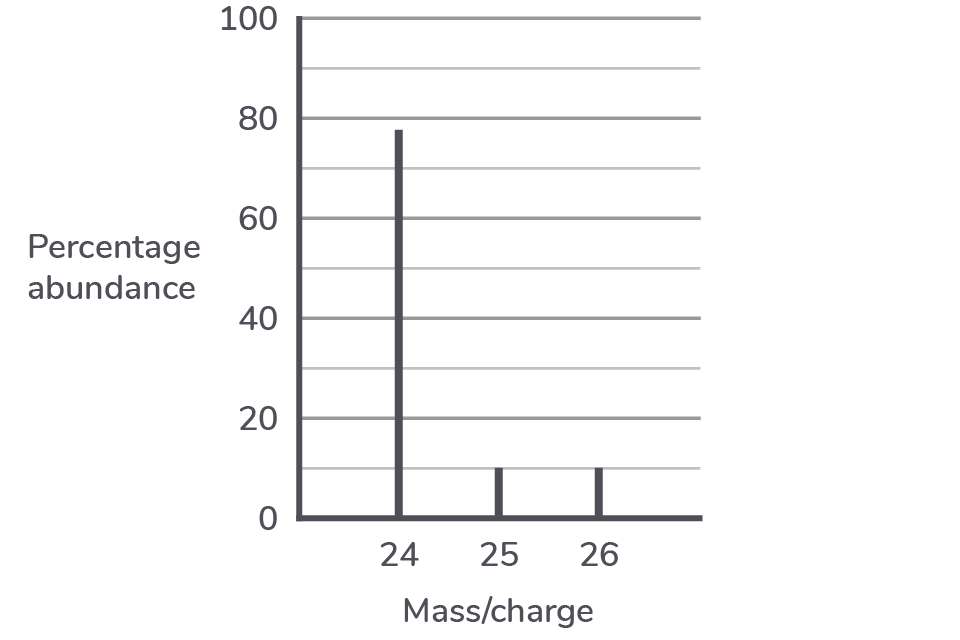
What is the relative atomic mass, Ar, of an element with this mass spectrum?
Question 20 of 24
20 of 24
Which electrons are removed from iron (Z = 26) to form iron(II)?
Question 21 of 24
21 of 24
In which set do all the species contain more electrons than neutrons?
Question 22 of 24
22 of 24
Which mass spectrum best represents bromine molecules with equal 79Br and 81Br isotope proportions?
Question 23 of 24
23 of 24
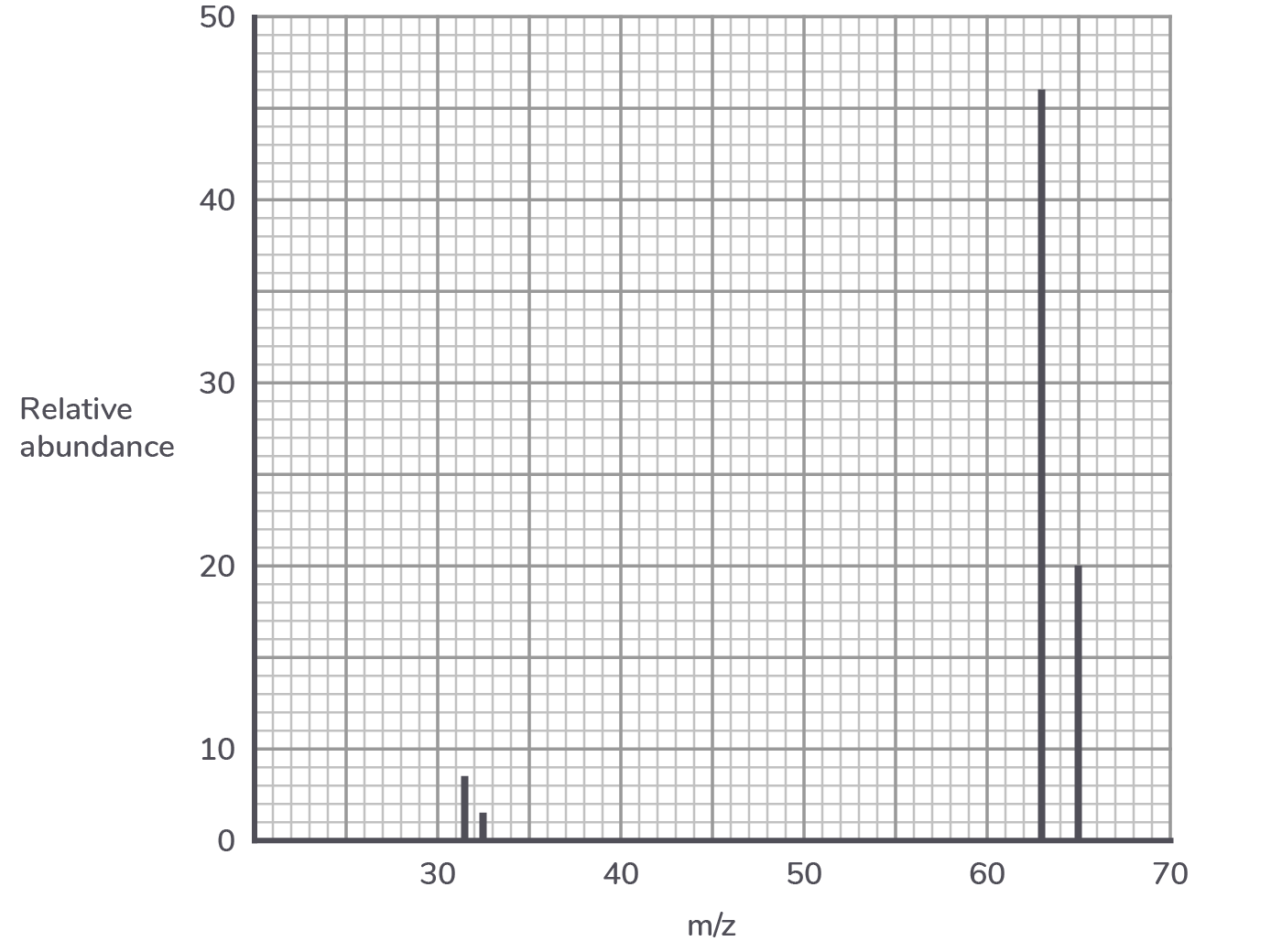
The mass spectrum of a sample of an element is shown above.
Which species could be responsible for the peak at m/z = 32.5?
Question 24 of 24
24 of 24
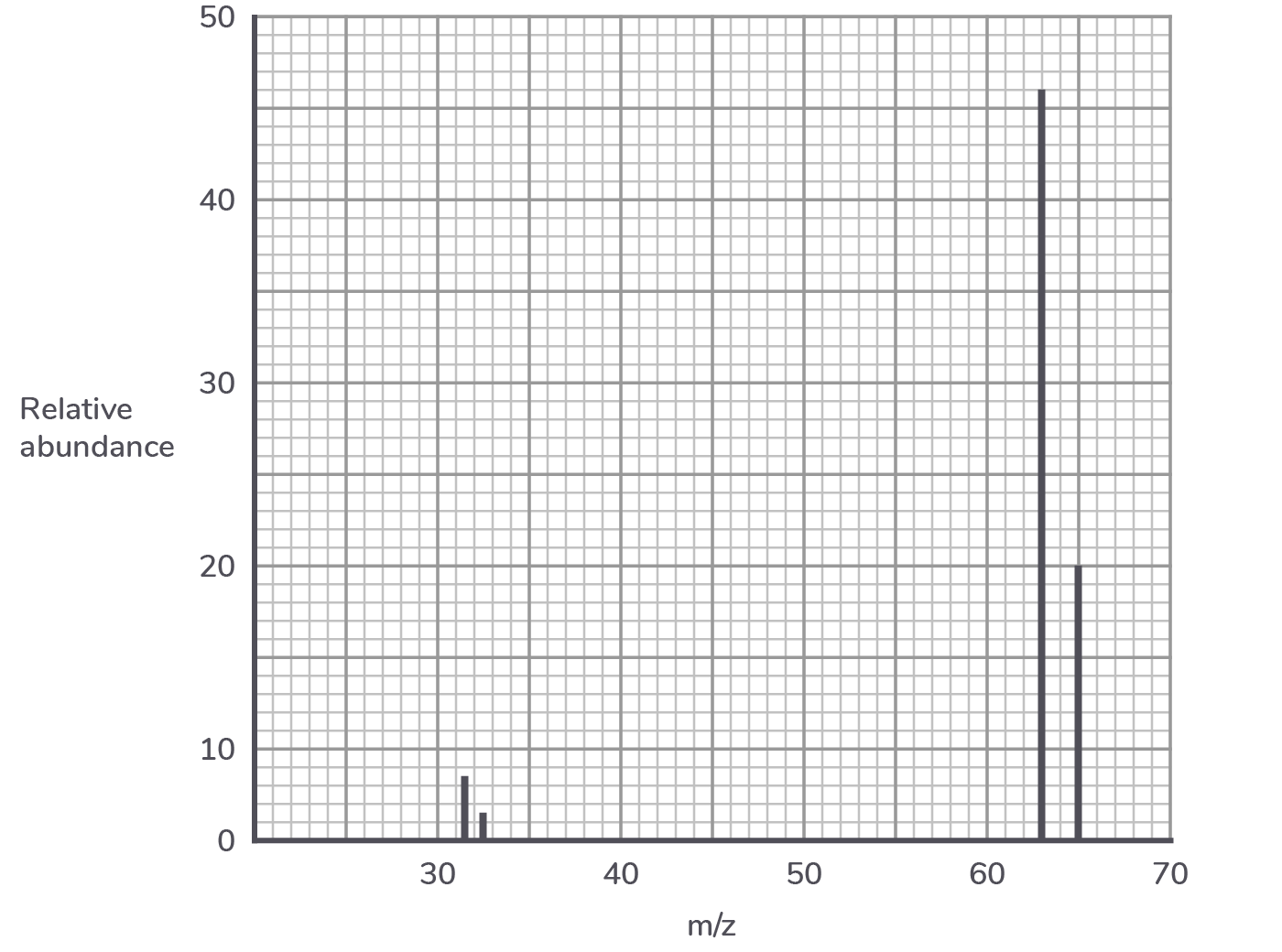
The mass spectrum of a sample of an element is shown above.
What is the Ar of the element?