Organic Synthesis - exam practice
Organic Synthesis
Question 1 of 30
1 of 30
Which organic compound reacts with a Grignard reagent to give a product that forms a secondary alcohol on hydrolysis?
Question 2 of 30
2 of 30
Which piece of apparatus is normally used in solvent extraction?
Question 3 of 30
3 of 30
Cinnamaldehyde, C6H5CH=CHCHO, is a liquid that is slightly soluble in water but is much more soluble in ether. It decomposes below its boiling temperature.
It can be extracted from cinnamon. Sticks of cinnamon are ground up and mixed with water.
Select the correct order of practical techniques to obtain cinnamaldehyde from this mixture.
Question 4 of 30
4 of 30
If the starting material is iodoethane, which sequence of reactions will produce propanoic acid as the main final product in good yield?
Question 5 of 30
5 of 30
Many, but not all, organic reactions need to be heated before a reaction occurs.
Which reaction occurs quickly at room temperature, 20°C?
Question 6 of 30
6 of 30
Which organic reaction is an example of nucleophilic substitution?
Question 7 of 30
7 of 30
A student is required to dry a liquid sample of pentanoic acid.
Which drying agent is suitable?
Question 8 of 30
8 of 30
Which reaction will not give bromoethane as a product?
Question 9 of 30
9 of 30
Which reaction will give CH3CH2CH(OH)CH2CH3 as a product?
Question 10 of 30
10 of 30
What are the correct reagents for the conversion below?
CH3CH2CHOHCH3 ➔ CH3CH2CHBrCH3
Question 11 of 30
11 of 30
Which pair of compounds can bothbe separately hydrolysed in acidic conditions to form propanoic acid?
Question 12 of 30
12 of 30
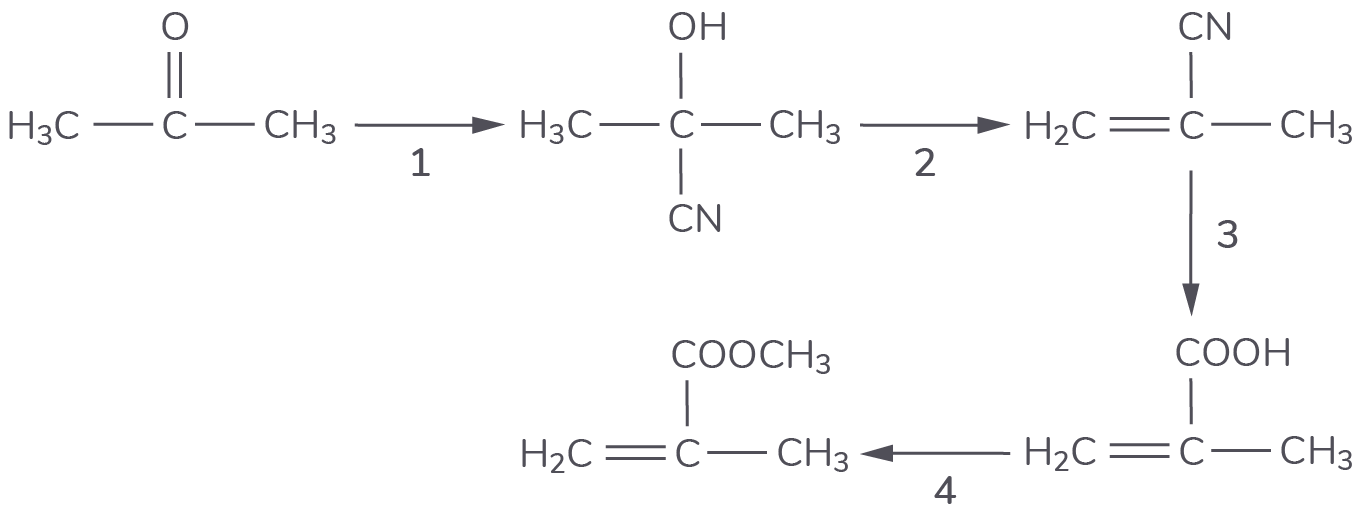
Which set of reagents is not suitable for the step indicated?
Question 13 of 30
13 of 30
Which reaction may be used to make a carboxylic acid in a single step?
Question 14 of 30
14 of 30
Cottonseed oil contains large amounts of polyunsaturated carboxylic acids. When this oil is used to make margarine, the C=C double bonds in the unsaturated carboxylic acids are hydrogenated.
What reagents and conditions would be suitable to bring about this hydrogenation reaction?
Question 15 of 30
15 of 30
Energy is released in the human body by the oxidation of glucose in a complex sequence of reactions. Part of this sequence is the Krebs cycle.
One reaction in the Krebs cycle is the conversion of fumaric acid into malic acid.
HO2CCH=CHCO2H ➔ HO2CCH(OH)CH2CO2H
fumaric acid malic acid
Which reagents could achieve this transformation in the laboratory?
Question 16 of 30
16 of 30
The compound ‘leaf alcohol’ is partly responsible for the smell of new-mown grass.
CH3CH2CH=CHCH2CH2OH
leaf alcohol
What will be formed when ‘leaf alcohol’ is oxidised using an excess of hot, acidified K2Cr2O7(aq)?
Question 17 of 30
17 of 30
Which pair of reagents will take part in a redox reaction?
Question 18 of 30
18 of 30
Which reaction would not give ethanoic acid?
Question 19 of 30
19 of 30
Which compound could be formed by a one-step reaction from 1-chloropropane?
Question 20 of 30
20 of 30
Which statement about the purification of a solid by recrystallisation is correct?
Question 21 of 30
21 of 30
Which substance cannotbe made in a single step from C2H4?
Question 22 of 30
22 of 30
Which compound does not react with nucleophiles?
Question 23 of 30
23 of 30
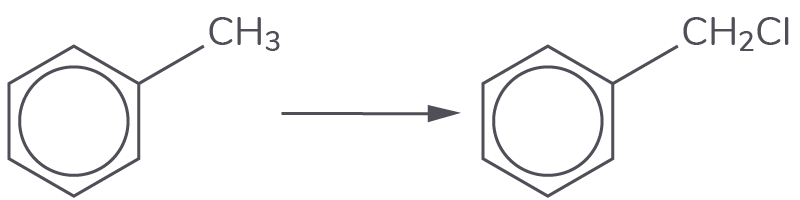
Which is the mechanism for this conversion?
Question 24 of 30
24 of 30
Pentanenitrile can be made by reaction of 1-bromobutane with potassium cyanide.
Which of these is the correct name for the mechanism of this reaction?
Question 25 of 30
25 of 30
A two-step preparation of propylamine is shown.
bromoethane ➔ X ➔ propylamine
What is X?
Question 26 of 30
26 of 30
Butan-1-ol can be made by reaction of 1-bromobutane with aqueous sodium hydroxide.
Which of these is the correct name for the mechanism of this reaction?
Question 27 of 30
27 of 30
What reagent reacts with propylmagnesium bromide to produce butanoic acid?
Question 28 of 30
28 of 30
What is the product of the reaction between propylmagnesium bromide and propanal?
Question 29 of 30
29 of 30
What is the product of the reaction between propylmagnesium bromide and butanone?
Question 30 of 30
30 of 30
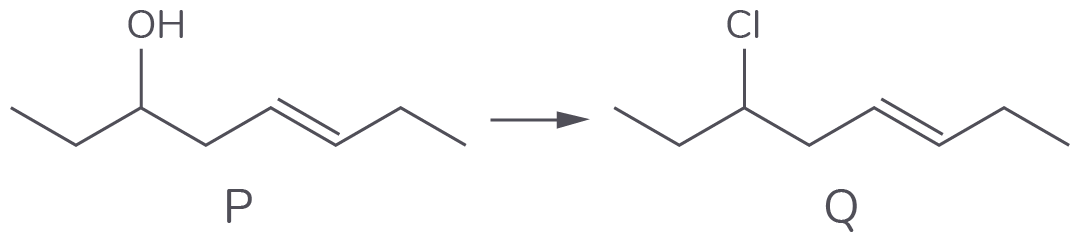
Compound P can be converted into compound Q.
Which reagent should be used?