Energetics - exam practice
Energetics
Question 1 of 20
1 of 20
Why are many bond enthalpies described as averages?
Question 2 of 20
2 of 20
What is the definition of the bond energy of the Br-Br covalent bond?
Question 3 of 20
3 of 20
Propanone has the molecular formula C3H6O.
The enthalpy change of combustion of hydrogen is -286 kJ mol-1.
The enthalpy change of combustion of carbon is -394 kJ mol-1.
The enthalpy change of combustion of propanone is -1,786 kJ mol-1.
Using this information, what is the enthalpy change of formation of propanone?
Question 4 of 20
4 of 20
A butane burner is used to heat water. The Mr of butane is 58.
● ΔHc⦵ of butane is -2,877 kJ mol-1.
● 250 g of water is heated from 12°C to 100°C.
● The burner transfers 47% of the heat released from the burning fuel to the water.
Assume that the butane undergoes complete combustion and none of the water evaporates.
What is the minimum mass of butane that must be burnt?
Question 5 of 20
5 of 20
Which equation represents the standard enthalpy change of formation of water?
Question 6 of 20
6 of 20
200 g of water are at 25°C.
The water is heated to 75°C by burning 2 g of ethanol.
What is the amount of energy transferred to the water?
Question 7 of 20
7 of 20
Which expression gives the standard enthalpy change of combustion of methane?
Question 8 of 20
8 of 20
A student mixed 25.0 cm3 of 4.00 moldm-3 hydrochloric acid with an equal volume of 4.00 mol dm-3 sodium hydroxide. The initial temperature of both solutions was 15°C. The maximum temperature recorded was 30°C.
Using these results, what is the enthalpy change of neutralisation of hydrochloric acid?
Question 9 of 20
9 of 20
All the reactants and products of an exothermic reaction are gaseous.
Which statement about this reaction is correct?
Question 10 of 20
10 of 20
Gaseous phosphorus pentachloride can be decomposed into gaseous phosphorus trichloride and chlorine by heating. The table gives the bond energies.
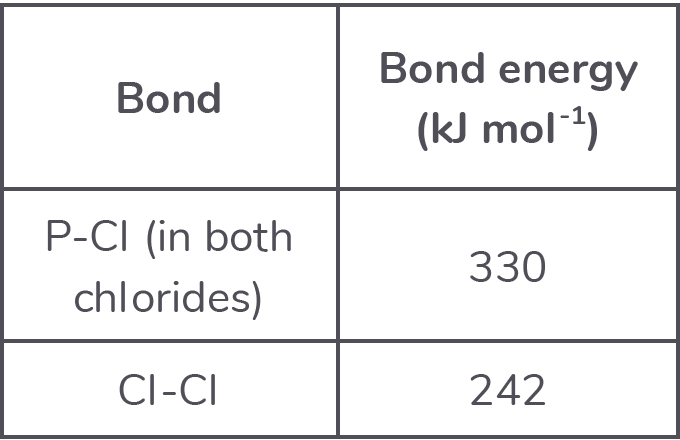
What is the enthalpy change for the decomposition of PCl5 to PCl3 and Cl2?
Question 11 of 20
11 of 20
Hydrogen and chlorine react as shown below.
H2(g) + Cl2(g) ➔ 2HCl(g) ΔH⦵ = -184.6 kJ mol-1
Which statement about this reaction is correct?
Question 12 of 20
12 of 20
Some enthalpy data is given in the table below.
| Bond | Bond enthalpy (kJ mol^-1^) |
|---|---|
| C-H | 413 |
| O-H | 463 |
| O=O | 498 |
| C=O | 798 |
Use the information in the table to calculate the enthalpy change for the complete combustion of methane, CH4.
Question 13 of 20
13 of 20
Which reaction has an enthalpy change equal to the standard enthalpy of formation of silver iodide?
Question 14 of 20
14 of 20
Nitrogen dioxide is produced from ammonia and air as shown in these equations
4NH3(g) + 5O2(g) ➔ 4NO(g) + 6H2O(g) ΔH = -909 kJ mol-1
2NO(g) + O2(g) ➔ 2NO2(g) ΔH = -115 kJ mol-1
What is the enthalpy change (in kJ mol-1) for the following reaction?
4NH3(g) + 7O2(g) ➔ 4NO2(g) + 6H2O(g)
Question 15 of 20
15 of 20
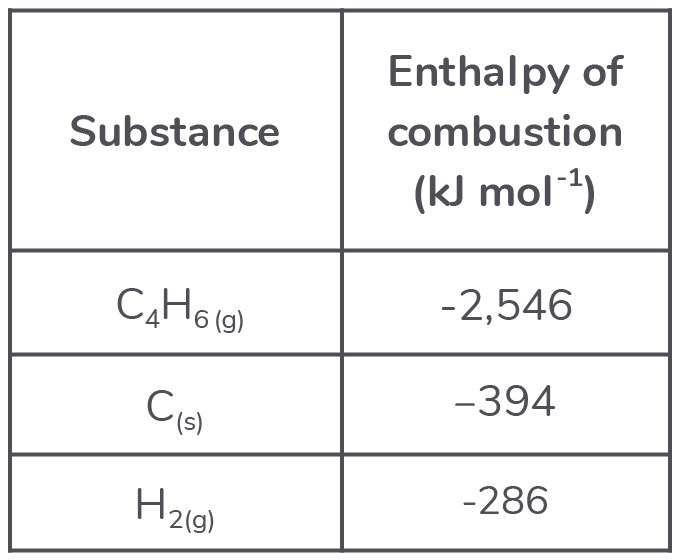
What is the enthalpy of formation of buta-1,3-diene, C4H6(g)?
Question 16 of 20
16 of 20
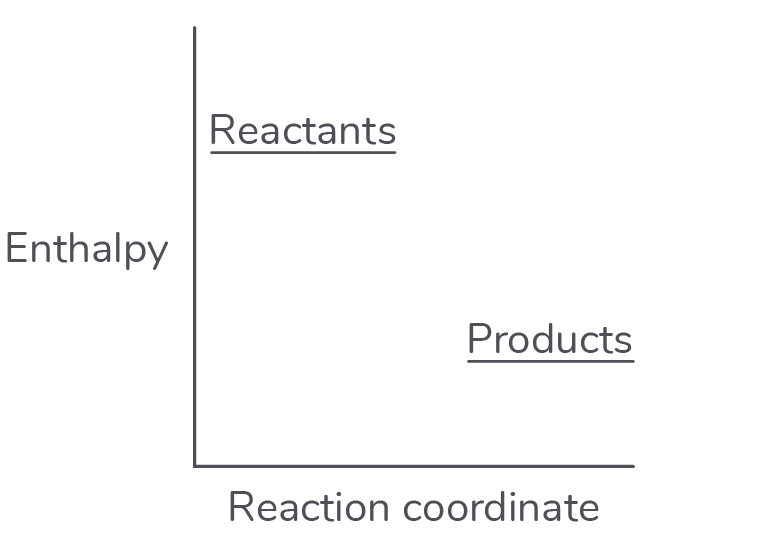
What can be deduced from this reaction profile?
Question 17 of 20
17 of 20
Which statement is correct?
Question 18 of 20
18 of 20
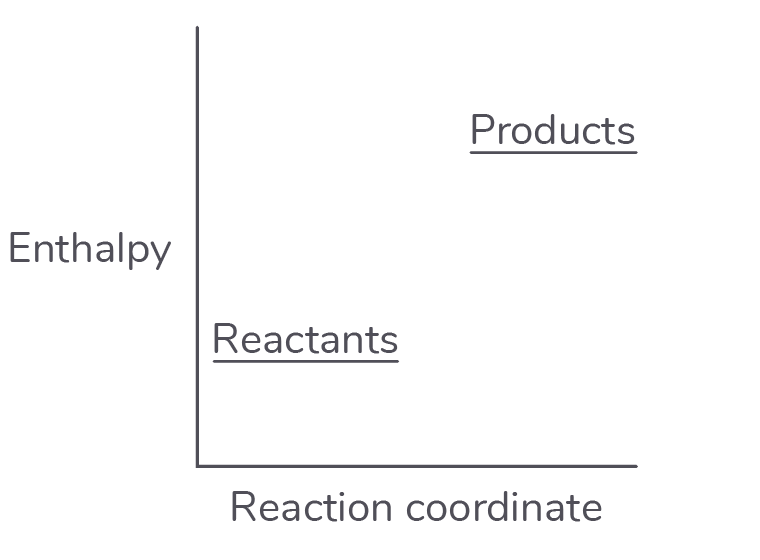
Which describes the reaction shown in the potential energy profile?
Question 19 of 20
19 of 20
Which physical property should be kept constant when measuring an enthalpy change?
Question 20 of 20
20 of 20
A reaction occurs under standard conditions.
Which of these represents a possible standard condition?