The Periodic Table - exam practice
The Periodic Table
Question 1 of 18
1 of 18
This question is about trends in the periodic table.
Which trend is correct?
Question 2 of 18
2 of 18
Which equation represents the third ionisation energy for element J?
Question 3 of 18
3 of 18
The melting points of the period 3 elements sodium to aluminium are shown in the table below.
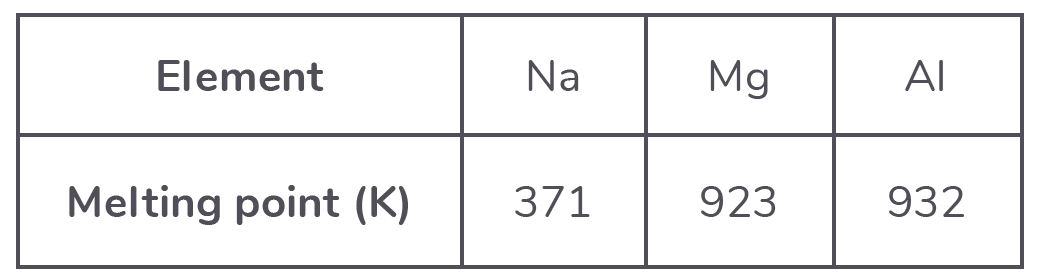
Which factor explains the increase in melting points from sodium to aluminium?
Question 4 of 18
4 of 18
Which factor helps to explain why the first ionisation energies of the group I elements decrease from lithium to sodium to potassium to rubidium?
Question 5 of 18
5 of 18
Which element has the second smallest atomic radius in its group and the third lowest first ionisation energy in its period?
Question 6 of 18
6 of 18
Why is the second ionisation energy of sodium larger than the second ionisation energy of magnesium?
Question 7 of 18
7 of 18
Consecutive elements X, Y and Z are in period 3 of the periodic table. Element Y has the highest first ionisation energy and the lowest melting point of these three elements.
What are the identities of X, Y and Z?
Question 8 of 18
8 of 18
Which statement best explains why nitrogen has a larger first ionisation energy than oxygen?
Question 9 of 18
9 of 18
Which change requires the largest amount of energy?
Question 10 of 18
10 of 18
Which element is classified as a d block element?
Question 11 of 18
11 of 18
Which element in period 3 has the highest melting point?
Question 12 of 18
12 of 18
The diagram shows how a property of period 3 elements varies across the period.
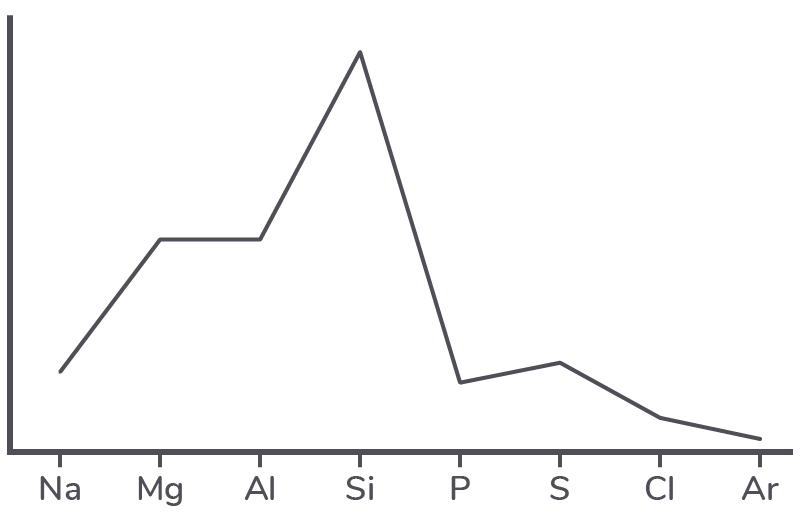
What is the property?
Question 13 of 18
13 of 18
Which element has the highest first ionisation energy?
Question 14 of 18
14 of 18
Which species will require the least energy for the removal of one electron?
Question 15 of 18
15 of 18
Which series represents atoms in order of decreasing atomic radius?
Question 16 of 18
16 of 18
The values for the first three successive ionisation energies for two elements X and Z are given.
| Element | First ionisation energy (kJ mol^-1^) | Second ionisation energy (kJ mol^-1^) | Third ionisation energy (kJ mol^-1^) |
|---|---|---|---|
| X | 520 | 7,300 | 11,800 |
| Z | 1,090 | 2,350 | 4,610 |
Which pair of elements represents X and Z?
Question 17 of 18
17 of 18
X, Y and Z represent the successive elements, Ne, Na and Mg, but not necessarily in that order.
| First ionisation energy (kJ mol^-1^) | |
|---|---|
| X | 2,081 |
| Y | 496 |
| Z | 738 |
What is the order of increasing atomic number?
Question 18 of 18
18 of 18
The graph shows the first ionisation energies of some consecutive elements.
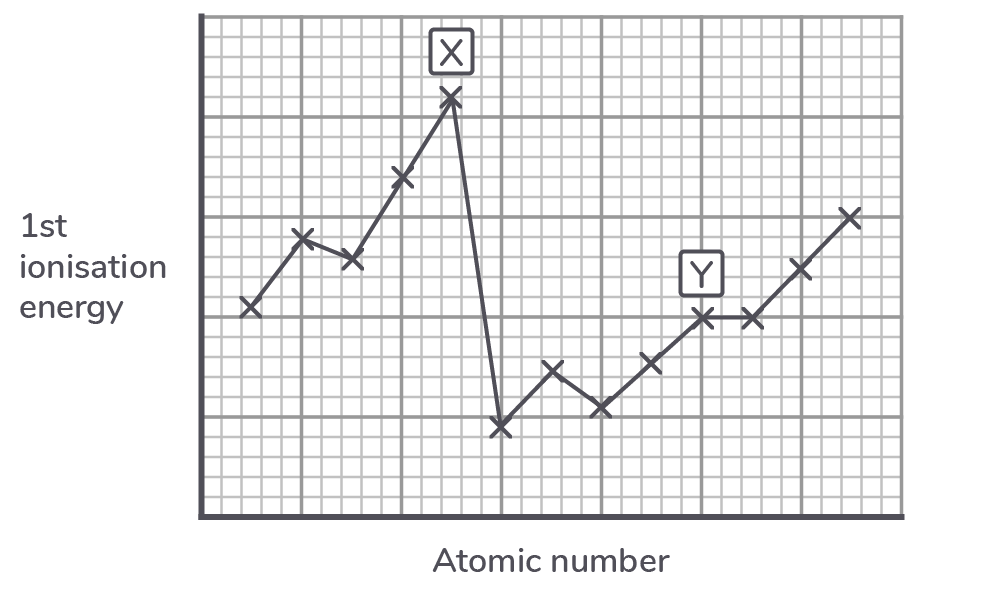
Which statement is correct?