Intermolecular Forces - exam practice
Intermolecular Forces
Question 1 of 10
1 of 10
Which statement about induced dipole-dipole forces is correct?
Question 2 of 10
2 of 10
Which molecule forms permanent dipole-dipole forces as its strongest intermolecular force?
Question 3 of 10
3 of 10
The boiling point of hydrogen bromide is -67 ºC.
The boiling point of hydrogen iodide is -34 ºC.
The different boiling points can be explained in terms of the strength of bonds or interactions.
Which bonds or interactions are responsible for the higher boiling point of hydrogen iodide?
Question 4 of 10
4 of 10
Which statement explains why ice is less dense than water?
Question 5 of 10
5 of 10
Which compound has hydrogen bonding?
Question 6 of 10
6 of 10
Which is the correct order based on increasing strength?
Question 7 of 10
7 of 10
Which statement gives a reason why phosphorus(V) chloride has a higher melting temperature than phosphorus(III) chloride?
Question 8 of 10
8 of 10
Which compound does not have hydrogen bonding between its molecules?
Question 9 of 10
9 of 10
Which of the following statements about water is not due to hydrogen bonding?
Question 10 of 10
10 of 10
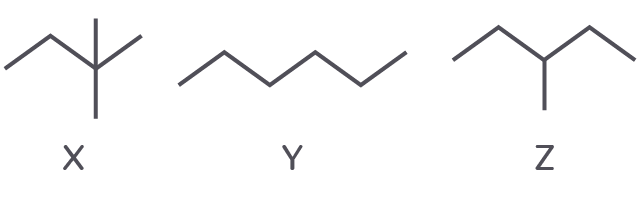
The skeletal formulae of three isomers are shown.
Which series shows the correct order of increasing boiling temperature?