Entropy - exam practice
Entropy
Question 1 of 16
1 of 16
Which of these changes has the largest increasein the entropy of the system?
Question 2 of 16
2 of 16
The table below shows standard entropies, Sө.
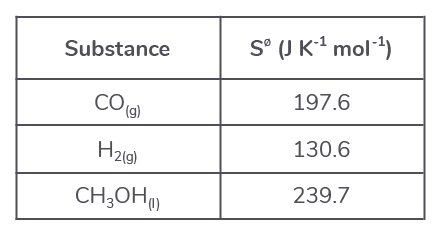
What is the entropy change, ∆Sө, in J mol-1 K-1, for the following reaction?
CO(g) + 2H2(g) ➔ CH3OH(l)
Question 3 of 16
3 of 16
Which is correct for the reaction H2O(g) ➔ H2O(l)
Question 4 of 16
4 of 16
Which reaction becomes more spontaneous as temperature increases?
Question 5 of 16
5 of 16
Which change results in the largest negative value of ΔSsys?
Question 6 of 16
6 of 16
Which system has the most negative entropy change, ΔSsys, for the forward reaction?
Question 7 of 16
7 of 16
What is the expression for ΔStotal?
Question 8 of 16
8 of 16
The equation for an exothermic reaction is shown.
Mg(s) + 2HCl(aq) ➔ MgCl2(aq) + H2(g)
Which of these is true?
Question 9 of 16
9 of 16
Four changes W, X, Y and Z have the following signs for their ∆H and ∆Ssystem values.
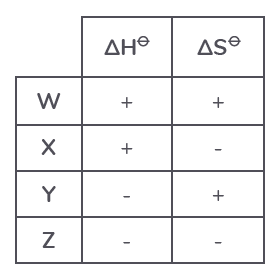
Which of the following is a correct statement?
Question 10 of 16
10 of 16
A reaction is exothermic and has a negative entropy change, ΔSsystem.
Which statement is correct?
Question 11 of 16
11 of 16
Which is correct for a reaction with a positive change in total entropy, ΔS⦵total?
Question 12 of 16
12 of 16
Which statement is correct?
Question 13 of 16
13 of 16
Which statement is correct for a spontaneous reaction?
Question 14 of 16
14 of 16
Which combination of ΔH⦵ and ΔS⦵system will result in a non-spontaneous reaction at all temperatures?
Question 15 of 16
15 of 16
Which combination of system entropy (Ssystem) and total entropy (Stotal) values describe a system at equilibrium?
Question 16 of 16
16 of 16
The table shows the variation of standard total entropy change with temperature for a reversible reaction.
ΔS⦵total = ΔS⦵system + ΔS⦵surroundings
ΔS⦵total = RlnK
| Temperature (K) | ΔS^⦵^total (J K^-1^ mol^-1^) |
|---|---|
| 298 | -18.1 |
| 350 | 13.1 |
| 400 | 43.3 |
What can be concluded about the reaction?