4.2 - Properties of the Compounds of Group 1 and 2 Metals
- 1
Solubility trends of group 2 compounds
- 2
Reactions of group 2 oxides and hydroxides
- 3
Thermal stability trends of the carbonates and nitrates of groups 1 and 2
- 4
Flame colours in compounds of group 1 and 2 elements
Opposite solubility trends for group 2 hydroxides and sulfates
The solubility of group 2 metal hydroxides and sulfates follows opposite trends down the group:
- Group 2 metal hydroxides become more soluble down the group.
- Group 2 metal sulfates become less soluble down the group.
This is summarised in the table below:
| Group 2 element | Solubility of hydroxide | Solubility of sulfate |
|---|---|---|
| Magnesium | Insoluble | Soluble |
| Calcium | Sparingly soluble | Sparingly soluble |
| Strontium | Soluble | Insoluble |
| Barium | Soluble | Insoluble |
Reactions of group 2 oxides and hydroxides
The oxides and hydroxides of group 2 elements are basic and alkaline:
Group 2 metal oxides (MO) readily react with water to form metal hydroxides that dissolve in water:
-
MO(s) + H2O(l) ➔ M(OH)2(aq) This releases hydroxide ions (OH-) making the solutions strongly alkaline. For example:
-
BaO(s) + H2O(l) ➔ Ba2+(aq) + 2OH-(aq) The pH of the resulting solutions increases down the group as the solubility of the hydroxides increases.
An exception is MgO which reacts slowly and has low solubility.
Group 2 metal hydroxides (M(OH)2) also react with dilute acids such as hydrochloric acid (HCl) to form salt and water:
- M(OH)2(s) + 2HCl(aq) ➔ MCl2(aq) + 2H2O(l) The reactions become more vigorous down the group as the solubility of the compounds increases.
Thermal decomposition of carbonates and nitrates
Group 1 compounds
Group 1 carbonates are very stable and don't decompose with Bunsen burner heating.An exception is lithium carbonate which decomposes to form lithium oxide and carbon dioxide:
- Li2CO3(s) ➔ Li2O(s) + CO2(g)
Group 1 nitrates (MNO3) decompose to nitrites and oxygen, for example:
-
2NaNO3(s) ➔ 2NaNO2(s) + O2(g) An exception is lithium nitrate which decomposes to form lithium oxide, nitrogen dioxide and oxygen:
-
2LiNO3(s) ➔ Li2O(s) + 2NO2(g) + 1⁄2O2(g)
Group 2 compounds
Group 2 carbonates (MCO3) decompose to oxides and carbon dioxide, for example:
- CaCO3(s) ➔ CaO(s) + CO2(g)
Group 2 nitrates, (M(NO3)2) decompose to oxides, nitrogen dioxide and oxygen, for example:
- 2Ca(NO3)2(s) ➔ 2CaO(s) + 4NO2(g) + O2(g)
Thermal stability of carbonates and nitrates
The thermal stability of carbonates and nitrates increases as we move down both group 1 and group 2. To understand this trend, we first need to introduce two key concepts:
- Ion polarisation - The distortion of an anion's electron cloud by a nearby cation.
- Polarising power - A cation's ability to distort an anion's electron cloud.
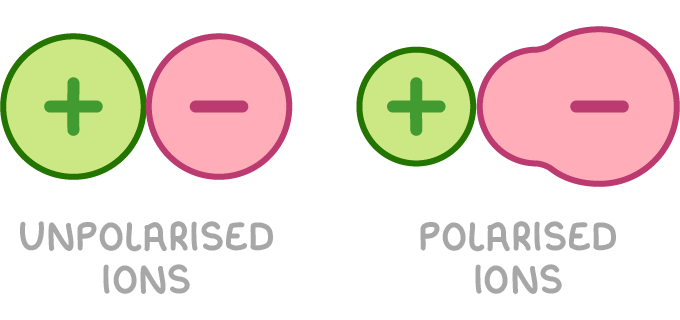
The trend in thermal stability can be explained by considering two main factors:
- Cation size:
- As we move down the group, cations become larger.
- Larger cations have lower charge density (charge spread over a larger area).
- This results in lower polarising power, causing less anion distortion.
- Less distortion leads to stronger C-O and N-O bonds, increasing stability.
- Cation charge:
- Group 2 cations (+2) have higher charge than group 1 cations (+1).
- Higher charge results in greater polarising power.
- This makes group 2 compounds generally less stable than their group 1 counterparts.
Testing the thermal stability of carbonates and nitrates
- Group 2 carbonates - Measure the time taken to produce enough CO2 gas to turn limewater cloudy.
- Group 1 nitrates - Measure the time taken to produce enough O2 gas to relight a glowing splint.
- Group 2 nitrates - In a fume cupboard, measure the time taken to produce brown NO2 gas.
Flame colours of group 1 and 2 compounds
Group 1 and 2 compounds produce characteristic flame colours when heated. This is due to electron transitions within the metal atoms. When energy is absorbed from the flame, electrons move to higher energy levels. As they fall back to lower levels, they release energy as light with a specific wavelength, producing the characteristic colour.
Flame test procedure:
- Mix a small amount of the compound with a few drops of hydrochloric acid.
- Clean a platinum or nichrome wire by heating it in a hot Bunsen flame.
- Dip the wire into the compound/acid mixture.
- Hold the wire in a hot flame and observe the colour produced.
Flame colours for group 1 and 2 compounds:
| Group 1 | Colour |
|---|---|
| Li | Red |
| Na | Orange/yellow |
| K | Lilac |
| Rb | Red |
| Cs | Blue |
| Group 2 | Colour |
|---|---|
| Ca | Orange-red |
| Sr | Crimson |
| Ba | Green |