2.7 - Solutions and Solubility
- 1
How bonding affects solubility
- 2
Polar and non-polar solvents
- 3
Dissolution of ionic substances in polar solvents
- 4
Solubility of alcohols in water
- 5
Why some polar molecules don't dissolve in water
- 6
Solubility of non-polar substances in non-polar solvents
Solubility depends on bond breaking and forming
For a substance to dissolve in a solvent, three key processes must occur:
- Bonds within the substance (solute) molecules must break.
- Bonds between the solvent molecules must break.
- New bonds must form between the solute and solvent molecules. Typically, a substance will only dissolve if the newly formed solute-solvent bonds are of similar strength or stronger than the bonds that are broken in the pure solute and solvent.
Polar and non-polar solvents
Solvents can be categorised as either polar or non-polar:
- Polar solvents - These consist of polar molecules. Water is the most common polar solvent, with water molecules bonding via hydrogen bonds. However, not all polar solvent molecules can form hydrogen bonds. For example, propanone is polar but only forms London dispersion forces and permanent dipole-dipole interactions.
- Non-polar solvents - These are composed non-polar molecules that interact through London dispersion forces. For example, hexane is a common non-polar solvent.
Many substances are soluble in one type of solvent but not the other, due to the types of intermolecular forces involved.
Ionic compounds dissolve in polar solvents
Ionic substances often dissolve in polar solvents like water due to a process called hydration:
- Water molecules are polar, with slightly positive (δ+) hydrogen atoms and slightly negative (δ-) oxygen atoms.
- When an ionic substance is added to water, the ions are attracted to the oppositely charged ends of the water molecules.
- Water molecules surround and separate the ions from the ionic lattice.
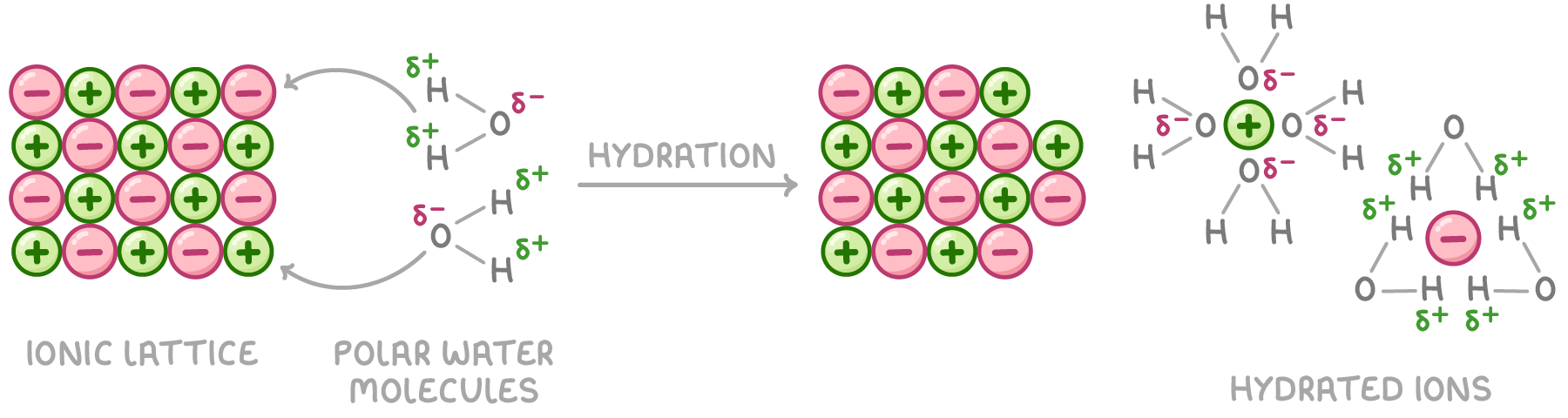
However, some ionic compounds like aluminium oxide (Al2O3) do not dissolve in water because the ionic bonds are stronger than potential bonds with water molecules. The high charge density of the Al3+ ion leads to particularly strong ionic bonding.
Alcohols also dissolve in polar solvents
Alcohols are generally soluble in water due to their ability to form hydrogen bonds:
- The polar O-H bond in alcohols is attracted to the polar O-H bonds in water.
- Hydrogen bonds form between the lone pairs on oxygen atoms (δ-) and hydrogen atoms (δ+).
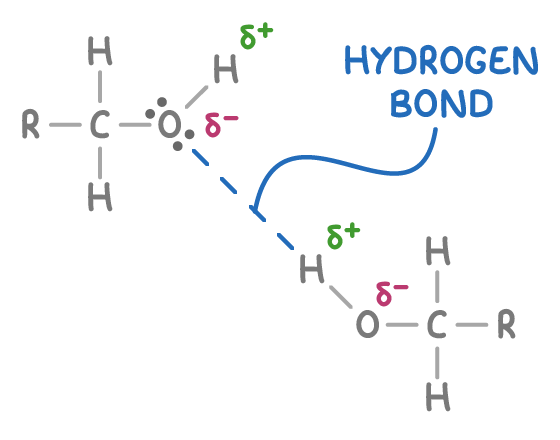
However, the carbon chain part of the alcohol is not attracted to water, so alcohol solubility decreases as the number of carbon atoms increases.
Not all polar molecules dissolve in water
Despite containing polar bonds, some molecules like halogenoalkanes do not readily dissolve in water:
- The dipoles in halogenoalkanes are not strong enough to form hydrogen bonds with water molecules.
- The hydrogen bonding between water molecules is stronger than the potential bonds with halogenoalkanes, preventing dissolution.
For example, chlorobutane and water form two distinct layers when mixed:
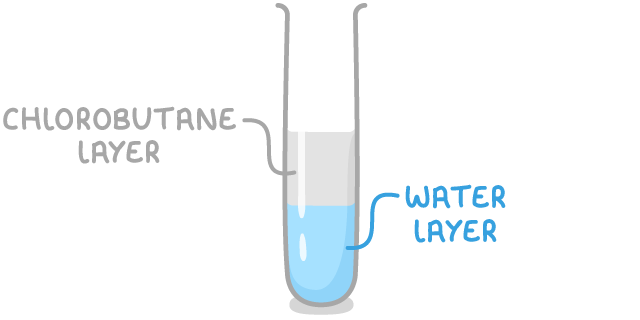
However, halogenoalkanes can form permanent dipole-dipole bonds and thus dissolve in polar solvents that also form such interactions rather than hydrogen bonds.
Non-polar substances dissolve in non-polar solvents
Non-polar substances tend to dissolve best in non-polar solvents:
- Non-polar molecules (e.g., ethene) have London forces between them.
- They form similar London forces with non-polar solvents like hexane, allowing dissolution.
- Water molecules have stronger attractions to each other than to non-polar molecules, so non-polar substances generally don't dissolve well in water.
This phenomenon is often summarised as "like dissolves like" - substances usually dissolve best in solvents with similar intermolecular forces.