6.16 - Chemical Properties of Alcohols
- 1
Combustion of alcohols
- 2
Oxidation of alcohols
- 3
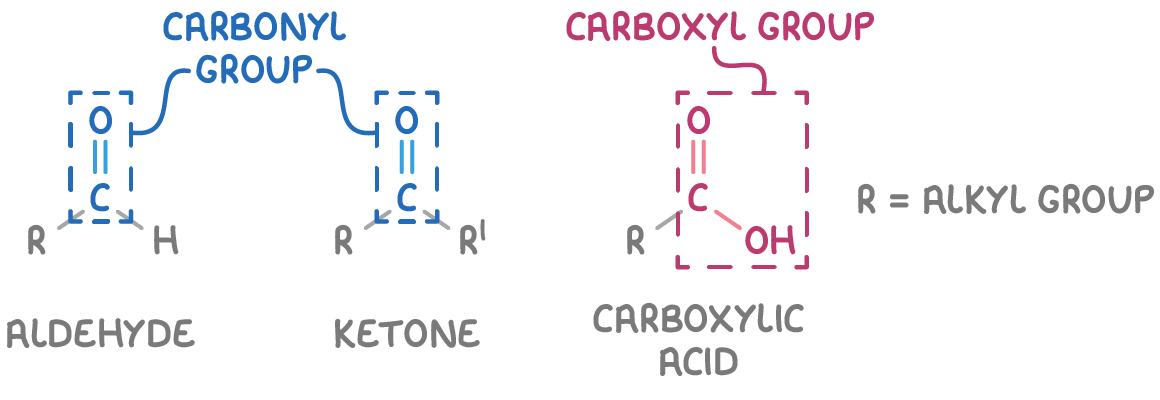
Structures of aldehydes, ketones and carboxylic acids
- 4
Halogenation of alcohols to produce halogenoalkanes
- 5
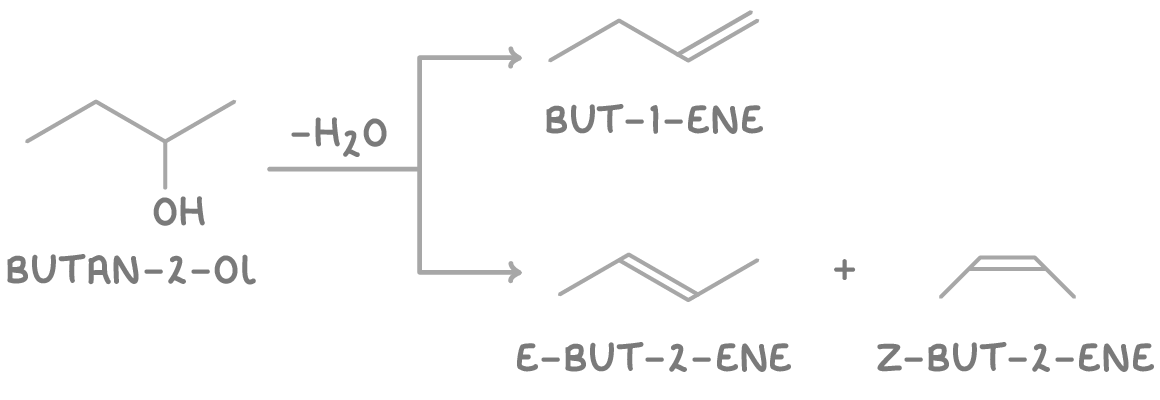
Dehydration of alcohols to produce alkenes
Complete combustion of alcohols
Alcohols combust completely when burned in an excess of oxygen, breaking all C-C and C-H bonds. This results in the production of carbon dioxide and water, along with the release of heat energy.
For example, the complete combustion of ethanol is represented by the equation:
C2H5OH(l) + 3O2(g) ➔ 2CO2(g) + 3H2O(g)
Oxidation of alcohols using potassium dichromate(VI) solution
Oxidation of alcohols can be performed using a potassium dichromate(VI) solution (K2Cr2O7), acidified with dilute sulfuric acid. The solution changes colour from orange to green as the reaction proceeds due to the reduction of dichromate(VI) ions (Cr2O72-) to chromium(III) ions (Cr3+).
The extent of oxidation depends on the alcohol's structure:
- Primary alcohols are oxidised to aldehydes and then to carboxylic acids.
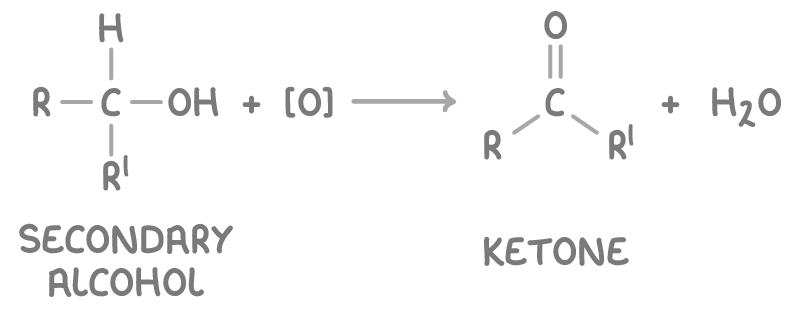
- Secondary alcohols are oxidised to ketones only.
- Tertiary alcohols do not oxidise under these conditions.
Controlling oxidation of primary alcohols
The oxidation of primary alcohols can proceed in two stages, initially forming an aldehyde and subsequently a carboxylic acid:
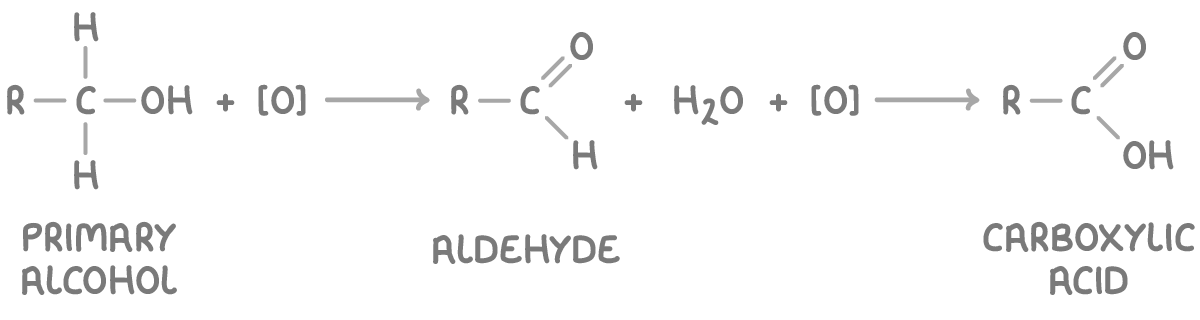
Here, [O] represents an oxidising agent.
To isolate the aldehyde, gently heat the alcohol in a distillation apparatus with a limited amount of potassium dichromate(VI) and distil the aldehyde as it forms to prevent further oxidation. To obtain the carboxylic acid, heat the alcohol with an excess of dichromate(VI) under reflux conditions.
Oxidising secondary alcohols
Secondary alcohols, such as propan-2-ol, can be converted into ketones by refluxing with acidified dichromate(VI).
This process does not allow for further oxidation of the ketone:
Structure of aldehydes, ketones and carboxylic acids
Aldehydes and ketones are characterised by the presence of a carbonyl functional group (C=O), but differ in their structure:
- Aldehydes have a hydrogen atom and an alkyl group attached to the carbonyl carbon.
- Ketones have two alkyl groups attached to the carbonyl carbon.
Carboxylic acids feature a carboxyl functional group (COOH) attached to an alkyl group.
Distinguishing aldehydes and ketones
Aldehydes and ketones can be differentiated using Fehling's solution or Benedict's solution:
- Both Fehling's and Benedict's solutions are alkaline and contain blue aqueous Cu2+ ions.
- When warmed, aldehydes reduce the blue Cu2+ ions in either solution to form a brick-red Cu2O precipitate.
- Ketones do not react with either solution - the mixture remains blue with no colour change observed.
Converting alcohols to halogenoalkanes
Alcohols can undergo substitution reactions to form halogenoalkanes using various reagents.
Synthesis of chloroalkanes using PCl5 or HCl
Chloroalkanes (RCl) can be prepared from alcohols by reacting them with phosphorus pentachloride (PCl5) or concentrated hydrochloric acid (HCl), depending on the type of alcohol.
- Reaction with PCl5 - When alcohols react with phosphorus pentachloride, chloroakanes, hydrochloric acid, and phosphoryl chloride (POCl3) are produced. The overall reaction is:
ROH + PCl5 ➔ RCl + HCl + POCl3
For example:
CH3OH + PCl5 ➔ CH3Cl + HCl + POCl3
- Reaction with HCl - Tertiary chloroalkanes can be synthesised from tertiary alcohols by reacting them with concentrated hydrochloric acid. The overall reaction is:
ROH + HCl ➔ RCl + H2O
For example:
(CH3)3COH + HCl ➔ (CH3)3CCl + H2O
Synthesis of bromoalkanes using KBr and H2SO4
Bromoalkanes (RBr) can be synthesised from alcohols by reacting them with hydrogen bromide (HBr).
In this reaction, HBr is usually generated in situ within the reaction mixture by mixing potassium bromide (KBr) with 50% concentrated sulfuric acid (H2SO4).
The overall reaction is:
ROH + HBr ➔ RBr + H2O
For example:
CH3OH + HBr ➔ CH3Br + H2O
Synthesis of iodoalkanes using red phosphorus and iodine
Iodoalkanes (RI) can be prepared from alcohols by reacting them with phosphorus triiodide (PI3).
PI3 is typically generated in situ within the reaction mixture by refluxing the alcohol with red phosphorus and iodine.
The overall reaction is:
3ROH + PI3 ➔ 3RI + H3PO3
For example:
3CH3OH + PI3 ➔ 3CH3I + H3PO3
Dehydrating alcohols to form alkenes
Dehydration of alcohols, an elimination reaction facilitated by a concentrated phosphoric acid catalyst (H3PO4) results in the formation of alkenes through the elimination of water:
alcohol ➔ alkene + water
For instance, dehydrating ethanol with concentrated phosphoric acid produces ethene:
CH3CH2OH ➔ CH2=CH2 + H2O
When more complex alcohols undergo dehydration, elimination can occur from different positions along the carbon chain. This results in a mixture of alkene positional isomers as products.
For example, the dehydration of butan-2-ol gives a mixture of but-1-ene, E-but-2-ene and Z-but-2-ene: