9.2 - Collision Theory
- 1
Collision theory and activation energy
- 2
The factors that affect rate of reaction
- 3
The kinetic energy distribution of gas molecules
- 4
Maxwell-Boltzmann distribution curves
- 5
How temperature affects the kinetic energy of gas molecules
Collision theory and activation energy
Collision theory states that for a reaction to occur between particles, two conditions must be met:
- Orientation - The particles must collide in the correct orientation. They need to be facing each other appropriately.
- Energy - The colliding particles need at least a minimum amount of kinetic energy. This minimum energy is called the activation energy (Ea).
For a collision to be effective and lead to a reaction, it must meet both the orientation and energy requirements. However, most collisions are non-effective because they fail to satisfy one or both conditions. As a result, these collisions do not lead to a reaction.
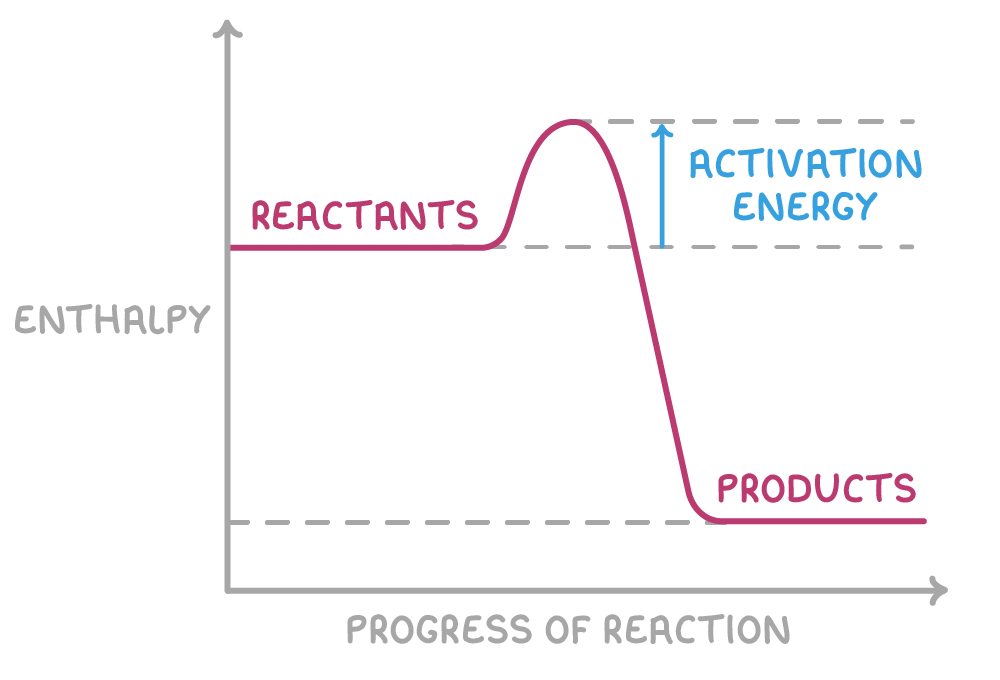
The activation energy, represented in the enthalpy profile diagram above, is the minimum energy required for a collision to be effective. This energy is necessary to break existing bonds in the reactants and initiate the reaction. Particles with kinetic energies greater than or equal to the activation energy will have sufficient energy to react upon collision.
Reactions with low activation energies tend to occur more readily, while those with high activation energies occur less easily. Adding heat energy to the particles can provide the extra energy needed for reactions with high activation energies to proceed.
Factors affecting rate of reaction
The 5 key factors that affect the rate of a chemical reaction are:
- Surface area (of solids)
- Concentration (of solutions)
- Pressure (of gases)
- Temperature
- Catalyst We can use collision theory to explain why each of these factors impacts reaction rate by considering their effect on the number of effective collisions.
Increasing surface area increases rate of reaction
- When the exposed surface area of the solid is increased, more particles on the surface are available to collide and react. This leads to a higher frequency of effective collisions between the solid and other reactants.
- For example, crushing a solid into a powder provides more exposed surface.
- Therefore, increasing the surface area of a solid reactant results in an increased reaction rate.
Increasing concentration increases rate of reaction
- If the concentration of reactants in solution is increased, the particles will on average be closer together.
- Particles that are closer together will collide more frequently, increasing the number of effective collisions.
- Therefore, increasing the concentration increases the reaction rate.
Increasing pressure increases rate of reaction
- Raising the pressure forces the gas particles closer together.
- Particles that are closer together will collide more frequently, increasing the number of effective collisions.
- Therefore, increasing the pressure increases the reaction rate.
Increasing temperature increases rate of reaction
- Raising the temperature increases the kinetic energy and speed of the particles.
- As the particles move faster, they collide more frequently, resulting in an increased frequency of collisions.
- Additionally, the increased kinetic energy means more particles have the necessary energy to overcome the activation energy, resulting in a greater proportion of effective collisions.
- Therefore, increasing temperature results in an increased reaction rate.
Adding a catalyst increases rate of reaction
- A catalyst provides an alternative pathway or mechanism for the reaction that has a lower activation energy.
- A lower activation energy means particles require less kinetic energy to react.
- More particles have the activation energy, leading to an increased number of effective collisions.
- Consequently, adding a catalyst increases the overall rate of reaction.
Kinetic energy distribution in gases
Gas molecules have varying kinetic energies, which is why they move at different speeds. This variation can be represented through a Maxwell-Boltzmann distribution curve:
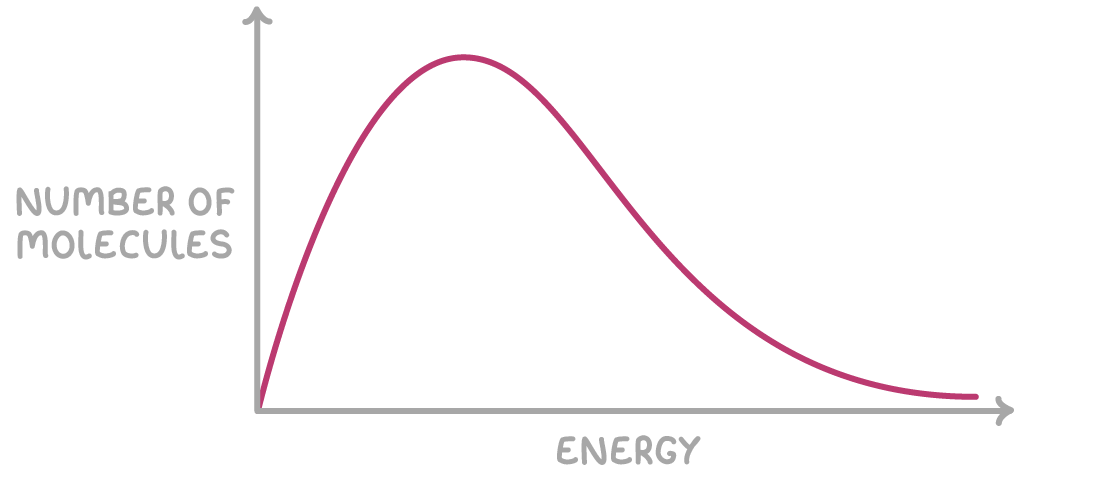
The Maxwell-Boltzmann distribution illustrates several key points about molecular kinetic energies in gases:
- Some molecules move slowly because they have low kinetic energy.
- Others move very fast due to their high kinetic energy.
- The majority of molecules, however, have moderate kinetic energies and speeds.
- Only molecules with kinetic energies greater than or equal to the activation energy have sufficient energy to react when they collide.
Features of the Maxwell-Boltzmann distribution
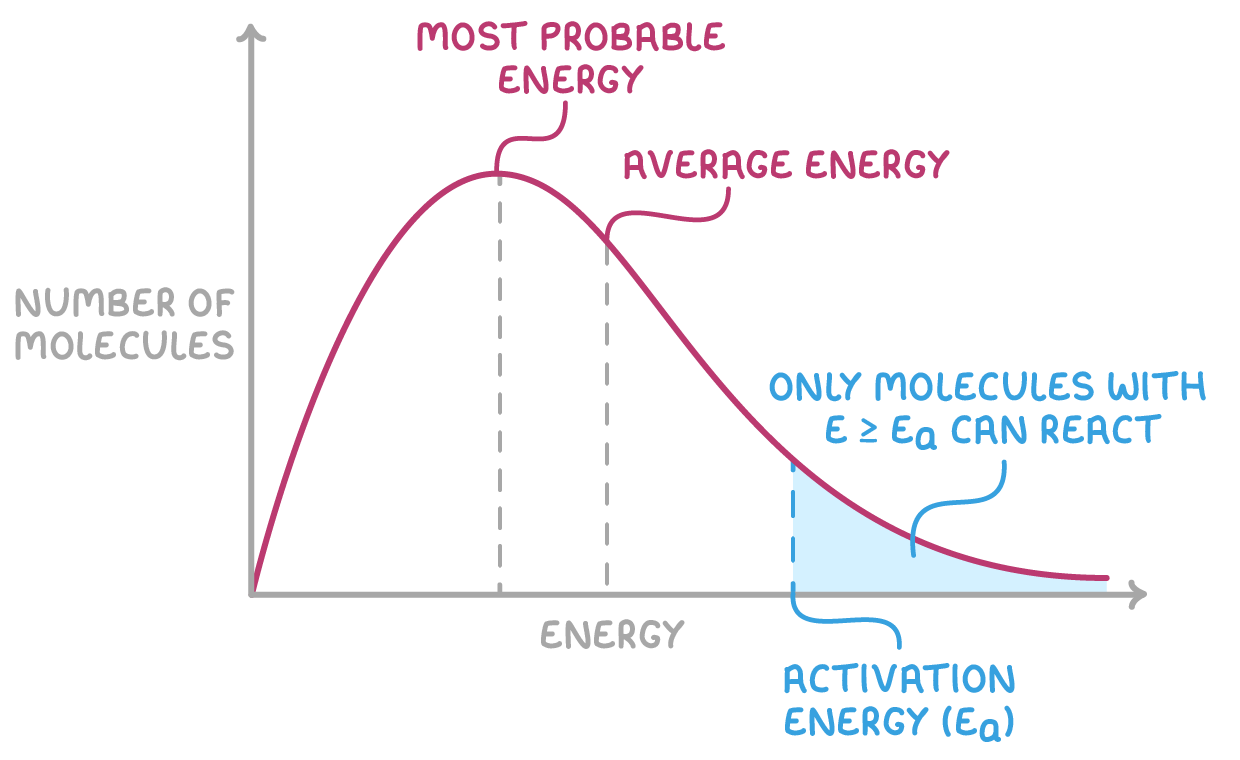
The Maxwell-Boltzmann distribution curve is characterised by several key features:
- The curve originates at the origin, indicating that no molecules have zero kinetic energy.
- It rises sharply to a peak that represents the most common kinetic energy level among the molecules, before gradually decreasing.
- The total area under the curve is equivalent to the total number of molecules.
- The peak of the curve shows the most probable kinetic energy a single molecule can have.
- On average, the kinetic energy of all molecules is a bit higher than the peak energy.
Increasing temperature shifts the curve
When the temperature increases, it affects the kinetic energy distribution:
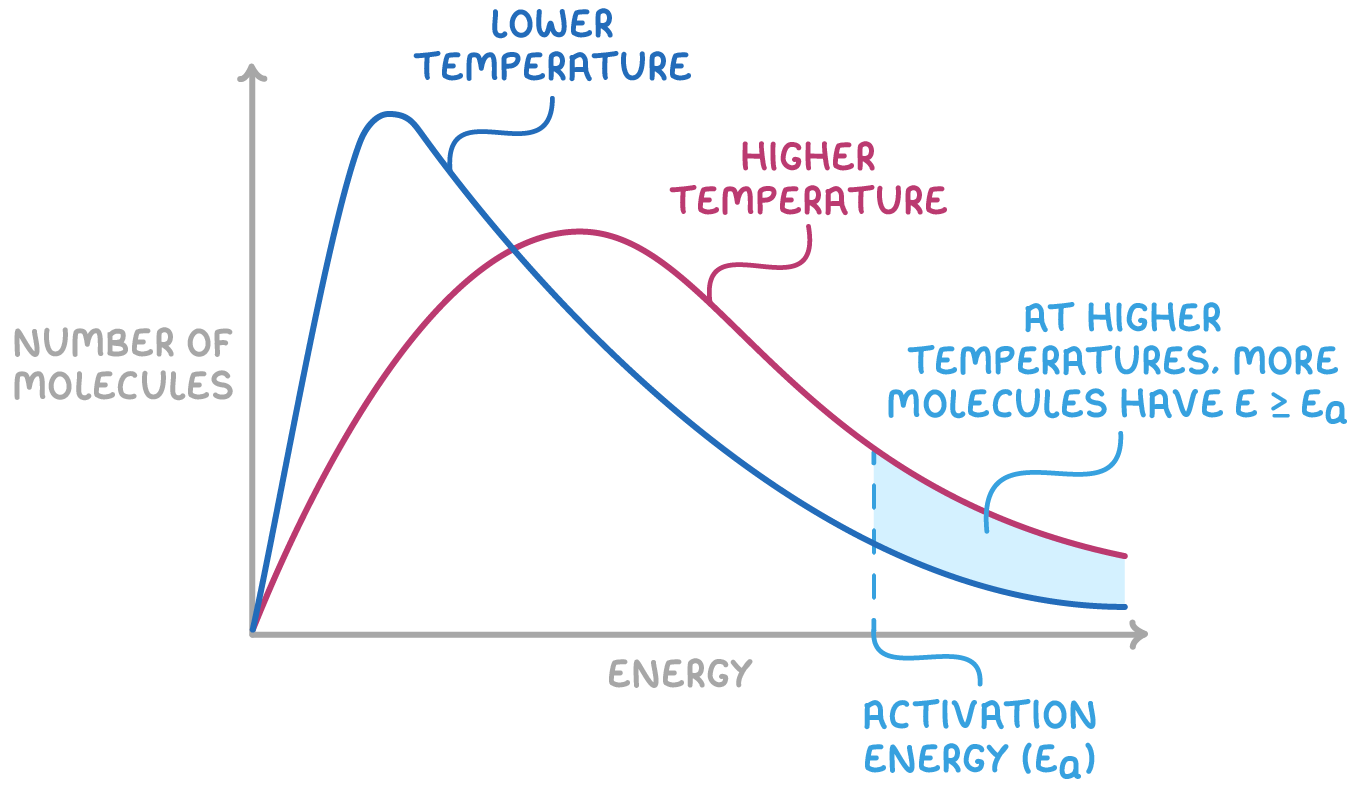
- As the temperature rises, a greater number of molecules attain the kinetic energy necessary to surpass the activation energy, leading to a reaction.
- Consequently, the distribution curve shifts to the right, indicating that more molecules have acquired sufficient kinetic energy.
- Despite the total number of molecules remaining constant, the area under both curves is unchanged, which results in a lower peak height. This is because the distribution of kinetic energies broadens at higher temperatures.
This shift in the distribution curve signifies that both the frequency of collisions and the proportion of effective collisions increase with temperature. Therefore, even a modest rise in temperature can lead to a significant increase in the rate of reaction.