6.6 - Alkanes
- 1
The general formula and bonding of alkanes
- 2
How alkanes undergo radical substitution reactions with halogens
- 3
The reaction mechanism for the halogenation of alkanes
- 4
Why radical substitution reactions produce mixtures of products
Alkanes are saturated hydrocarbons
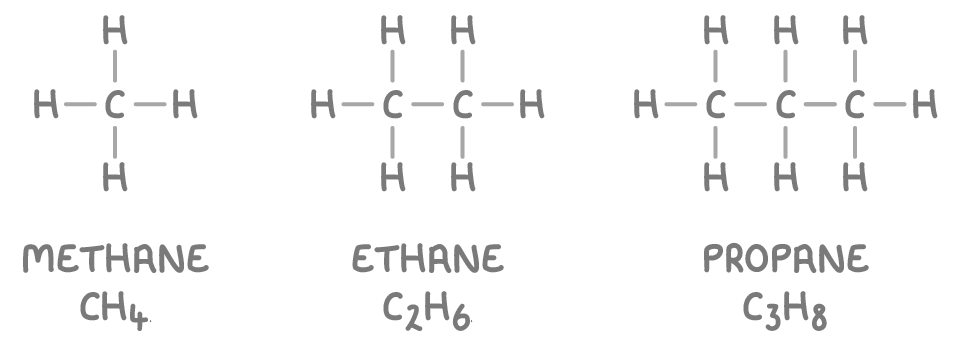
Alkanes are a class of hydrocarbons that have the general formula CnH_2n+2_, where 'n' represents the number of carbon atoms.
Key features of alkanes include:
- They consist solely of carbon and hydrogen atoms (thus called hydrocarbons).
- Each carbon atom forms four single bonds.
- They are fully "saturated" with hydrogen, meaning they contain no double or triple bonds.
Examples of alkanes:
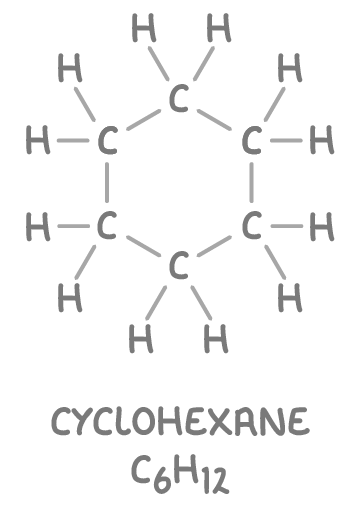
Cycloalkanes are a type of alkane in which the carbon atoms form a ring structure. Their general formula is CnH_2n_, where 'n' is the number of carbon atoms in the ring. Despite the ring structure, cycloalkanes remain saturated.
Photochemical halogenation of alkanes
Halogens react with alkanes in special light-induced reactions called photochemical reactions.
For the reaction to occur:
- Ultraviolet (UV) light must be present.
- This UV light provides the activation energy to start the reaction.
The overall reaction is a substitution, where a hydrogen atom in the alkane molecule is replaced by a halogen atom like chlorine or bromine.
Free radical substitution mechanism
Photochemical halogenation of alkanes follows a three-step free radical substitution mechanism:
- Initiation - UV light produces reactive radicals.
- Propagation - Radicals react in a chain reaction.
- Termination - Radicals join to form stable molecules.
Methane reacts vigorously with chlorine gas in the presence of UV light, as represented by the equation:
CH4 + Cl2 ➔ CH3Cl + HCl
The three-stage mechanism for this reaction is detailed below.
Stage 1 - Initiation
-
UV light breaks the Cl-Cl bond in chlorine via homolytic fission to give two chlorine radicals (Cl•): Cl2 ➔ 2Cl•
-
The unpaired electron makes Cl• highly reactive.
Stage 2 - Propagation
-
The chlorine radical attacks a methane molecule in a substitution reaction: Cl• + CH4 ➔ CH3• + HCl
-
The methyl radical (CH3•) attacks another chlorine molecule: CH3• + Cl2 ➔ CH3Cl + Cl•
-
This propagation cycle continues until reagents are used up.
Stage 3 - Termination
-
Two radicals join to form a stable covalent bond: Cl• + CH3• ➔ CH3Cl
-
Other combinations like 2CH3• ➔ C2H6 or 2Cl• ➔ Cl2 are also possible.
The end products of the termination step depend on which reagent is in excess:
- Excess chlorine - Further substitution on products like chloromethane occurs, producing a mixture of products such as CH3Cl, CH2Cl2, CHCl3, and CCl4.
- Excess methane - Predominantly single substitution occurs to form chloromethane.
Problems with free radical substitution
Using free radical halogenation to make specific haloalkane products has two key problems.
1. Production of product mixtures
- With an excess of halogen, additional substitution reactions can occur.
- For example, chloromethane (CH3Cl) can undergo further substitution: Cl• + CH3Cl ➔ CH2Cl• + HCl
CH2Cl• + Cl2 ➔ CH2Cl2 + Cl•
- This results in a mixture of halogenoalkanes (e.g., CH3Cl, CH2Cl2, CHCl3, CCl4) that must be separated.
2. Formation of multiple isomers
- The propagating radical can substitute at any position along a carbon chain.
- This leads to the production of various positional isomers.
- For example, halogenation of propane yields a mixture of 1-chloropropane and 2-chloropropane.
To maximise the yield of a desired halogenoalkane, it's advisable to use a significant excess of the alkane relative to the halogen, minimising further substitution reactions.