17.2 - Carbonyl Compounds
- 1
The carbonyl group in aldehydes and ketones
- 2
Intermolecular forces and solubility of aldehydes and ketones
Aldehydes and ketones contain a carbonyl group
Aldehydes and ketones are both carbonyl compounds, meaning they contain a carbon-oxygen double bond called the carbonyl group.
The key difference lies in the position of this functional group:
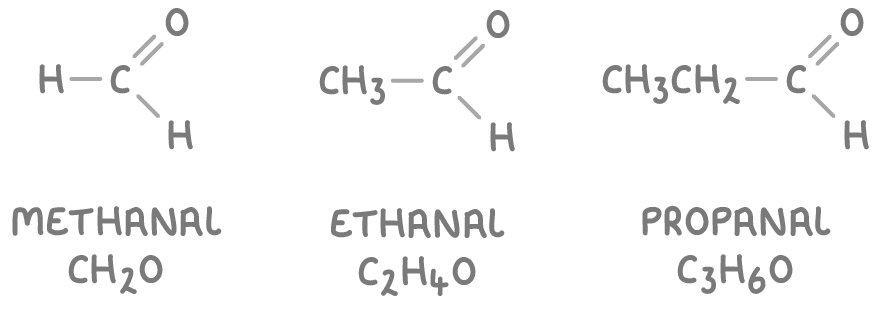
- Aldehydes have their carbonyl group at the end of a carbon chain. Their names end in -al.
- Some common examples of aldehydes are:
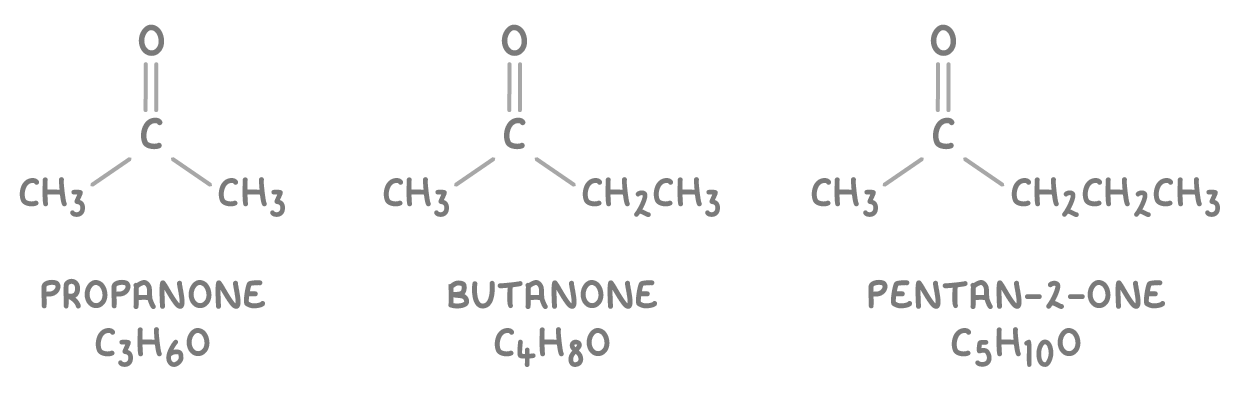
- Ketones have their carbonyl group within the carbon chain. Their names end in -one and often have a number indicating the carbon with the C=O group.
- Some common examples of ketones are:
No hydrogen bonding between aldehydes or ketones
Unlike alcohols, aldehydes and ketones do not have a polar O-H bond. This means that they cannot form hydrogen bonds with other aldehyde or ketone molecules.
The absence of intermolecular hydrogen bonding results in lower boiling temperatures of aldehydes and ketones compared to equivalent alcohols. This is because alcohols can form strong hydrogen bonds, which require more energy to break and transition into the gas phase.
For example, propanal and propanone have lower boiling points than propan-1-ol:
| Compound | Formula | Boiling point (°C) |
|---|---|---|
| Propanal | C3H6O | 48 |
| Propanone | C3H6O | 56 |
| Propan-1-ol | C3H8O | 97 |
However, aldehyde and ketone molecules still interact via weaker intermolecular forces including:
- London dispersion forces.
- Permanent dipole-permanent dipole interactions.
Aldehydes and ketones can hydrogen bond with water
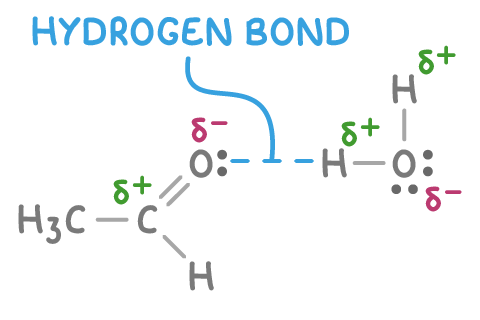
Although aldehydes and ketones lack polar -OH groups, they do possess a lone pair of electrons on the oxygen atom of the C=O group. This lone pair allows the oxygen to form hydrogen bonds with hydrogen atoms of water molecules.
Consequently, small aldehydes and ketones are able to dissolve in water.
However, larger aldehydes and ketones with longer carbon chains are insoluble in water:
- The hydrocarbon chains disrupt the hydrogen bonding network between water molecules but are unable to form compensatory hydrogen bonds themselves.
- In sufficiently large aldehydes or ketones, the intermolecular forces between the aldehyde or ketone molecules and the hydrogen bonding between water molecules outweigh any potential hydrogen bonds between the compound and water.