12.1 - Acids, Bases and Proton Transfer
- 1
The Brønsted-Lowry definitions of acids and bases
- 2
The difference between strong and weak acids and bases
- 3
Conjugate acid-base pairs
Brønsted-Lowry acids are proton donors, bases are proton acceptors
According to the Brønsted-Lowry theory:
- An acid is defined as a substance that donates a proton (H+).
- A base is defined as a substance that accepts a proton.
For instance, when a Brønsted-Lowry acid (HA) is dissolved in water, it donates a proton to a water molecule, forming a hydronium ion (H3O+):
HA(aq) + H2O(l) ⇌ H3O+(aq) + A-(aq)
Conversely, when a Brønsted-Lowry base (B) is mixed with water, it accepts a proton from a water molecule, forming a hydroxide ion (OH-):
B(aq) + H2O(l) ⇌ BH+(aq) + OH-(aq)
Strength depends on extent of dissociation
The strength of an acid or a base is determined by its ability to dissociate in water. This dissociation process can be reversible, as shown in the equations below:
- Acid dissociation: HA + H_2_O ⇌ H_3_O^+^ + A^-^
- Base dissociation: B + H_2_O ⇌ BH^+^ + OH^-^
Strong acids and bases:
Strong acids, such as hydrochloric acid (HCl), and strong bases, like sodium hydroxide (NaOH), dissociate completely in water. This results in a significant release of H_3_O^+^ and OH^-^ ions, respectively, with the forward reaction being predominantly favoured:
- HCl_(aq)_ ➔ H^+^(aq) + Cl^-^(aq)
- NaOH_(aq)_ ➔ Na^+^(aq) + OH^-^(aq)
Weak acids and bases:
Conversely, weak acids and bases, like ethanoic acid (CH_3_COOH) and ammonia (NH_3_), only partially dissociate in water, releasing fewer H_3_O^+^ and OH^-^ ions. In these cases, the reverse reaction is favoured:
- CH_3_COOH_(aq)_ ⇌ H^+^(aq) + CH_3_COO^-^(aq)
- NH_3(aq)_ + H_2_O_(l)_ ⇌ NH_4_^+^(aq) + OH^-^(aq)
Acids and bases form conjugate pairs
When Brønsted-Lowry acids and bases react together, they form conjugate acid-base pairs on opposite sides of the reaction equation:
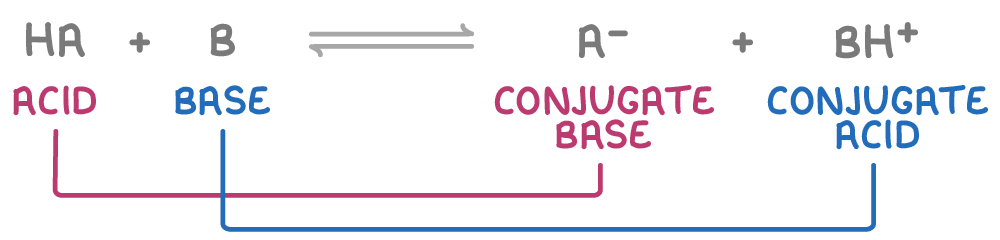
A conjugate acid-base pair consists of two species that are interconverted by the transfer of a proton (H+).
- In the forward reaction, HA acts as an acid, donating a proton to form its conjugate base (A-).
- In the reverse reaction, A- acts as a base, accepting a proton from BH+ to reform the acid (HA).
- Similarly, B and BH+ form another conjugate pair, with B being the base (proton acceptor) and BH+ its conjugate acid.
For example, when ethanoic acid (CH3COOH) reacts with water:

In this reaction:
- CH3COOH and CH3COO- are a conjugate pair. CH3COOH is the acid (proton donor) and CH3COO- is its conjugate base.
- H2O and H3O+ form the other conjugate pair, with H2O acting as the base (proton acceptor) and H3O+ as its conjugate acid.
Key points:
- The conjugate base always has one less H+ than its conjugate acid.
- The conjugate acid always has one more H+ than its conjugate base.
Water can act as an acid or a base
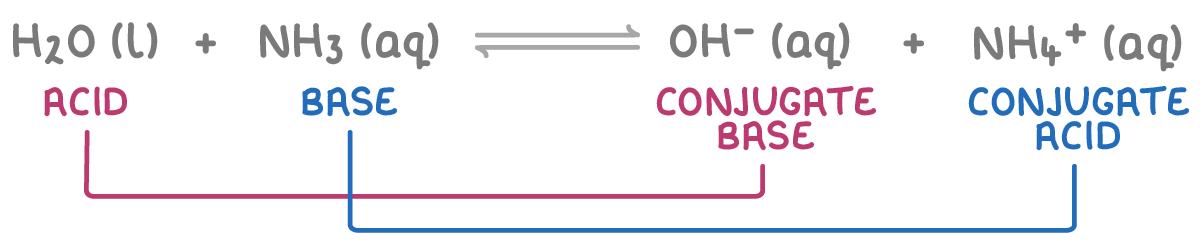
Water is an amphiprotic substance, meaning it can behave as both an acid and a base depending on the reaction.
- Water as a base - When reacting with acids, water accepts a proton to form a hydronium ion (H3O+), which is water's conjugate acid. For example:

- Water as an acid - When interacting with bases, water donates a proton to form a hydroxide ion (OH-), which is water's conjugate base. For example: