19.3 - Chromatography
- 1
What chromatography is and how it works
- 2
Identifying substances using Rf values in paper chromatography
- 3
High performance liquid chromatography (HPLC)
- 4
Gas chromatography (GC)
- 5
Gas chromatography-mass spectrometry (GC-MS)
Chromatography separates mixtures
Chromatography is a group of laboratory techniques for separating the components of a mixture.
It involves two key elements:
- A mobile phase - A liquid or gas that carries the mixture through a system.
- A stationary phase - A solid or solid-supported liquid that does not move with the mobile phase.
The separation happens because of two main reasons:
- The mobile phase moves mixture components at varying speeds based on their solubility. Components that dissolve more easily move faster.
- The stationary phase holds onto the components differently through a process called adsorption. Components that are adsorbed more strongly move slower.
As a result, mixture components travel at different rates and separate into distinct layers, which can be individually analysed.
Identifying components using Rf values in paper chromatography
Paper chromatography is a simple form of one-way chromatography where a solvent (mobile phase) moves over a piece of paper (stationary phase).
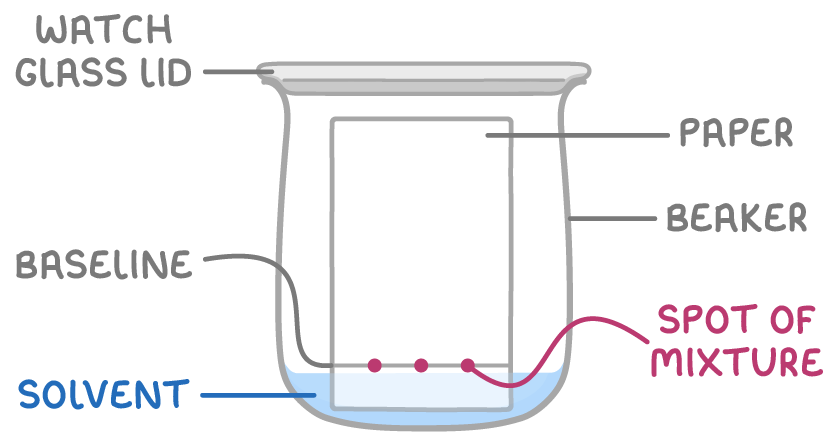
The retardation factor (Rf) value is the ratio of the distance travelled by a component (spot) from the baseline to the distance travelled by the solvent. Rf values range from 0 to 1.
The Rf value can be calculated for each component using the formula:
These distances are represented on the chromatogram below.
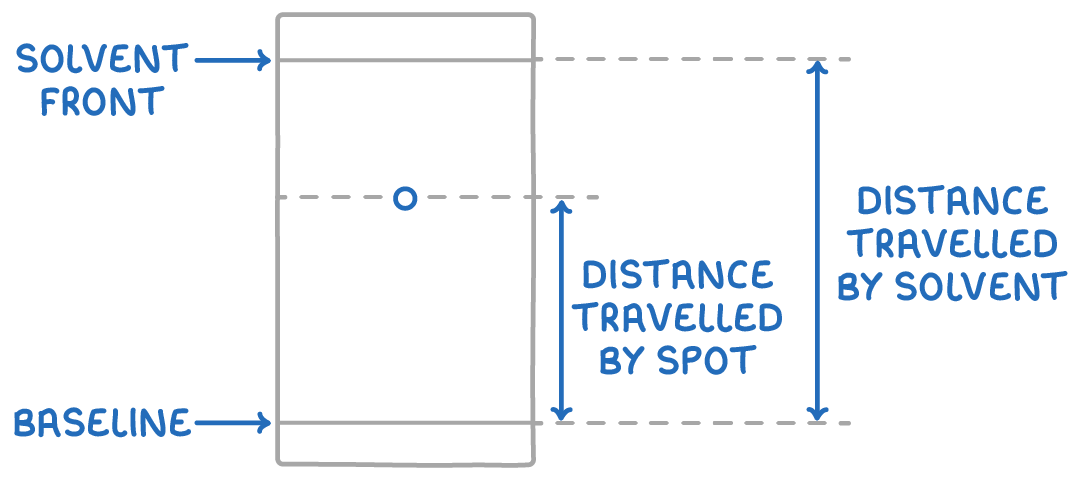
The Rf values can be used to identify the components of the mixture by comparing them with the Rf values of known substances under the same chromatographic conditions.
High-performance liquid chromatography (HPLC)
In HPLC, the stationary phase consists of small particles of a solid (usually silica bonded to hydrocarbons) tighly packed into a column. The liquid mobile phase, typically a polar mixture such as methanol and water, is pumped through the column under high pressure.
How HPLC works:
- The mixture to be separated is injected into the solvent stream and carried through the column.
- The components of the mixture are attracted to the solid by varying degrees, resulting in different travel times through the column.
- As the liquid exits the column, it passes through a UV detector that measures the UV light absorbed by the mixture.
- A chromatogram is produced, showing the retention time of each component (the time taken to reach the detector).
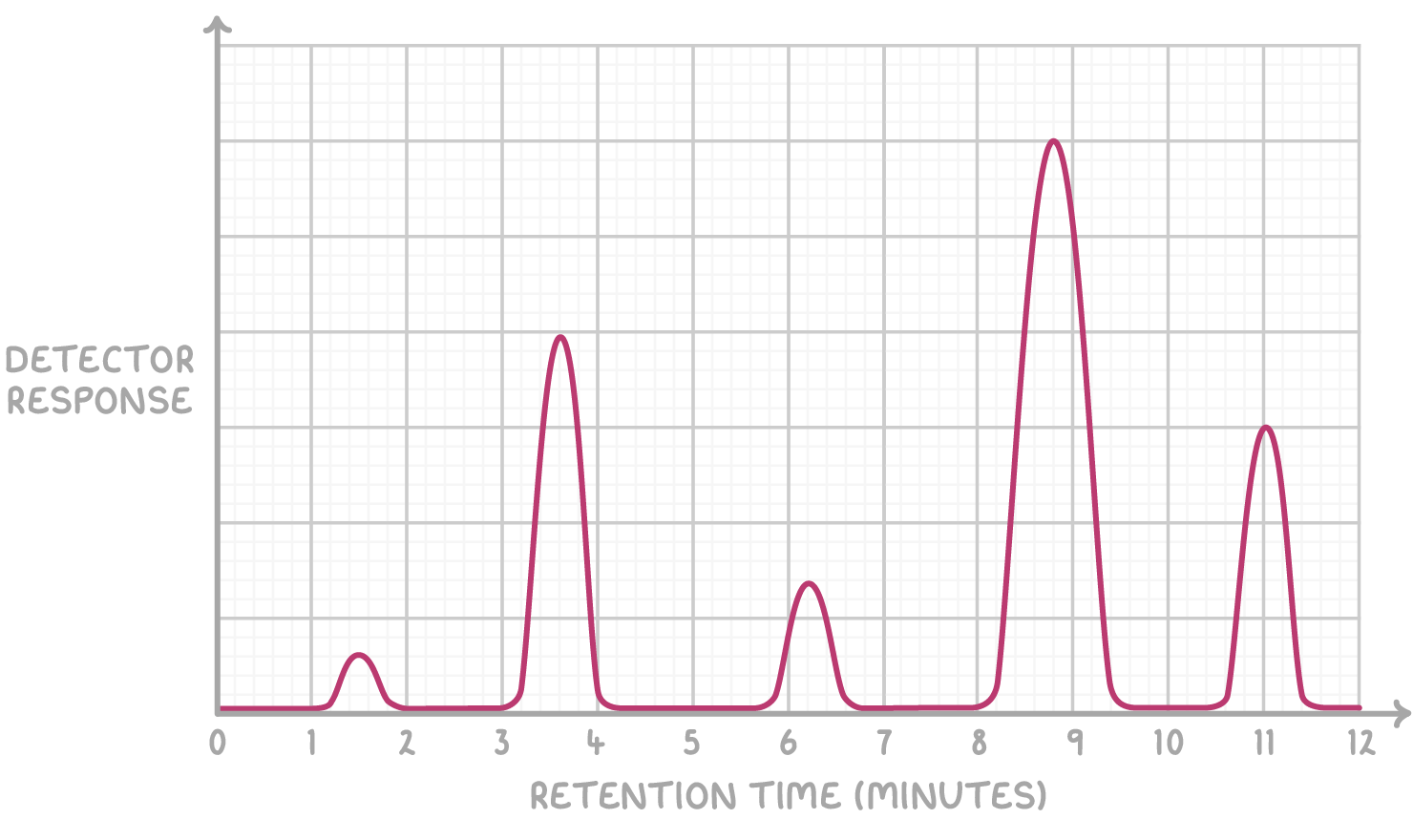
By comparing the experimental retention times with known values, the substances in the mixture can be identified.
Gas chromatography (GC)
In gas chromatography, the sample is injected into a stream of gas (the mobile phase), which carries it through a coiled column containing a stationary phrase, which consists of a non-polar high boiling liquid adsorbed onto a solid support.
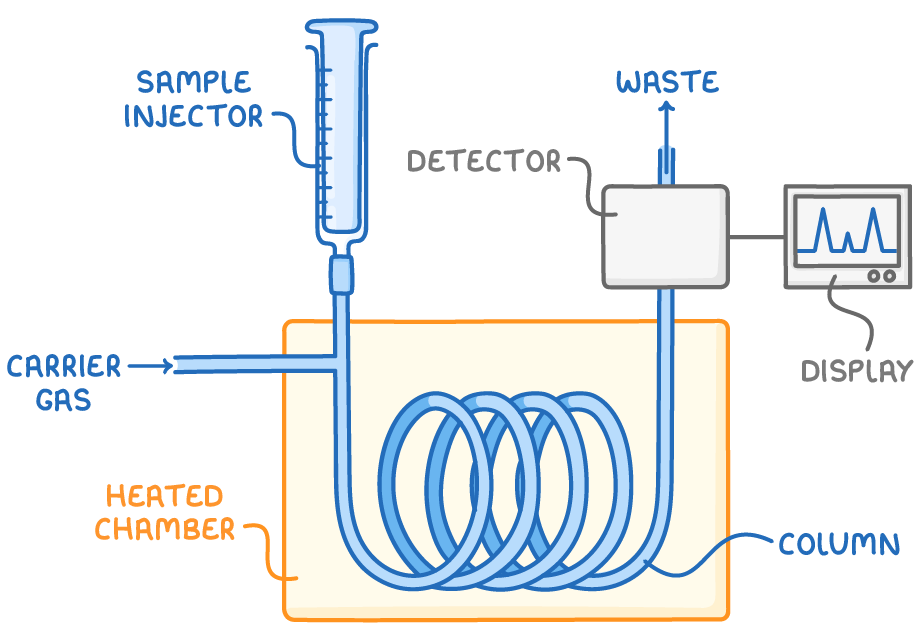
How GC works:
- A liquid sample is vaporised in a heated chamber.
- An inert carrier gas then transports the vaporised sample through a chromatographic column containing the stationary phase.
- The components of the mixture are attracted to the solid by varying degrees, resulting in different travel times through the column.
- As they exit the column, a detector records the separation, producing a chromatogram with distinct peaks for each component.
As with HPLC, the components can be identified by their retention times.
Combining chromatography with mass spectrometry
Mass spectrometry is a powerful technique for identifying substances based on their mass/charge ratio. However, it can give confusing results when analysing mixtures. On the other hand, GC and HPLC excel at separating mixtures but are less effective at identifying individual components.
Combining these techniques creates an extremely useful analytical tool with applications in forensics, toxicology and dug testing in athletes.
How gas chromatography-mass spectrometry (GC-MS) works:
- The sample is first separated using gas chromatography.
- The separated components are introduced into a mass spectrometer, where they are ionised.
- A distinct mass spectrum for each component is generated.
- Each substance is then identified by comparing its mass spectrum to reference spectra in computerised libraries, revealing the composition of the original sample.