18.5 - The Preparation of Amines and Amides
- 1
Making aliphatic amines from halogenoalkanes and nitriles
- 2
Making aromatic amines from nitro compounds
- 3
Amides as carboxylic acid derivatives
- 4
Making amides from acyl chlorides
Aliphatic amines form from halogenoalkanes or nitriles
There are two main ways to produce aliphatic amines:
- Nucleophilic substitution of halogenoalkanes.
- Reduction of nitriles.
Reacting halogenoalkanes with ammonia and amines
Aliphatic amines can be produced by reacting a halogenoalkane with ammonia, primary amines, secondary amines, or tertiary amines in a nucleophilic substitution reaction.
- Reaction with ammonia to form primary amines: Primary aliphatic amines can be produced by heating a halogenoalkane with excess ethanolic ammonia.
For example, bromoethane reacts with ammonia to give ethylamine:
C2H5Br + NH3 ➔ C2H5NH2 + HBr
Excess ammonia reacts with the HBr byproduct, forming ammonium bromide.
The mechanism for this reaction is:

- Reaction with primary amines to form secondary amines:
Secondary aliphatic amines can be produced by reacting a halogenoalkane with a primary amine.
For example, bromoethane reacts with butylamine to give N-ethylbutylamine:
C2H5Br + CH3(CH2)3NH2 ➔ C2H5NH(CH2)3CH3 + HBr
- Reaction with secondary amines to form tertiary amines:
Tertiary aliphatic amines can be produced by reacting a halogenoalkane with a secondary amine.
For example, bromoethane reacts with N-ethylbutylamine to give N,N-diethylbutylamine:
C2H5Br + C2H5NH(CH2)3CH3 ➔ (C2H5)2N(CH2)3CH3 + HBr
- Reaction with tertiary amines to form quaternary ammonium salts:
Quaternary ammonium salts can be produced by reacting a halogenoalkane with a tertiary amine.
For example, bromoethane reacts with N,N-diethylbutylamine to give N,N,N-triethylbutylammonium bromide:
(C2H5)2N(CH2)3CH3 + C2H5Br ➔ (C2H5)3N(CH2)3CH3N+Br-
Reducing nitriles to amines
Primary aliphatic amines can be prepared by reducing nitriles through catalytic hydrogenation. This process involves reacting the nitrile with hydrogen gas (H2) in the presence of a metal catalyst, such as nickel or platinum.
The general reaction for this reduction is:
R-C≡N + 4[H] ➔ R-CH2-NH2
For example, the reduction of ethanenitrile to ethylamine can be represented as follows:
CH3CN + 4[H] ➔ CH3CH2NH2
An advantage of catalytic hydrogenation is that it produces a purer product compared to other methods, such as the reaction of halogenoalkanes with ammonia. In catalytic hydrogenation, the primary amine formed does not undergo further substitution reactions, preventing the formation of secondary, tertiary, and quaternary ammonium compounds as byproducts.
Aromatic amines from nitro compounds
Aromatic amines are produced by reducing nitro compounds in a two-step process:
- The nitro compound is heated under reflux with tin and concentrated HCl to form an ammonium salt.
- The ammonium salt is then treated with aqueous NaOH to give the free amine.
For example, nitrobenzene is reduced to phenylamine via phenylammonium chloride:

Aromatic amines like this are useful in organic synthesis for making pharmaceuticals, dyes, and other compounds.
Amides are carboxylic acid derivatives
Amides are organic compounds that contain the functional group –CONH2. They are derived from carboxylic acids by replacing the hydroxyl group with an amino group.
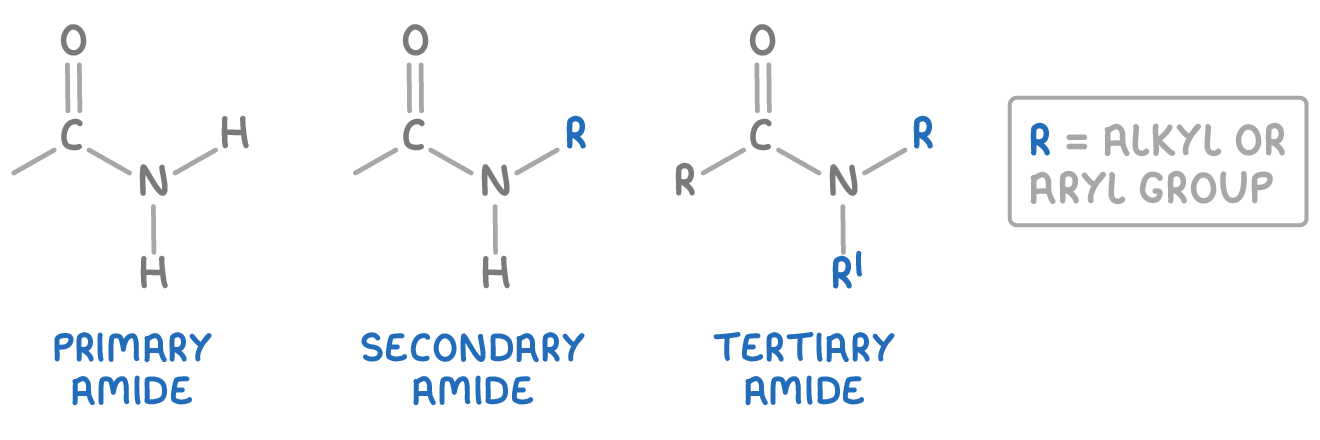
There are three main types of amide you should be familiar with:
- Primary amides - These are amides where the nitrogen atom is bonded to one carbonyl group (C=O) and two hydrogen atoms.
- Secondary amides - These are amides where the nitrogen atom is bonded to one carbonyl group (C=O), one hydrogen atom and one alkyl or aryl group.
- Tertiary amides - These are amides where the nitrogen atom is bonded to one carbonyl group (C=O), and two alkyl or aryl groups.
Making amides from acyl chlorides
Amides can be synthesised through the reaction of acyl chlorides with concentrated ammonia or primary amines, typically occurring at room temperature.
With ammonia:
The reaction between acyl chlorides and ammonia produces primary amides.
For example, ethanoyl chloride reacts with ammonia to give ethanamide and HCl:
CH3COCl + NH3 ➔ CH3CONH2 + HCl
With amines:
The reaction between acyl chlorides and primary amines produces secondary amides, also known as N-substituted amides.
For example, ethanoyl chloride reacts with butylamine to give N-butylethanamide and HCl:
CH3COCl + CH3(CH2)3NH2 ➔ CH3CONHCH3(CH2)3 + HCl
In these reactions, the produced HCl typically reacts with any excess amine to form ammonium salts.