16.2 - Rate Equations
- 1
Designing experiments to determine the rate equation
- 2
The initial rates method and clock reactions
- 3
Continuous monitoring methods
- 4
Calculations involving the rate equation
Performing rate experiments to determine reaction orders
To determine the reaction order with respect to the concentration of a specific reactant, you can use two main methods:
- Initial rates method - This involves measuring how the initial rate changes when you alter the initial concentration of the reactant in question.
- Continuous monitoring - This involves tracking the change in concentration of the reactant over time and plotting a rate-concentration graph.
In both strategies, ensure that the concentrations of any other reactants remain substantially constant (in large excess) throughout the experiment. This approach helps ensure that any observed changes in rate are solely due to the reactant being studied.
Using the initial rates method to work out rate equations
The initial rate of a reaction refers to the rate at the very beginning of the reaction (time = 0) and is found by calculating the gradient of the tangent to the concentration-time graph at t = 0.

The steps involved in the initial rates method are:
- Perform the reaction several times, each time changing the initial concentration of one reactant while keeping the others constant.
- Calculate the initial rate from the concentration-time data for each experiment.
- Analyse how the initial rates change with varying initial concentrations to deduce the order of the reaction with respect to each reactant.
- Use these findings to assemble the overall rate equation.
Worked example 1 - Determining the rate equation using initial rates
Consider the reaction below, carried out at a constant temperature.
2NO(g) + O2(g) ➔ 2NO2(g)
| Experiment | [NO] (mol dm-3) | [O_2_] (mol dm-3) | Initial rate (mol dm-3 s-1) |
|---|---|---|---|
| 1 | 0.05 | 0.05 | 0.020 |
| 2 | 0.10 | 0.05 | 0.080 |
| 3 | 0.05 | 0.10 | 0.040 |
Determine the rate equation for this reaction.
Step 1: Analyse NO concentration change
Between experiments 1 and 2, the concentration of [NO] doubles while [O2] remains constant, and the rate quadruples. This suggests the reaction is second order with respect to [NO].
Step 2: Analyse O2 concentration change
Between experiments 1 and 3, doubling the concentration of [O2] while keeping [NO] constant doubles the rate, indicating first-order dependence on [O2].
Step 3: Write the rate equation
rate = k[NO]2[O2]
Worked example 2 - Calculating the rate constant using initial rates
Using the same reaction and data from the previous worked example 1, calculate the rate constant (k), including its units. Give your answer to 3 significant figures.
Step 1: Rearrange rate equation
First, rearrange the rate equation to solve for k.
Step 2: Substitution and correct evaluation
Substitute values from one of the experiments into the equation to find k. For example, substituting values from experiment 1:
Step 3: Determine the units
Given that the rate is expressed in mol dm-3 s-1 and the concentration cubed in (mol dm-3)3, solving for k in the equation results in units of mol-2 dm6 s-1.
Therefore the rate constant for the reaction above is 160 mol-2 dm6 s-1.
Simplifying initial rate experiments with clock reactions
Clock reactions offer an easier way to estimate initial rates, avoiding continuous measurements.
In a clock reaction:
- The time taken to produce a fixed amount of product is measured as the initial concentrations of reactants are varied.
- A clear observable change, such as a colour change, signals the endpoint of the reaction.
- The faster the clock reaction finishes, the higher the initial rate.
For this method to be valid, it is assumed that:
- The reactant concentrations do not change appreciably over the timescale of the experiment.
- The temperature remains constant.
If the reaction has not progressed too far by the endpoint, the rate can be assumed to be approximately constant and equal to the initial rate. The initial rate is inversely proportional to time taken for the observable change to occur.
The iodine clock reaction
The classic example of a clock reaction is the iodine clock:
H2O2(aq) + 2I-(aq) + 2H+(aq) ➔ 2H2O(l) + I2(aq)
A small quantity of sodium thiosulfate and starch indicator is added to an excess of hydrogen peroxide and acidified iodide.
The thiosulfate rapidly consumes any iodine produced:
2S2O32-(aq) + I2(aq) ➔ S4O62-(aq) + 2I-(aq)
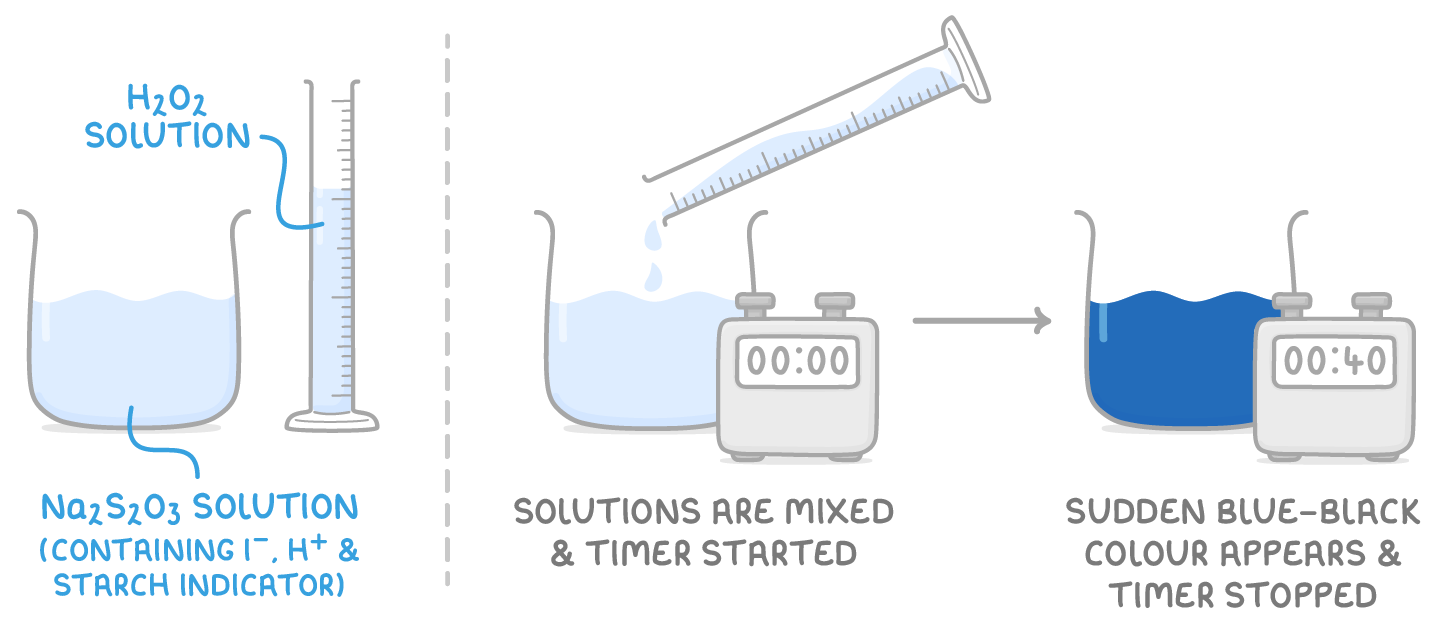
Initially, all iodine generated in the first reaction is immediately consumed by the second. However, once the thiosulfate is exhausted, subsequent iodine accumulates, triggering a sudden blue-black colour change due to the starch indicator. This marks the clock reaction endpoint.
By varying the concentration of iodide or hydrogen peroxide while keeping other reactants constant, the time to reach this endpoint will change, reflecting the effect on reaction rate.
Using continuous monitoring methods to work out rate equations
Rather than finding initial rates, some reactions can be continuously monitored as they proceed to completion. The amounts of reactant or product are determined at regular intervals to see how the rate varies over the course of the reaction.
Numerous methods can be used depending on what property changes during the reaction:
- Measuring the volume of gas evolved.
- Measuring the mass loss as a gas escapes.
- Measuring pH changes.
- Using colorimetry to quantify colour changes.
Worked example 3 - Calculating the rate of an acid-catalysed reaction
Calculate the rate of the acid-catalysed reaction between propanone and iodine, given that the reaction is first order with respect to propanone, zero order with respect to iodine, and first order with respect to H+.
CH3COCH3 + I2 ➔ CH3COCH2I + HI
The rate constant (k) at a certain temperature is 630 mol-1 dm3 s-1 and the concentrations of propanone, iodine, and H+ are each . Give your answer to 3 significant figures.
Step 1: Write the rate equation
Step 2: Substitution and correct evaluation
Thus, at this temperature, the rate of the acid-catalysed reaction between propanone and iodine is .
Worked example 4 - Calculating the rate constant for a gas-phase reaction
The following reaction is second order with respect to NO and zero order with respect to CO and O2:
NO(g) + CO(g) + O2(g) ➔ NO2(g) + CO2(g)
At a certain temperature, the reaction rate is mol dm-3 s-1, with the concentrations of NO, CO, and O2 each at mol dm-3.
Calculate the rate constant (k) for the reaction. Give your answer to 3 significant figures.
Step 1: Write the rate equation
Step 2: Rearrange rate equation
Step 3: Substitution and correct evaluation
Step 3: Determine the units of k
Given that the rate is expressed in mol dm-3 s-1 and the concentration squared in (mol dm-3)2, solving for k in the equation results in units of mol-1 dm3 s-1.
Thus, at this temperature, the rate constant is 198 mol-1 dm3 s-1 for the given gas-phase reaction.